

Most Shopify platform deadlines mean a migration. The June 30 Scripts sunset breaks Plus stores. The August 26 checkout cutover retires checkout.liquid. So when a subscription merchant forwarded me Shopify’s June 22 changelog last week and asked what would break, the honest answer surprised them: nothing breaks. This one is four lines of copy.
TL;DR: On June 22, 2026, Shopify shows a new default subscription purchase disclosure at checkout for any store that has not customised it. The change adds translation keys for the agreement label, consent text, cancellation instructions, and cancel text. It is a wording default, not a layout rebuild. The five-minute job: read the new default in Checkout settings and confirm it matches your real cancellation policy before it goes live.
Why this matters for your store
- The disclosure is the exact text a customer reads before agreeing to a recurring charge, so its wording shapes trust, chargebacks, and dispute rate more than almost any other line in your checkout.
- A platform default that does not match your cancellation flow creates a quiet mismatch: the checkout promises one thing, your subscription portal does another, and support tickets follow.
- Subscription merchants on Recharge, Skio, and Loop already manage layered consent language, so a new Shopify-default block is one more piece to keep consistent.
What actually changes on June 22
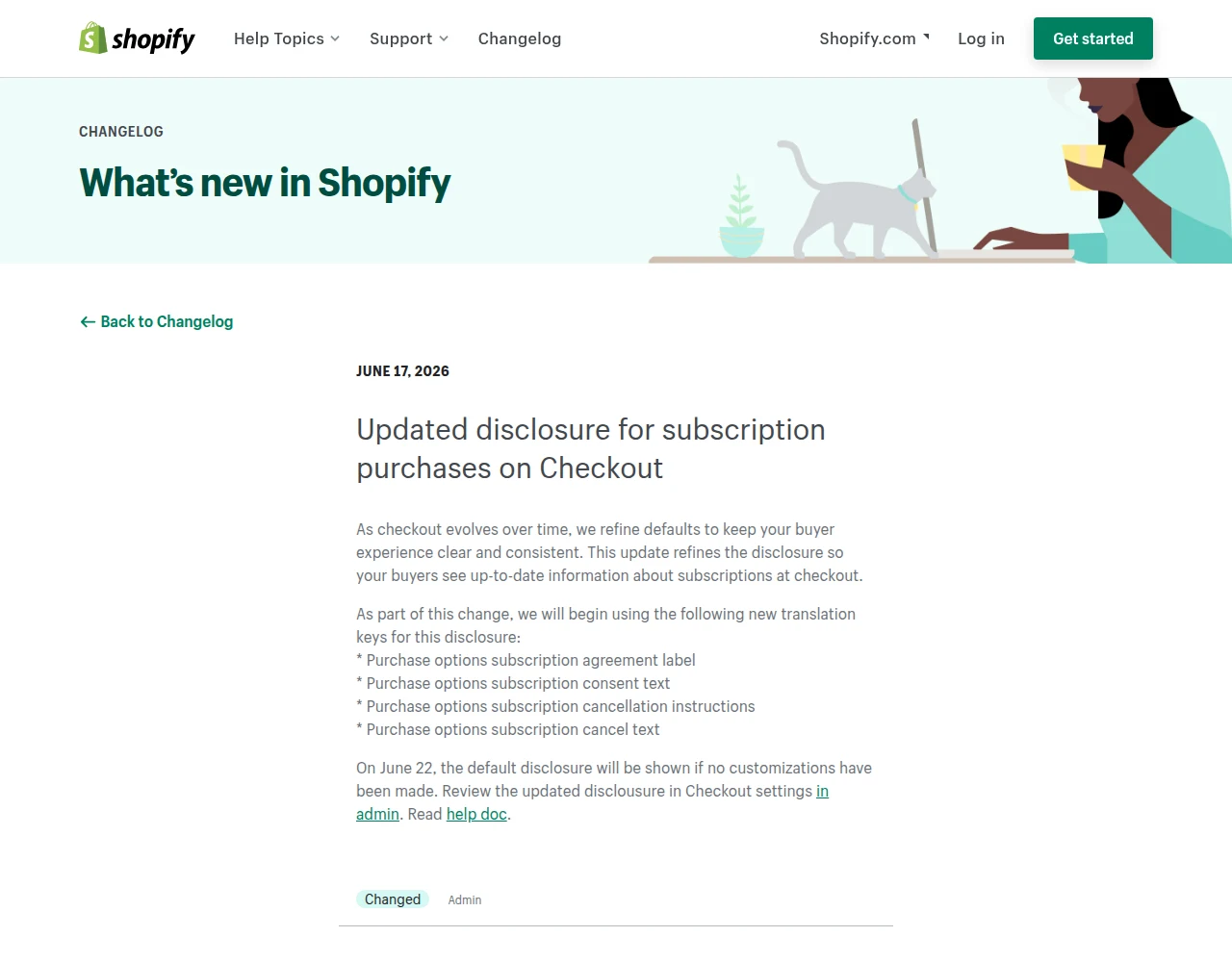
Shopify’s June 17 changelog entry introduces new translation keys for the subscription purchase disclosure. There are four: the agreement label, the consent text, the cancellation instructions, and the cancel text. These are the strings Shopify renders to confirm that the buyer understands they are starting a recurring charge.
On June 22, stores that have left these strings untouched get Shopify’s refreshed default wording. Stores that have already customised the disclosure keep their own copy.
That is the whole change. The order summary still loads. Orders still process. Your subscription app still injects its selling-plan controls the same way. What moves is the default consent language, and only for stores that never set their own.
Who is affected, and who is not
Any store selling a subscription product through Shopify checkout is in scope. The change is platform-level, so it is not gated to Shopify Plus or to Checkout Extensibility. Basic, Shopify, Advanced, and Plus stores running subscriptions all see it.
You are not affected in a way that needs action if you have already written your own disclosure copy. Those custom strings stay. The June 22 default only fills the gap for merchants who left Shopify’s wording in place, which, in my experience auditing subscription checkouts, is most of them. Few stores customise consent text until a chargeback forces the conversation.
Where the disclosure lives, and how to read it before June 22
The disclosure is part of the Shopify-controlled checkout, not your theme. You will not find it in Liquid. You review and edit it in Checkout settings in the Shopify admin, through the translation keys for the four strings above.
The five-minute check, in order:
- Open Shopify admin, go to Settings, then Checkout, and find the subscription disclosure or checkout language section.
- Read the current consent text and cancellation instructions as a customer would. Does the cancellation instruction match how cancellation actually works in your Recharge, Skio, or Loop portal? A disclosure that says “cancel anytime in your account” when your real flow routes through a support email is a dispute waiting to happen.
- If the default does not fit, customise the translation keys now. If it fits, leave it and you are done.
That is the entire job for most stores. The reason to do it before June 22 rather than after is simple: you want to read the new default in a preview, not discover it live when a customer screenshots it in a complaint.
Does a longer default cause a layout shift at checkout?
This is the one technical question worth a glance, and the honest answer is: probably not, but check if you are cautious. If Shopify’s new default consent text runs longer than what rendered before, the disclosure block grows by a line or two and pushes the content below it down slightly. On a short mobile viewport that is the difference between a Pay Now button sitting just above or just below the fold.
I would not lose sleep over it. A copy change of a few words rarely moves layout enough to matter. But if you sell subscriptions and you are already tight on mobile checkout real estate, a 60-second preview on a real phone settles it. You can also baseline your checkout’s real-user Core Web Vitals so you know whether layout stability at checkout was ever an issue to begin with.
The point is proportion. This is a copy default to review, not a migration to fear like the June 30 Scripts deadline that shipped in the same Summer ‘26 wave.
What Recharge, Skio, and Loop merchants should check
Each subscription app surfaces its own consent and frequency language, so the risk is not the Shopify block on its own. It is duplication.
Open a test checkout with a subscription product and read the full stack of recurring-charge language top to bottom. If your app already shows a clear “you will be charged every 30 days, cancel anytime” line and Shopify’s new default adds a second, near-identical statement, the customer reads the same commitment twice. That is not dangerous, but it is friction at the decision point, and on a recurring purchase friction is the enemy.
If you see a doubled disclosure, the fix is to align the wording: customise the Shopify keys to complement your app’s language rather than repeat it. My Recharge vs Skio vs Loop breakdown covers how each app handles checkout consent differently, which tells you where the overlap is most likely.
What to do this week
Three steps, under ten minutes, no developer needed:
- Open Checkout settings and read your current subscription disclosure wording.
- Confirm the cancellation instruction matches your real cancellation flow. Fix it if it does not.
- Run one test checkout with a subscription product and read the full consent stack for duplication with your app.
Then move on. The Scripts deadline on June 30 is the platform change with actual teeth this month.
The takeaway
- Treat June 22 as a copy review, not a migration. Nothing breaks. The default disclosure wording changes for stores that never customised it.
- Read the new default in Checkout settings before it goes live. You want to see it in preview, not in a customer complaint.
- Match the cancellation text to your real flow. A disclosure that misstates how cancellation works is a dispute you are signing up for.
- Check for doubled consent language between Shopify’s block and your subscription app.
- Spend your real deadline energy on June 30. The Scripts sunset is the change that actually stops logic from running.
Kaspian Fuad is a Shopify CRO consultant and Liquid developer. 12 years in ecommerce, 100+ DTC stores, Top Rated Plus on Upwork. Book a free 30-minute call if you want a second set of eyes on your subscription checkout.