

Shopify shipped roughly 150 things on June 17. One of them quietly changes how merchants touch their app stack every day, and almost nobody is talking about it. Sidekick app extensions let Shopify’s merchant AI assistant read data from and take actions inside the apps you already pay for. Klaviyo, Loop, Judge.me, and more, answered in one conversation instead of seven browser tabs.
TL;DR: Sidekick app extensions, live June 17, 2026, give Shopify’s admin assistant two new powers: read your installed apps’ data (“find my best-performing email subject lines”) and take actions inside them with your confirmation. Eighteen launch partners, including Klaviyo, Loop, Smile, Judge.me, Checkout Links, and Matrixify, are live in early access. It does not reduce your app spend or change your storefront. It changes how you work, and it signals where Shopify is pointing its AI.
Why this matters for your store
- The average store I audit runs a dozen apps, and answering a simple question (“which review-request flow converts best?”) means opening three of them. A conversational layer over that stack saves real operator time every day.
- App actions with confirmation move Sidekick from a chatbot that explains things to an assistant that does things, which is a different relationship with your admin.
- This is the clearest signal yet that Shopify wants Sidekick to be the command surface for the whole admin, apps included, and that shapes where app vendors invest next.
What Sidekick app extensions actually do
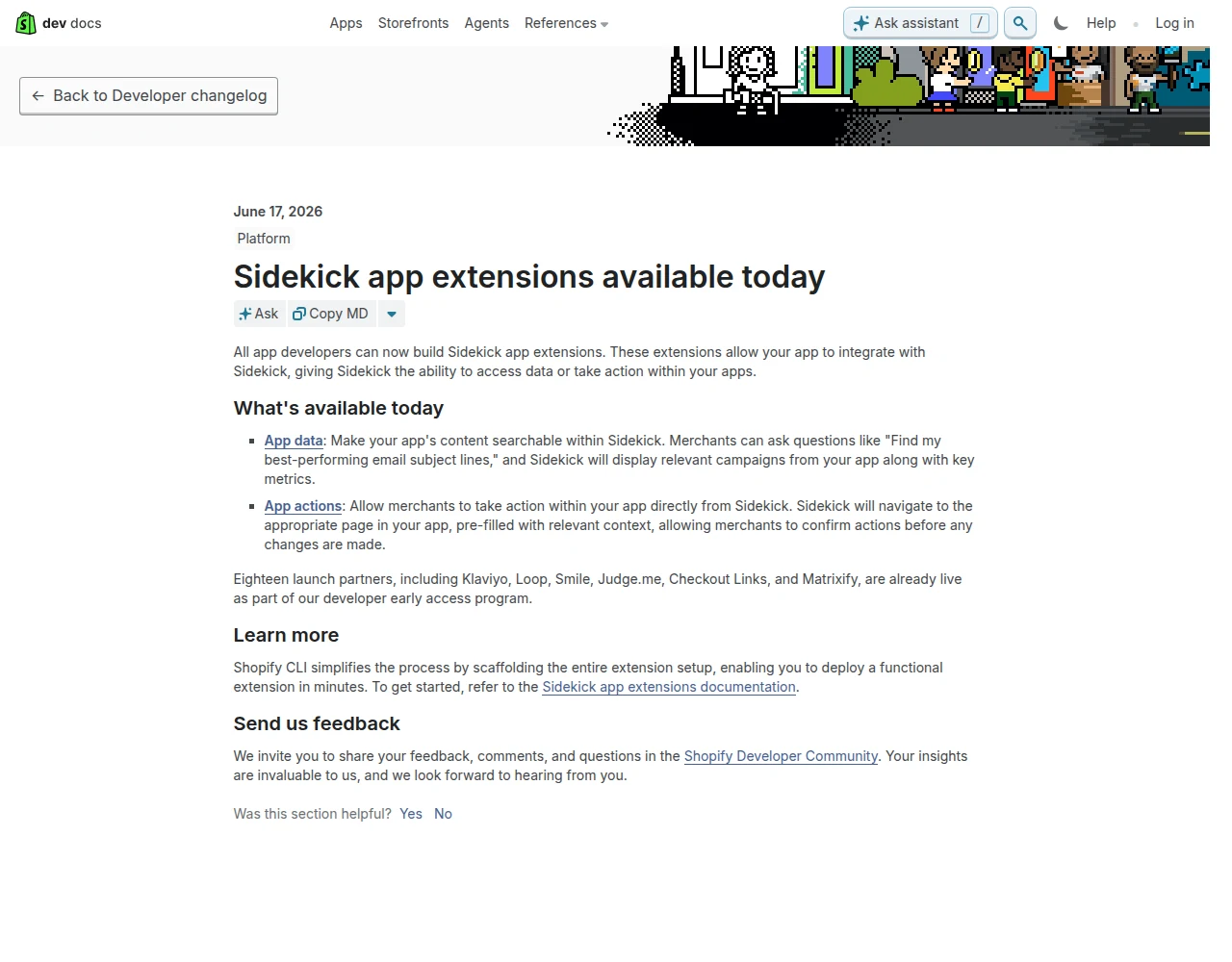
Sidekick is Shopify’s AI assistant inside the admin. It already answered questions about your store’s own data: orders, products, customers. The June 17 changelog extends that reach into third-party apps through two distinct capabilities.
App Data makes an app’s content discoverable inside Sidekick. Ask “find my best-performing email subject lines” and Sidekick returns matching Klaviyo campaigns with their metrics, without you opening Klaviyo. It is retrieval: the app exposes its data, Sidekick surfaces it in the conversation.
App Actions let you perform a task in an app from the Sidekick prompt. Sidekick navigates to the relevant section of the app, pre-populated with the context from your request, and waits for you to confirm before anything executes. That confirmation step matters: this is not an autonomous agent firing changes into your live store. It is a faster path to an action you still approve.
The two together turn Sidekick from an explainer into an operator’s console. You ask in plain language, it reads across your tools, and it teases up the action for your sign-off.
Which apps work with Sidekick right now?
Shopify launched with eighteen partners in its developer early access program and named six: Klaviyo, Loop, Smile, Judge.me, Checkout Links, and Matrixify. That spread is deliberate. Email and SMS (Klaviyo), subscriptions (Loop), loyalty (Smile), reviews (Judge.me), link-in-bio commerce (Checkout Links), and bulk data (Matrixify) cover most of the daily-driver categories in a typical DTC app stack.
The more important detail is the second sentence of the announcement: all app developers can now build Sidekick app extensions. The framework is open, the Shopify CLI scaffolds the setup, and a functional extension deploys in minutes. So those launch partners are a floor, not a ceiling. Expect your existing apps to ship extensions over the coming months, the way they once rushed to add Web Pixels and Checkout UI Extensions.
Does this change my app spend or my storefront?
No, and it is worth being clear about both, because the framing in some early coverage overreaches.
Your app spend does not move. Klaviyo still bills for Klaviyo. Loop still bills for Loop. Sidekick app extensions are a layer on top of apps you already run; they do not consolidate or replace them. If your goal is to cut app cost, this is not the lever. The lever is still auditing which apps you actually need, which is what my app-detector scan and the guide on replacing apps with native Liquid are for.
Your storefront does not change either. Sidekick is a merchant tool inside the admin. It is not a customer-facing recommendation engine, and app extensions do not alter what a shopper sees or how products surface on a product page. If you read a headline implying Sidekick now recommends products to your buyers, that is conflating the admin assistant with the separate, storefront-facing world of agentic shopping where AI agents transact on behalf of customers. Different surface, different audience.
What changes is your workflow. The question is whether shaving tab-switching off your daily operations is worth paying attention to, and for a busy operator it usually is.
What this signals about Shopify’s AI direction for the rest of 2026
Step back from the feature and look at the shape of it. Shopify is building Sidekick into the single place a merchant talks to their entire operation, and it just opened that place to every app vendor. That is a platform move, not a feature.
The parallel is the app store itself. Once Shopify made it trivial to extend the admin, the apps that integrated deepest won distribution. Sidekick app extensions are the same incentive aimed at conversation. The vendors who expose their data and actions cleanly will be the ones Sidekick reaches for when a merchant asks a question, and being the default answer inside the assistant is a new distribution channel.
For merchants, the read is simpler. The apps you keep should be the ones that ship a Sidekick extension and make themselves answerable in your admin. An app that stays a walled garden you have to open manually is, on the margin, worth less than one Sidekick can reach. That is a new criterion for the next app stack audit, alongside performance cost and monthly price.
Should agencies and developers care?
Yes, and there is a build opportunity here for anyone who develops Shopify apps or custom merchant tooling.
The CLI scaffolds an extension in minutes, the two capabilities (App Data and App Actions) are narrow and well-defined, and the early-mover advantage is real: the apps that ship clean Sidekick extensions in the first quarter become the assistant’s default reach for their category. If you build or maintain a Shopify app, a Sidekick extension is one of the higher-return things you can ship this quarter. If you run a store, this is one more reason to favour app vendors who move fast on platform primitives.
What to do this week
- If you run a store: open Sidekick in your admin and ask it about one of your launch-partner apps (Klaviyo, Loop, Smile, Judge.me, Checkout Links, or Matrixify). See whether the extension is live on your account yet, and whether the answer saves you a tab.
- If you develop apps: read the Sidekick app extensions docs, scaffold an App Data extension with the CLI, and ship retrieval first. Actions can follow.
- Either way, add “ships a Sidekick extension” to how you judge whether an app earns its place.
The takeaway
- Sidekick app extensions let Shopify’s admin assistant read and act inside your installed apps, starting with eighteen launch partners and open to all developers.
- It does not cut your app spend or touch your storefront. It changes how you operate, not what you pay or what shoppers see.
- App Actions need your confirmation, so this is a faster path to approved changes, not an autonomous agent.
- Favour app vendors that ship a Sidekick extension. Being answerable inside the assistant is a new distribution channel and a new selection criterion.
- If you build apps, ship an extension this quarter. The early default-answer advantage inside Sidekick is real.
Kaspian Fuad is a Shopify CRO consultant and Liquid developer. 12 years in ecommerce, 100+ DTC stores, Top Rated Plus on Upwork. Book a free 30-minute call to audit which apps in your stack are actually earning their place.