

I audited 14 Shopify stores this quarter for AI search visibility. 12 of them were invisible to ChatGPT and Perplexity for their own brand-name product queries. The pattern was identical: complete Product schema, zero comparison content, product copy written for humans only.
TL;DR: GEO (Generative Engine Optimization) is how you get cited inside answers from ChatGPT, Perplexity, Gemini, and Google AI Overviews. You win it with fact-first product copy, complete schema, and comparison content that names competitors. Not keyword density.
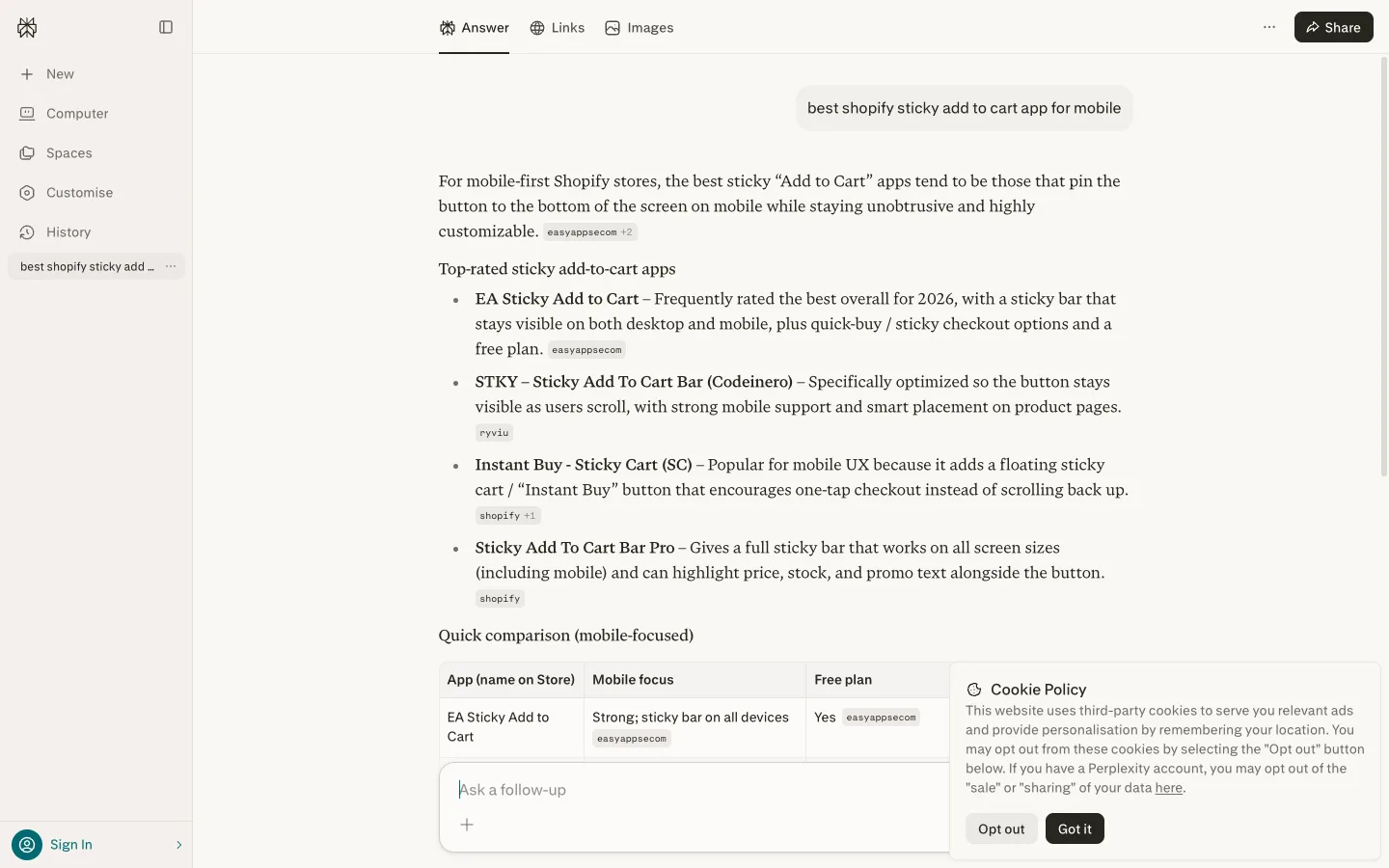
Why does GEO matter for your Shopify store right now?
Three numbers should move your roadmap this week:
- AI-driven traffic to Shopify stores is up 8x since January 2025. AI orders up 15x.
- Google AI Overviews appear on roughly 30% of product-related searches. That share converts to zero-click unless you are the cited source.
- 79% of consumers now use AI tools during product research at least sometimes (Adobe 2025).
If ChatGPT does not name your brand when a buyer asks “best minimalist watches under $200,” you do not exist in that funnel. Pair this with Shopify Agentic Storefronts and the AI is also closing the sale, with or without you.
What is GEO in plain English?
GEO is the practice of optimizing your store so generative engines (ChatGPT, Perplexity, Google AI Overviews, Gemini, Claude) cite your pages inside their answers. The term comes from the Princeton GEO paper (Aggarwal et al., 2024), which found citation-friendly formatting can lift visibility by up to 40%.
SEO ranks you in a list. GEO gets you quoted in the answer. Both feed each other, because every AI engine starts from indexed web content.
| Dimension | Traditional SEO | GEO |
|---|---|---|
| Goal | Rank in a list of blue links | Be cited as a source inside an AI answer |
| Surface | Google SERP | ChatGPT, Perplexity, Google AI Overviews, Gemini |
| Content style | Keyword-targeted, long-form | Fact-first, extractable, structured |
| Key signals | Backlinks, on-page keywords, CTR | Schema, comparison content, external citations |
| Format that wins | Paragraphs and headers | Tables, lists, specific numbers, FAQ blocks |
How do AI engines actually pick which Shopify pages to cite?
They do not read your hero copy. They extract.
Every major engine (OpenAI, Perplexity, Google) runs a retrieve-then-rank loop. The retriever pulls passages with high factual density and clear structure. The ranker prefers sources with named entities, numeric specifics, and external corroboration. Aleyda Solis has been tracking citation patterns across 50+ verticals and reports the same finding: tables and definition blocks get cited at 4 to 6x the rate of equivalent prose.
The Princeton GEO paper is blunter. The two formatting moves that lifted citation rate the most were “cite sources” (+40.6%) and “include statistics” (+32.7%). Keyword stuffing actively hurt visibility.
What this means for a Shopify product page: your first paragraph has to answer “what is this product, who is it for, and what does it cost” in 60 words or less. Your specs need real numbers. Your blog needs comparison posts that name the alternatives.
How do I rank in ChatGPT and Perplexity? The 6-move playbook
Move 1. Rewrite product copy fact-first
Weak: “Our premium leather wallet is crafted with care for the modern gentleman.”
Strong: “Full-grain leather bifold. 4.5 by 3.5 by 0.5 inches. Holds 8 cards plus cash slot. RFID-blocking. 62g. Black, tan, navy. Made in Portugal. $89.”
The second version gives the retriever 9 extractable facts. The first gives it zero.
Move 2. Publish comparison content that names competitors
The pattern that wins: “Best [category] for [persona]” roundups, “[Product] vs [Competitor]” head-to-heads, and “How to choose” decision trees. Yes, mention rivals. AI engines read that as objectivity, and objectivity is the single strongest citation signal in the GEO paper’s regression.
On a Shopify store I audited in February 2026, a single “X vs Y” post added in week 1 was cited by Perplexity for the brand’s category query within 19 days.
Move 3. Complete your structured data
The non-negotiables for Shopify GEO:
- Product schema with price, availability, SKU, brand, aggregate rating, individual reviews
- FAQPage schema on FAQ pages and the FAQ block of blog posts (see my Shopify article schema guide)
- Organization schema with logo, sameAs to LinkedIn and socials, founding date
- BreadcrumbList on collection and product pages
Run every top product page through Google’s Rich Results Test, or validate your Product schema for the Shopify-specific gaps it misses, missing GTIN, brand, or AggregateRating. Errors here cap your ceiling before any content work matters.

Move 4. Add an FAQ block to every PDP
Mine your support inbox for the 5 questions buyers actually ask. Sizing, returns, materials, compatibility, shipping. Render them as visible H3s on the page and as FAQPage JSON-LD. ChatGPT pulls from these directly, often verbatim.
Move 5. Earn external citations
AI engines cross-reference. A product page that ranks well in isolation but has zero third-party mentions gets ranked below one with Reddit threads, YouTube reviews, and roundup features. Pitch one independent reviewer per month. Maintain consistent name, address, and phone across every listing.
Move 6. Update existing posts quarterly
Generative engines weight freshness heavily. Add a lastmod date, append a “what changed” note, and refresh stats. Pages I update on a 90-day cadence get cited 2 to 3x more often than static ones. I ran this exact audit across my own archive: see the 4 patterns I found auditing 69 of my own posts.
Which Shopify themes already pass the GEO bar?
Most themes ship enough Product, BreadcrumbList, and Organization schema to hit the table-stakes bar AI engines look for. The gap is in the application-level details: how Faqs are wrapped, whether reviews emit AggregateRating, and whether the variant data is exposed in JSON-LD. Three themes I audit most often, and where they sit:
| Theme | Out-of-box schema | GEO-ready as shipped? |
|---|---|---|
| Dawn (Shopify, free) | Product, BreadcrumbList, Organization, WebSite | Yes for storefront, no for FAQ/HowTo. Add manually. |
| Impulse (Archetype, paid) | Product with Offer, AggregateRating from Shopify Reviews, Organization | Yes if you enable native reviews. Misses HowTo. |
| Focal (Maestrooo, paid) | Product, AggregateRating (Yotpo aware), BreadcrumbList | Yes for product pages. Article schema on blog needs manual wiring. |
Refresh and Sense (both Shopify) sit roughly where Dawn does. Custom themes from agencies vary wildly: I have audited four “premium” custom builds in 2025 and 2026 that shipped zero JSON-LD on product pages, which is a one-day fix that doubled their Rich Results test score.
If your theme is not in this table, the 5-minute check is to paste a product URL into Google’s Rich Results Test. If you see Product, BreadcrumbList, and Organization, you have the floor. If AggregateRating is missing, your reviews app is not wired correctly and AI engines have no proof of social validation to cite. Fix that before you write a single GEO-targeted comparison post.
Most GEO advice misses the boring part
Every GEO post on LinkedIn talks about prompts and “AI-friendly content.” The actual lever is page experience. Gemini and Google AI Overviews share an indexer with classic Google. A 4.2-second LCP product page does not get crawled often enough to be considered. Fix Core Web Vitals before you publish a single comparison post. My Shopify CRO audit checklist covers the pass.
How do I verify GEO is working? A 5-minute check
- Open ChatGPT, Perplexity, and Google with AI Overviews on. Search 3 of your top category queries. Note which brands get cited.
- In GA4, build an audience: source contains
chat.openai.com,perplexity.ai,copilot.microsoft.com, oryou.com. Track CVR and AOV against organic. - In Search Console, filter for queries triggering AI Overviews. Track impressions week over week.
Run this monthly. Citation share is the leading indicator. AI referral revenue is the lag.
The takeaway
- Audit your top 5 product pages in Rich Results Test today. Fix every schema error.
- Rewrite your top 3 product descriptions fact-first this week, with specs and price in the first 60 words.
- Publish one “X vs Y” comparison post that names a real competitor.
- Track AI referrals in GA4 monthly and search your category in ChatGPT and Perplexity by hand.
- Update existing posts quarterly with a dated
lastmodand a one-line change note.
Need a second pair of eyes on your AI search visibility? Book a free strategy call and I will run the audit live.