

Varsity Gripz
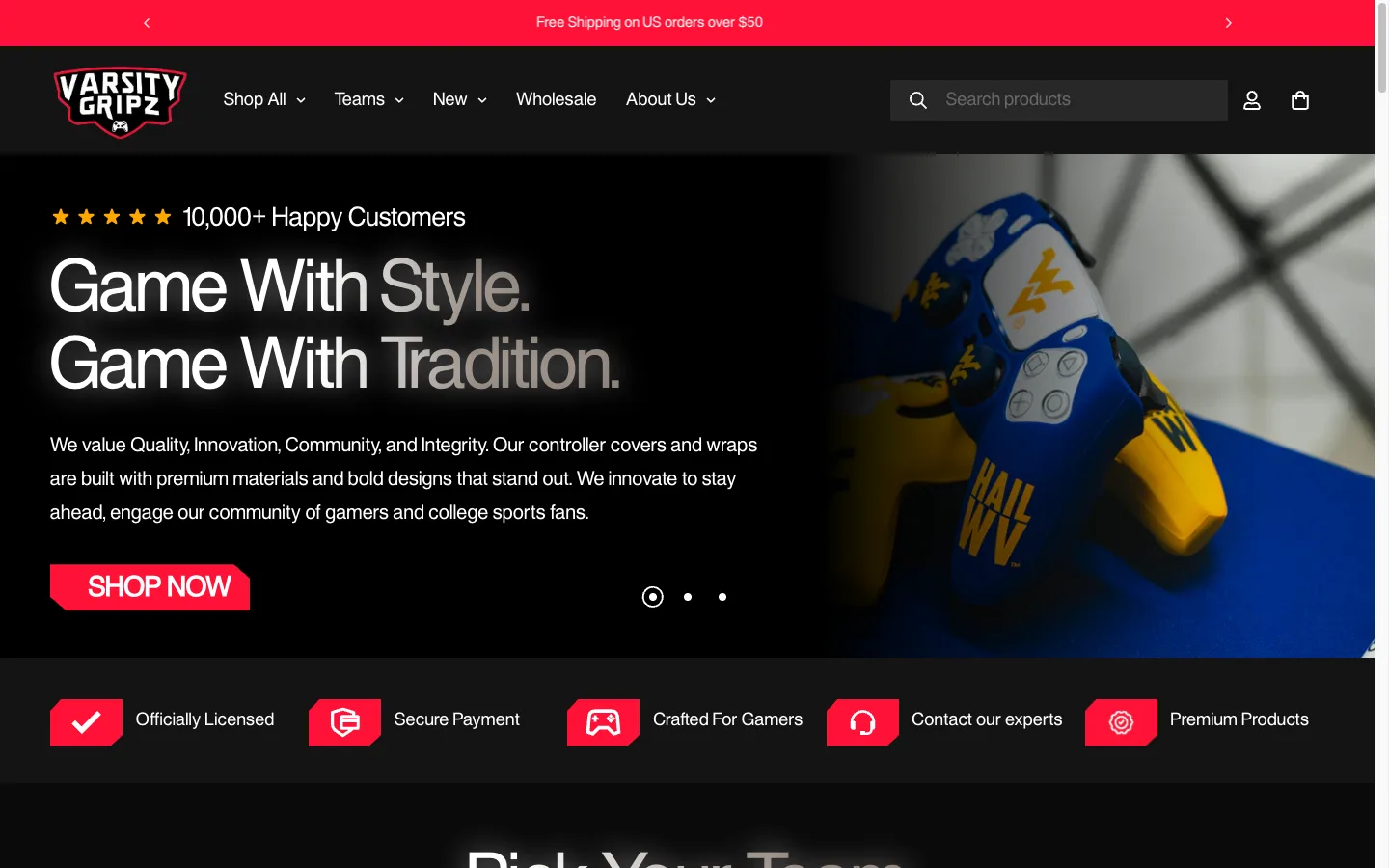
Building a sports accessories brand from absolute zero to 7-figure annual revenue in under 12 months, through conversion-first Shopify architecture and dual DTC + B2B channel execution.
The Challenge
Varsity Gripz was not a store redesign. It was not a migration from another platform. It was a brand-new sports accessories company launching from absolute zero, with no revenue, no customers, no reviews, no store infrastructure, and no brand recognition in the market.
The founding team had a strong product and a clear vision, but no ecommerce operation. Everything needed to be built from scratch: the DTC storefront, the product catalog, the checkout experience, the email marketing system, the returns process, and a separate B2B wholesale channel for team and retail buyers.
The timeline was aggressive. The goal was not just to launch a functional store, but to build one capable of scaling to 7-figure annual revenue within the first year. That meant every architectural decision made in the first weeks would either compound into growth or become technical debt that slowed it down.
This is the core tension of building from zero. You do not have the luxury of A/B testing your way to insights over months. You need to make the right structural decisions early, based on experience and CRO principles, and then iterate fast once real traffic arrives.
I joined at Day 0 as Founding Ecommerce Lead, owning end-to-end Shopify execution across both DTC and B2B channels, working directly with the CEO on launches, promotions, pricing, and growth strategy.
The Approach
Conversion-First Architecture from Day 0
Most brands build their store first and think about conversion optimization later. That is backwards. When you are launching from zero with no existing traffic to test against, you need to build CRO into the architecture itself so the store is ready to convert from the first visitor.
For Varsity Gripz, this meant making deliberate decisions about every element of the product detail page before a single product was published. The PDP layout followed a structure I have refined across multiple builds: product imagery occupying the left column with a sticky add-to-cart section on the right, trust signals placed between the price and the CTA button, and social proof sections positioned to catch scrolling visitors who need more convincing.
Trust signal placement was critical for a brand with zero recognition. When a customer lands on a product page from a new brand they have never heard of, they are looking for reasons to leave. The job of the PDP is to remove those reasons one by one. I placed shipping information, return policy highlights, and security badges directly within the purchase flow, not buried in footer links where nobody looks.
The mobile experience was designed first, not adapted after. On mobile, the product image gallery sits above the fold with the price and primary CTA immediately visible on scroll. There is no layout shift, no content jumping, and no hidden information that requires extra taps to access. These are the details that separate a store built for conversion from one built for aesthetics. If you want a deeper look at how I approach checkout optimization on Shopify, I have written about the methodology separately.
PDP Optimization and the Zero-Review Problem
Launching with zero reviews is one of the hardest conversion challenges in ecommerce. Social proof is the single strongest trust signal for new visitors, and without it, every other element on the page has to work harder.
The solution was a multi-layered approach. First, I configured Okendo as the review platform, chosen specifically for its rich snippet support, photo review capability, and clean integration with Shopify’s product schema. Okendo was not just a review collection tool. It was a structured data asset that would feed Google Shopping listings and organic search results as reviews accumulated.
Before reviews existed, the PDP needed to compensate. I implemented detailed product descriptions with specific use-case information, high-quality lifestyle imagery showing the products in context, and clear sizing and specification tables that answered questions customers would normally look to reviews for. The goal was to reduce the information gap that reviews normally fill.
As the first reviews came in, Okendo’s display widgets were positioned at two points on the PDP: a star rating summary near the product title for quick social proof, and a full review section further down the page for customers who needed deeper validation. This dual placement ensures that both quick-decision buyers and research-heavy buyers encounter social proof at the right moment in their journey.
Bundle Strategy and Starter Kits
The Starter Kit strategy was one of the highest-impact decisions made during the build phase. It drove a 20-30% increase in average order value and solved a problem that most new brands underestimate: decision paralysis.
When a first-time visitor lands on a new brand’s store, they face a paradox. They are interested enough to browse, but they do not know the product range well enough to make confident purchasing decisions. Should they buy one grip or three? Which style works for their sport? What accessories complement the main product?
Starter Kits removed that friction entirely. Each kit bundled complementary products into a curated package at a slight discount, effectively making the purchase decision for the customer. Instead of asking “which product should I buy?”, the customer asks “do I want the Starter Kit?”, which is a much simpler yes-or-no decision.
The bundles were implemented through Shopify’s native product system rather than relying on a third-party bundle app. This kept the checkout flow clean, avoided additional JavaScript overhead, and ensured that inventory tracking remained accurate across individual SKUs and bundled offerings. Each Starter Kit was built as a product with its own PDP, its own imagery, and its own value proposition, not just a discount on multiple items.
The cross-sell logic extended beyond Starter Kits. Rebuy Smart Cart handled intelligent product recommendations within the cart drawer, surfacing complementary items based on what was already in the cart. The combination of curated bundles on the PDP and dynamic cross-sells in the cart created two distinct AOV growth mechanisms that worked together without feeling aggressive or spammy.
This approach to replacing app functionality with native Liquid solutions where possible kept the store lean while the third-party tools handled the genuinely complex logic.
App Stack Decisions
Every app in the Varsity Gripz stack was chosen for a specific reason, and several were chosen specifically because of what they replaced or made unnecessary.
Rebuy Smart Cart handled cart-level upsells and cross-sells. The decision to use Rebuy over simpler alternatives came down to its rule engine. For a store with bundles, individual products, and eventually B2B pricing, the cross-sell logic needed to be context-aware. Rebuy could recommend bundle upgrades to customers buying individual items, suggest complementary accessories based on sport type, and suppress recommendations that did not make sense for the items already in the cart.
Okendo was chosen over Yotpo and Judge.me for its structured data output and visual review capabilities. For a sports accessories brand, photo reviews showing products in use are significantly more persuasive than text-only reviews. Okendo’s review request flows integrated with Klaviyo, creating a unified post-purchase communication sequence rather than competing email streams.
Klaviyo was the email marketing backbone. The initial setup included a welcome series for new subscribers, abandoned cart recovery flows, post-purchase review request sequences triggered through Okendo, and a win-back series for lapsed customers. Klaviyo was chosen for its deep Shopify integration and its ability to segment based on purchase behavior, browse behavior, and predicted customer lifetime value.
Loop Returns replaced what would otherwise have been a manual, email-based returns process. For a new brand building trust, the returns experience matters as much as the purchase experience. Loop provided a self-service portal that reduced support tickets, offered exchange options that retained revenue, and gave the team data on return reasons that informed product development.
Gorgias + Zendesk handled customer support across channels. This dual setup achieved a 35-45% improvement in response time by centralizing inquiries from email, social media, and on-site chat into unified dashboards with automated tagging and routing.
The key principle behind every app decision was integration coherence. Each tool needed to work with the others without creating data silos or conflicting customer communications. Klaviyo served as the communication hub, receiving data from Okendo, Rebuy, and Loop to build a complete customer profile that informed every touchpoint.
B2B Channel Launch
The B2B channel was a separate Shopify storefront on its own domain, built to serve wholesale buyers, teams, and retail partners with different pricing, minimum order quantities, and catalog access.
Running DTC and B2B on separate Shopify instances was a deliberate architectural choice. A single store with customer-tag-based pricing would have been simpler to maintain, but it introduces risks: pricing logic leaks, catalog management complexity, and the constant danger of wholesale prices being visible to retail customers through cached pages or misapplied tags.
The B2B store used gated access, requiring account approval before buyers could view pricing or place orders. The product catalog was structured to support bulk ordering with tiered pricing that rewarded volume purchases. Catalog management across two storefronts required disciplined product data workflows to keep imagery, descriptions, and variant structures synchronized while maintaining separate pricing.
This dual-channel approach meant Varsity Gripz was not dependent on a single revenue stream. The DTC store drove consumer sales and brand awareness, while the B2B channel created recurring wholesale relationships with predictable order volumes.
Licensing and Compliance During Rapid Scaling
Sports accessories frequently involve licensing requirements for team logos, colors, and official branding. As Varsity Gripz scaled its catalog rapidly, maintaining 100% licensing accuracy became a genuine operational challenge.
The approach was systematic. Product data management within Shopify was structured with metafields tracking licensing status, expiration dates, and approved usage terms for every product and variant. This was not just a legal safeguard. It was an operational requirement that prevented unlicensed products from being published and ensured that licensed products were removed or updated when agreements changed.
During the rapid scaling phase, maintaining this accuracy required clear workflows: new products could not go live without verified licensing documentation, and the catalog was audited regularly against active licensing agreements. This discipline meant the brand never faced a compliance issue during its fastest growth period, which is the exact time when most brands cut corners and create problems.
The Compound Effect of Early CRO
This is the part of the Varsity Gripz story that matters most for other brands considering their approach to ecommerce growth.
When you build conversion optimization into a store from Day 0, every improvement compounds. A 15-25% conversion rate improvement does not just mean more orders this month. It means more customers entering your email flows, more post-purchase review requests generating social proof, more data for Klaviyo to build segments from, and more repeat purchase opportunities.
Compare this to the alternative: launching a store quickly with minimal optimization, driving traffic to it, and then trying to retrofit CRO improvements after the fact. Every visitor who arrives before optimization is in place is a partially wasted acquisition cost. Every week without proper email flows is lost retention revenue. Every month without review collection is social proof that will never exist.
The Varsity Gripz approach inverted this completely. By the time paid traffic was scaled, the store was already built to convert. The email flows were already running. The review collection was already active. The bundle strategy was already driving AOV. This meant that every dollar spent on acquisition worked harder from Day 1, and the gap between Varsity Gripz and competitors who launched first and optimized later widened every month.
This compound effect is why I advocate for a thorough CRO audit before scaling traffic spend, whether you are launching from zero or optimizing an existing store. The earlier you get the fundamentals right, the more every subsequent decision benefits from them.
The Results
The numbers tell the story of what conversion-first architecture looks like when executed from Day 0:
- $0 to 7-figure annual revenue in under 12 months
- 15-25% CVR improvement through systematic PDP and checkout optimization
- 20-30% AOV increase driven by Starter Kit bundles and Rebuy cross-sell logic
- 35-45% faster customer support response through Gorgias + Zendesk integration
- 100% licensing accuracy maintained throughout rapid catalog scaling
- Successful DTC + B2B dual-channel launch on separate Shopify storefronts
- Complete app ecosystem integrated and operational from launch, including Rebuy, Okendo, Klaviyo, Loop Returns, and Gorgias
These results were not achieved through a single optimization or a single campaign. They were the compound output of hundreds of deliberate decisions made from Day 0, each one designed to reduce friction, increase trust, and make the next decision easier.
Key Takeaway
Varsity Gripz is proof that CRO is not something you bolt on after launch. It is the architecture itself. When conversion-first thinking drives every decision from Day 0, from PDP layout to app stack selection to bundle strategy, the store is not just ready to sell. It is built to scale.
The difference between a store that grows to 7 figures in 12 months and one that stalls at 6 figures is rarely the product or the traffic. It is the conversion infrastructure underneath. Every visitor who lands on a page that is already optimized, every email flow that is already running, every review request that is already automated, compounds into growth that a poorly architected store simply cannot replicate by spending more on ads.
For other end-to-end Shopify execution work, see the Factory Direct Blinds 7-sprint engagement covering CRO, Core Web Vitals, and a full product builder rebuild, or the Enea Studio 6-sprint engagement for technical SEO and PageSpeed on luxury jewelry.
What Changed for the Merchant
The 7-figure run rate within 12 months was the headline number, but the structural outcome was a Shopify operation built to keep compounding. By the end of Year 1, the brand had a working DTC storefront with a 15-25% lift in conversion rate baked in from launch, a separate B2B channel generating recurring wholesale revenue, an automated post-purchase review flow producing social proof every week, and a Klaviyo-Okendo-Loop-Rebuy-Gorgias stack where every tool fed the next. The CEO had a launch partner who owned ecommerce execution end-to-end while strategy decisions stayed at the founder level.
Ready to build your Shopify store with conversion-first architecture from Day 0? See how I work with brands or book a free strategy call to discuss your growth goals.