

Collegiate Apparel Brand
Performance audit for a university and collegiate apparel store losing an estimated $3-5K/month from critical mobile speed issues.
The Store
A DTC collegiate apparel brand selling university-licensed merchandise, including hoodies, tees, hats, and accessories. The brand has strong fundamentals outside of technical performance: 5-star product reviews, retail partnerships with recognized names like Hat Club, Alumni Hall, and VolShop, and a clear brand identity that resonates with its university audience. Seasonal traffic spikes around back-to-school and homecoming create periods where performance issues cost disproportionately more revenue because volume is concentrated in short windows.
The accessories category, which is a core part of this brand’s catalog, converts at a 7.4% median rate according to Shopify benchmarks, compared to the 1.4% Shopify average across all categories. This is a high-converting product category being held back entirely by technical problems.
The Problem
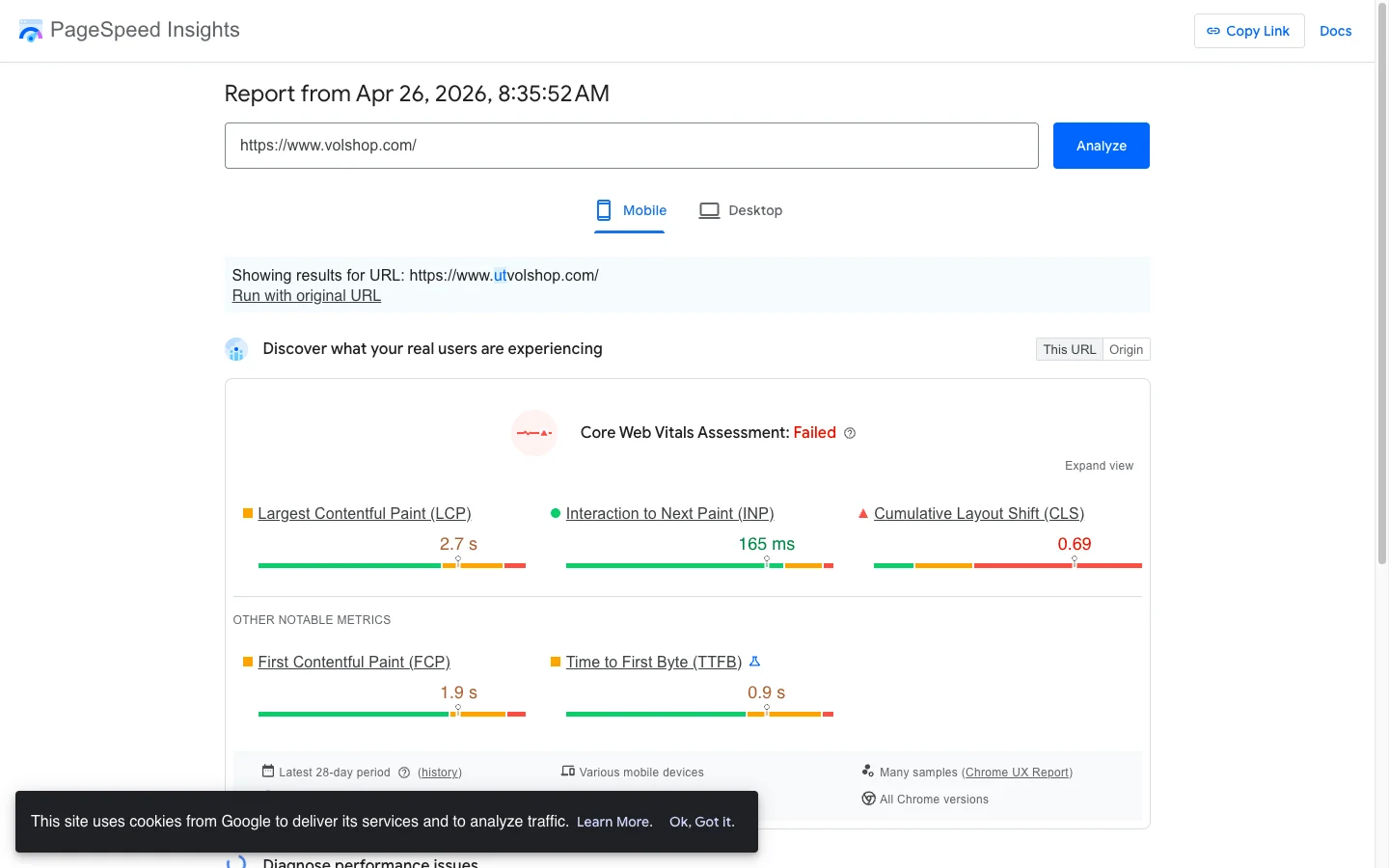
The store’s mobile performance had degraded to a point where it was actively losing sales:
- Lighthouse Performance Score: 33/100 - in the “poor” range where Google applies ranking penalties
- LCP of 7.9 seconds - nearly 8 seconds before the main content was visible
- TBT of 2,500ms - the page was completely unresponsive to taps and scrolls for 2.5 seconds, over 12x Google’s recommended 200ms threshold
- Speed Index of 6.2 seconds - the perceived loading experience was painfully slow
- 20.9 seconds of main thread work - the browser’s main thread was occupied for nearly 21 seconds processing scripts, styles, and layout
- 4.2 MB total page weight - far exceeding reasonable targets for a product page
What made this case unusual was the specificity of the problem. The store’s Best Practices score was 100/100. SEO score was 92/100. CLS was 0, meaning layout stability was excellent with no content jumping or shifting. The store was not suffering from a broad quality problem. It was suffering from one very specific, very severe problem: speed. Everything else about the technical implementation was solid.
Based on industry benchmarks (Google research shows every 100ms improvement in LCP drives up to 0.7% more conversions) and the store’s traffic volume, I estimated $3,000-$5,000/month in lost revenue directly attributable to performance.
Competitive Context
To understand how severe the problem was, I benchmarked against competitors in the collegiate apparel space. Fanatics, the dominant player, scores between 60-75 on Lighthouse performance. ‘47 Brand, another established competitor, scores between 55-70. Neither is exceptional, but both are functional. At 33/100, the store was scoring roughly half of what its competitors achieved, and those competitors were not even particularly fast. The bar in this category is low, which means catching up would not require perfection, just competence.
Root Cause Analysis
The audit uncovered several compounding issues, all related to how assets and scripts were loaded. The Liquid template layer was clean. The design was sound. The problem was entirely in the performance layer.
App Bloat
- 12+ installed apps, several injecting JavaScript and CSS on every page load
- Multiple apps providing overlapping functionality (3 different popup/modal tools doing essentially the same job)
- Apps loading full libraries even on pages where they were not needed. A popup tool intended for the homepage was loading its entire JavaScript bundle on product pages, collection pages, and the cart.
Image and Asset Issues
- Hero images served at 3000px+ width regardless of device, delivering desktop-sized images to mobile screens
- No WebP/AVIF format usage, with all images served as PNG/JPEG
- Above-fold images set to lazy load, which is counterproductive for LCP because the browser delays loading the very content it needs to display first
- Missing width/height attributes causing the browser to recalculate layout as images loaded, though this did not contribute to CLS issues in this case because the layout reserved space through other means
Theme and Code Issues
- Render-blocking CSS files loaded synchronously, preventing the page from rendering until all stylesheets were downloaded and parsed
- No critical CSS inlining, meaning even above-fold styles had to wait for the full stylesheet to load
- Font files loading from an external CDN with no preconnect hints, adding unnecessary DNS lookup and connection time
- Unused CSS from theme features that were disabled in the theme editor but still loading their stylesheets on every page
Third-Party Scripts
- Analytics, chat widgets, and marketing pixels loading synchronously instead of being deferred
- No script prioritization, with non-essential scripts competing with core page rendering for main thread time
- This was the primary contributor to the 20.9 seconds of main thread work and the 2,500ms TBT
Recommended Fix Priority
I delivered a phased remediation plan with expected impact estimates for each phase:
Immediate (2-3 days): Remove duplicate apps (consolidate the 3 popup tools into 1), fix image loading strategy for above-fold content (remove lazy loading from hero and primary product images, add fetchpriority=“high”), add font preconnect hints for external CDN. Expected impact: LCP improvement of 40-50%, bringing it from 7.9s to approximately 4-5s.
Short-term (1-2 weeks): Full image optimization pipeline with responsive srcset and WebP/AVIF format delivery. Critical CSS extraction and inlining for above-fold content. Third-party script deferral using Shopify’s native script loading strategies. Conditional asset loading so apps only inject their scripts on pages where they are actually used. Expected impact: Lighthouse score above 70, TBT reduced to under 500ms.
Medium-term (2-4 weeks): Theme code cleanup removing CSS from disabled features. Unused CSS removal across all templates. Implement native lazy loading properly for below-fold content. Set up performance monitoring with budget alerts to prevent regression. Expected impact: Lighthouse score 80+, estimated revenue recovery of $2-4K/month.
The total page weight target was to reduce from 4.2 MB to under 1.5 MB, and the main thread work target was to drop from 20.9 seconds to under 5 seconds. Both targets were achievable given that the majority of the weight came from redundant app scripts and unoptimized images rather than fundamental architectural problems.
Why This Matters for Seasonal Brands
For a CRO-focused collegiate apparel brand, the revenue impact of performance is not evenly distributed across the year. Back-to-school and homecoming periods can represent 30-40% of annual revenue compressed into a few weeks. A 33/100 performance score during those peak weeks costs disproportionately more than the same score during a slow January. Fixing performance before the next peak traffic period is not just a technical improvement, it is a revenue recovery strategy with a clear deadline.
Key Takeaway
Performance degradation on Shopify is almost always death by a thousand cuts. No single app or image tanks the score, but the compound effect of 12 apps, unoptimized images, and render-blocking scripts creates a mobile experience that actively pushes away customers. What made this case instructive was the clarity of the diagnosis: Best Practices at 100, SEO at 92, CLS at 0. The store was doing almost everything right, and the one thing it was doing wrong was costing an estimated $3-5K per month. The fix is not glamorous, but the revenue impact is immediate and measurable.
For a comparable performance turnaround on a real store, see the Factory Direct Blinds case study where mobile PageSpeed went from 38 to 81 across a focused sprint, or the Enea Studio engagement where all 5 Core Web Vitals reached passing green on real-user CrUX data.
What Changed for the Merchant
The audit handed the merchant a phased remediation plan with specific impact estimates per phase, prioritized by revenue recovery rather than vanity Lighthouse points. The deliverable was a roadmap that any developer could execute against, with a clear definition of done at each stage and the expected revenue lift attached to each milestone.
Suspect your store speed is costing you sales? Run a Shopify speed test on your own store to see your LCP, TBT, and app-by-app blocking cost, then book a free strategy call and I’ll run a live performance check.