

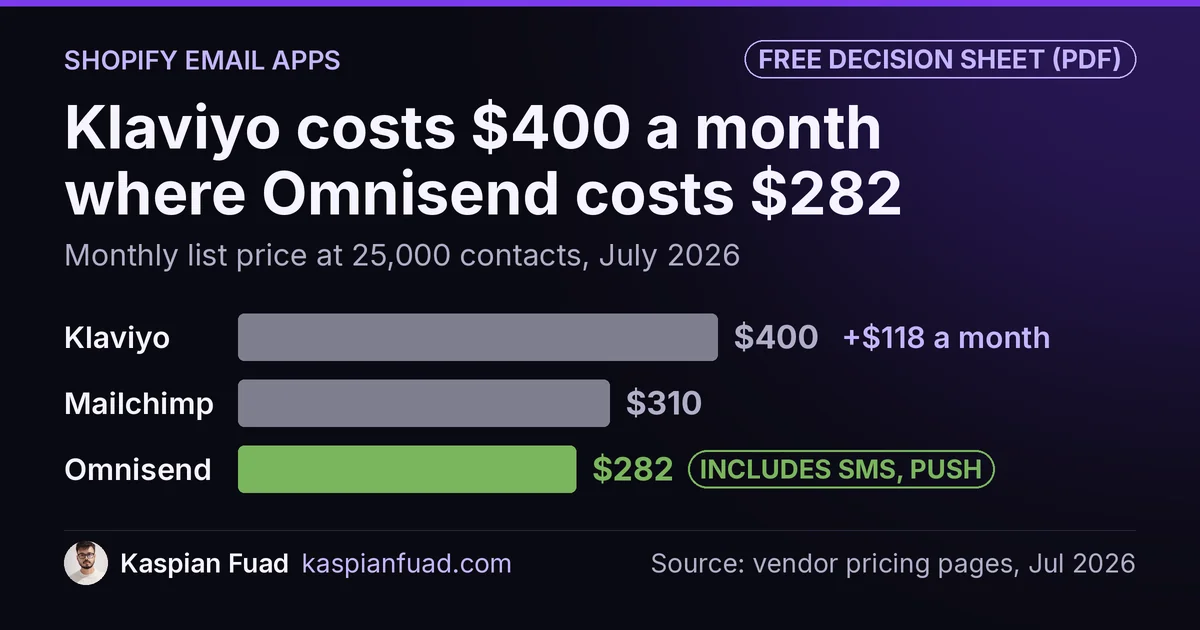
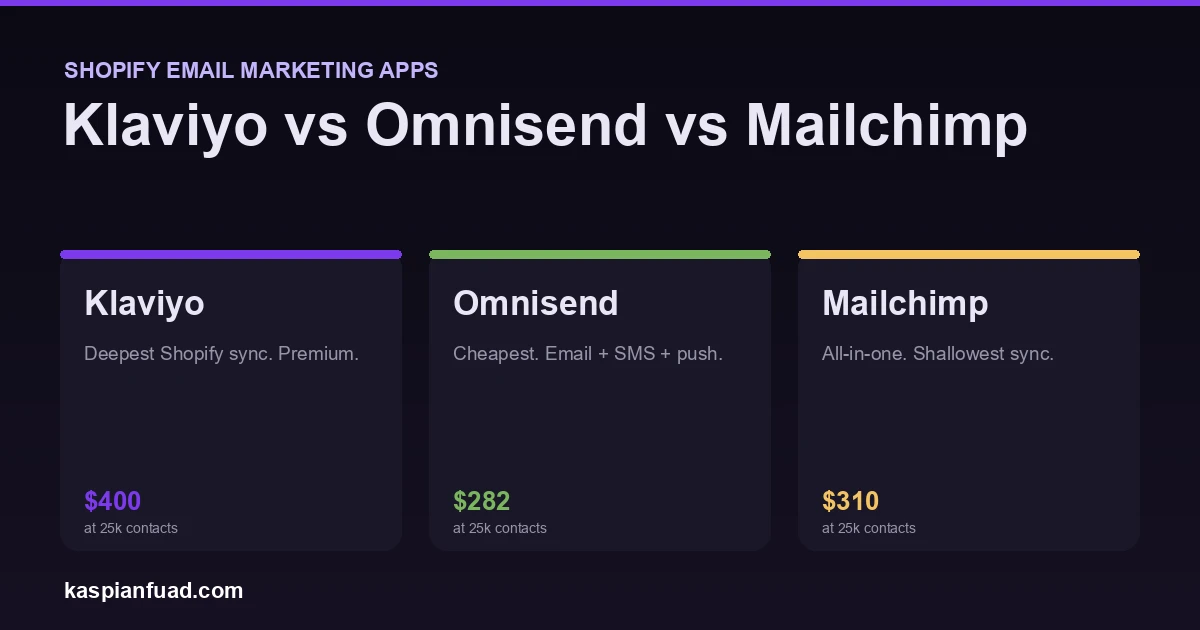
TL;DR: All three collect an email and run a flow, so the editor is not the decision. The split is list-size pricing and Shopify data sync. Omnisend is the cheapest at every tier and bundles SMS and push ($16, $81, $282 at 500, 5,000, 25,000 contacts). Klaviyo costs the most ($20, $100, $400) but buys the deepest real-time Shopify sync and best segmentation. Mailchimp sits in the middle on price with the broadest all-in-one suite and the shallowest Shopify integration, because it lost the partnership in 2019 and returned later. Choose on cost trajectory and sync depth.
I have set up email flows on Shopify stores across all three platforms and migrated a brand off Klaviyo when its list outgrew its revenue. The lens for this comparison is the one no vendor or affiliate uses: what each app costs as your list grows, how deeply it syncs Shopify data, and which channel mix you actually get. Not the drag-and-drop editor. Every top result on this query is a vendor page or an affiliate who earns on the signup.
The 3 leading Shopify email apps (and what each is best at)
Klaviyo is the premium incumbent. Omnisend is the value play. Mailchimp is the all-in-one generalist.
Klaviyo carries 4.7 stars across 2,964 reviews and is the recommended email and SMS platform for Shopify Plus, with Shopify holding an equity stake in the company. Its identity is depth: real-time Shopify data sync and the best segmentation and predictive analytics in the category. Its weakness is the bill, because it prices on active profiles.
Omnisend is built for cost-conscious DTC stores that want one tool for email, SMS, and web push. Its free plan is genuinely feature-complete, gated only by volume, and its paid pricing is the lowest of the three at every list size.
Mailchimp is the legacy generalist, now Intuit-owned, bundling email, SMS, WhatsApp, landing pages, and an AI content assistant. It has the widest feature surface and the strongest brand recognition, but its Shopify integration is the youngest of the three.
Every one of these will send a campaign in 2026. The decision is which one fits your list size, your Shopify data needs, and your budget as you scale.
How much does each email app cost as your list grows?
This is where the “they are all about the same” myth dies. All three are free up to 250 contacts and 500 monthly sends. Past that, the curves diverge hard. These are the regular monthly list prices for the comparable automation tier.
| Contacts | Klaviyo (email) | Omnisend (Standard) | Mailchimp (Standard) |
|---|---|---|---|
| Free tier | 250 profiles, 500 sends | 250 contacts, 500 emails | 250 contacts, 500 emails |
| ~500 | $20 | $16 | $20 |
| ~5,000 | $100 | $81 | $100 |
| ~25,000 | $400 | $282 | $310 |
The number that drives every “klaviyo alternatives” search sits inside Klaviyo’s own curve: it rises 167 percent from $150 a month at 10,000 profiles to $400 at 25,000. And because Klaviyo bills on active profiles, that count includes every contact in the account, not just the ones you email, so a big list of dead subscribers inflates the bill faster than it earns.
Two footnotes that change the real number. Omnisend’s site shows a 30 percent discount everywhere, but that is a 3-month prepay rate that reverts, so the monthly figures above are the honest ongoing cost. Mailchimp shows a “50 percent off for 12 months” promo, so budget for the list price once year one ends, not the half-price number you first see.
Download the one-page email app comparison (free PDF)
Which is cheaper, Klaviyo or Omnisend?
Omnisend, at every list size, and the gap grows with your list. At 5,000 contacts it is $81 against Klaviyo’s $100. At 25,000 it is $282 against $400, a $118 a month difference, roughly $1,400 a year, and Omnisend folds SMS and web push into that price while Klaviyo charges an SMS add-on on top. For a store under about 10,000 contacts that wants email plus SMS in one bill, Omnisend is the cheaper answer by a clear margin. If you were on SMSBump before it shut down, I compared where to move your SMS list.
That does not make Klaviyo overpriced. It makes it a different purchase. You are paying the premium for segmentation depth and Shopify data, not for the send itself. The question is whether your store uses that depth.
Which email app syncs deepest with Shopify?
Klaviyo, and it is not close. Here is how the three compare on the integration that actually drives ecommerce revenue.
| Sync capability | Klaviyo | Omnisend | Mailchimp |
|---|---|---|---|
| Native Shopify app | Yes | Yes | Yes |
| Real-time order and event sync | Deepest | Yes | Basic |
| Abandoned cart and back-in-stock | Yes | Yes | Limited |
| Shopify relationship | Equity stake, preferred Plus partner | Standard native app | Split in 2019, returned later |
| Channels in one platform | Email, SMS, WhatsApp | Email, SMS, push | Email, SMS, WhatsApp |
Klaviyo streams orders, customers, browse events, cart activity, and back-in-stock triggers in real time, which is why its segmentation can act on behavior the moment it happens. Omnisend covers the same core events with a solid native sync. Mailchimp reads the essentials but its connection is the shallowest, which brings us to the history most comparisons skip.
Does Mailchimp still work with Shopify in 2026?
Yes, through a native app, but the backstory matters. In 2019 Mailchimp and Shopify split over customer-data-sharing terms, and Mailchimp was pulled from the App Store. The integration returned later through a rebuilt app, so Mailchimp’s Shopify sync is genuinely younger and less deep than Klaviyo’s, even though its overall marketing suite is the broadest of the three. If your reason for choosing an email tool is deep Shopify behavior data, that history is the tell. If you want one login for email, SMS, WhatsApp, and landing pages with AI-assisted content, Mailchimp’s breadth is the draw.
Is Klaviyo worth it, or should you switch?
Klaviyo is worth it when your store earns enough per contact to absorb profile-based pricing and you actually use the segmentation. The move to a cheaper tool pays off in one specific case: a list-heavy, lower-margin store where the profile count, padded with unengaged and never-purchased subscribers, climbs faster than the revenue those emails produce. That store is the one typing “klaviyo alternatives” into Google, and for it Omnisend is the cleanest switch, since it keeps a deep Shopify sync while pricing lower and including SMS.
Before you switch for cost alone, clean the list. Archiving unengaged profiles drops your Klaviyo tier directly, and a store paying the $400 tier on a 25,000 list is often a $150 store once the dead weight is suppressed. The same discipline applies whichever tool you land on, and it pairs with the wider funnel work in my Shopify email marketing setup guide and the channel-split math in my SMS vs email for abandoned carts breakdown.
Which Shopify email app should you install?
Match the tool to the store, not the brand name.
Pick Omnisend if you are cost-sensitive, under roughly 10,000 contacts, and want email, SMS, and push in one cheaper bill. For most small and mid Shopify stores this is the value default, and the free tier alone outruns the paid entry plans of the others on channels.
Pick Klaviyo if you need the deepest real-time Shopify data, the best segmentation, and a large agency ecosystem, and your revenue per contact justifies the profile-based cost. It is the correct call for established brands that live in their flows.
Pick Mailchimp if you want one platform for email, SMS, WhatsApp, and landing pages with built-in AI content, value the brand and template library, and can accept a shallower Shopify sync than Klaviyo’s.
If you are already on Klaviyo and only use it to send, model your list at your real engaged-contact count and compare it to Omnisend’s rate before you renew. The pattern is the same one I mapped for subscription apps and reviews apps: the monthly number that scales with your store is where the real cost hides, and the sticker price at 500 contacts tells you almost nothing about the bill at 25,000.
The takeaway:
- Do not choose on the editor. All three send campaigns and run flows; the on-store result is similar.
- Choose on cost trajectory. Omnisend is cheapest at every list size and includes SMS and push; Klaviyo costs the most and jumps 167 percent from 10,000 to 25,000 contacts.
- Klaviyo buys Shopify depth, the deepest real-time order and event sync of the three, worth the premium only if you use it.
- Mailchimp’s Shopify sync is the shallowest because of the 2019 split; its draw is breadth and AI content, not data depth.
- Clean your list before you switch for cost. Archiving dead profiles can drop a Klaviyo tier on its own.
Kaspian Fuad is a Shopify developer and CRO consultant who builds, audits, and ships themes for DTC brands. 12 years in ecommerce, 100+ stores, Top Rated Plus on Upwork. See a recent theme and performance build, or book a free 30-minute call if you want a second pair of eyes on your email stack.