

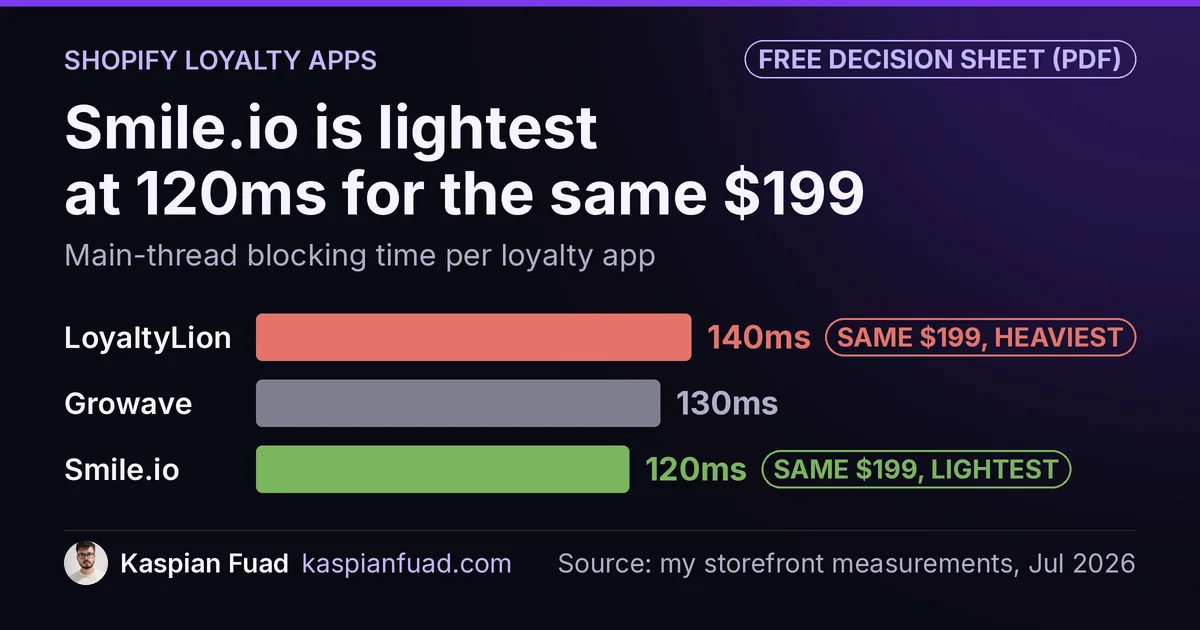
Two Shopify loyalty apps charge the same $199 a month. One costs your storefront 120ms of blocking time. The other costs 140ms and has a ninth of the reviews.
TL;DR: I measured every major Shopify loyalty app. Smile.io is the lightest full program at 120ms, Growave is 130ms, and LoyaltyLion is the heaviest at 140ms. Smile.io and LoyaltyLion cost the same, free to $199 a month, so speed and review count are the real tiebreakers. Growave is the value pick because it replaces three apps with one.
Download the loyalty app comparison (PDF)
Search “smile.io vs loyaltylion” and the first result is Smile.io explaining why Smile.io wins. The last result is also Smile.io. In between sit LoyaltyLion’s own page and a row of comparison sites that make money when you click through to sign up.
None of them measures what the widget does to your storefront.
I do not sell a loyalty app, so here is the number the vendor pages leave out.
Which Shopify loyalty app is the fastest?
The full loyalty programs cluster tightly, between 120ms and 140ms. This is not a category where one app is twice the weight of another, which changes how you should choose.
| App | Blocking time | Price | Reviews |
|---|---|---|---|
| LoyaltyLion | 140ms | Free to $199 | 4.6 (469) |
| Growave | 130ms | Free to $499 | 4.8 (1,171) |
| Smile.io | 120ms | Free to $199 | 4.9 (4,135) |
| Yotpo Loyalty | 120ms | Quote-based | 4.7 |
The number that jumps out is not the speed spread, it is that LoyaltyLion is the heaviest and Smile.io is the lightest, yet they charge the same $199 published ceiling. You pay the same money for 20ms more blocking time and, going by review count, a lot less proof it works. Smile.io carries 4,135 reviews to LoyaltyLion’s 469.
Blocking time is the single thread that also answers taps. While the widget’s JavaScript runs, the page looks loaded and does nothing. Google counts a task as blocking past 50ms and flags any page whose third-party code blocks the main thread for 250ms or longer. A loyalty widget at 140ms uses well over half of that budget on its own.
Is Smile.io or LoyaltyLion better for Shopify?
Smile.io for most stores. LoyaltyLion for enterprise.
Smile.io is the safe default. It is the lightest at 120ms, starts free, and runs Free, $15, $79, then $199 a month on its Growth plan. The 4.9 rating across 4,135 reviews is the deepest track record in the category, and the free tier is genuinely usable for a small store testing whether points move the needle.
LoyaltyLion earns its place at the top end. Its published pricing is Free then $199 on Classic, but the reason merchants choose it lives above that: the Advanced and Plus tiers are quote-only and built for high-volume stores that have outgrown flat pricing. If you are doing thousands of orders a month and want a loyalty program with a dedicated account team, the extra 20ms is not what the decision hinges on.
The trap is paying LoyaltyLion’s enterprise-shaped price on a small store that Smile.io would serve for the same $199, lighter and with more social proof.
Should you use Growave instead of separate apps?
This is the most useful finding in the category, and it runs against the instinct to always pick the lightest single app.
Growave bundles loyalty, wishlist and reviews into one app at 130ms, priced Free to $499. Compare that to the alternative most stores actually run: a loyalty app, plus a separate wishlist app, plus a separate reviews app. That is three script loads competing for the same thread.
Smile.io at 120ms is lighter than Growave at 130ms if loyalty is all you need. But if you need loyalty and wishlist and reviews, one 130ms Growave install beats three separate widgets that would stack well past 300ms combined. Consolidation is the speed play here, not picking the single lightest app. If you also pay creators per sale, I measured the affiliate apps on fee and speed the same way.
That is the same logic behind replacing apps with native Liquid where you can: fewer scripts fighting for the main thread.
What about Yotpo Loyalty?
Yotpo Loyalty, the app formerly known as Swell, measures 120ms, as light as Smile.io. The catch is pricing: Yotpo does not publish a loyalty price. It sells loyalty as part of the broader Yotpo suite alongside reviews and SMS, and pricing is quote-based.
That makes it hard to recommend on cost, because you cannot compare a number you cannot see. It fits stores already committed to the Yotpo suite for reviews and email, where adding loyalty is an upsell rather than a new vendor. For everyone else, the apps that publish their pricing are easier to trust.
How do I make my loyalty widget faster?
You do not have to switch apps to win most of the cost back. Three fixes, in the order I apply them:
- Idle-load the widget. Nobody redeems points in the first second. Defer the loyalty script until the visitor scrolls or the main thread goes quiet, and the 120 to 140ms stops landing during page load.
- Load it only where it earns. The loyalty launcher belongs on the PDP, cart and account pages. It does not need to load on every blog post and policy page.
- Audit the whole stack, not one app. A loyalty widget rarely loads alone. Scan your store with the App Bloat Detector to see it next to your chat widget and everything else fighting for the thread.
Then confirm the result against real users with the CruxGrader. Field data decides, not a lab run.
Should you switch?
Only if your current app is not earning its cost. A loyalty program that lifts repeat purchase rate is worth 140ms. One that a handful of customers ever open is not, whatever it weighs.
If you are on LoyaltyLion at Smile.io’s price without using the enterprise tiers, Smile.io is lighter, cheaper to prove, and better reviewed. If you run loyalty plus wishlist plus reviews as three apps, Growave is one. And if the app is driving real repeat revenue, leave it alone and idle-load it instead.
The takeaway
- Smile.io is the default, lightest at 120ms, free to $199, and the most reviewed loyalty app at 4,135.
- LoyaltyLion is enterprise-shaped, heaviest at 140ms for the same $199 published price, with quote-only tiers above.
- Growave replaces three apps with one at 130ms, the real speed play if you need loyalty plus wishlist plus reviews.
- Yotpo Loyalty is quote-based, so treat it as a suite add-on, not a standalone buy.
- Idle-load whichever you pick. That wins back most of the blocking time without switching.
I am Kaspian Fuad, a Shopify CRO consultant. Every blocking-time figure here is my own measurement and every price is from the app’s live listing, checked today. The full 191-app dataset is public at the App Speed Index.