

The heaviest chat app on Shopify costs 220ms of blocking time. The lightest costs 90ms, is free, and Shopify makes it.
TL;DR: I measured every major Shopify chat widget. Intercom is the heaviest at 220ms, Gorgias sits at 150ms from $10 a month, Tidio at 130ms and Crisp at 110ms both have free tiers, and Shopify Inbox is the lightest at 90ms and costs nothing. Paying more does not buy you a faster widget.
Download the chat app comparison (PDF)
Search “gorgias vs intercom” and read who answers. Gorgias ranks first, explaining why Gorgias wins. Kustomer ranks third, explaining why you should buy Kustomer instead. Then Hiver, Help Scout, Fin and a row of others, each one a helpdesk arguing that the right helpdesk is theirs.
Not one of them tells you what the widget costs your storefront.
I do not sell a helpdesk, so here is the number nobody in that search result has any reason to publish.
Which Shopify chat app is the fastest?
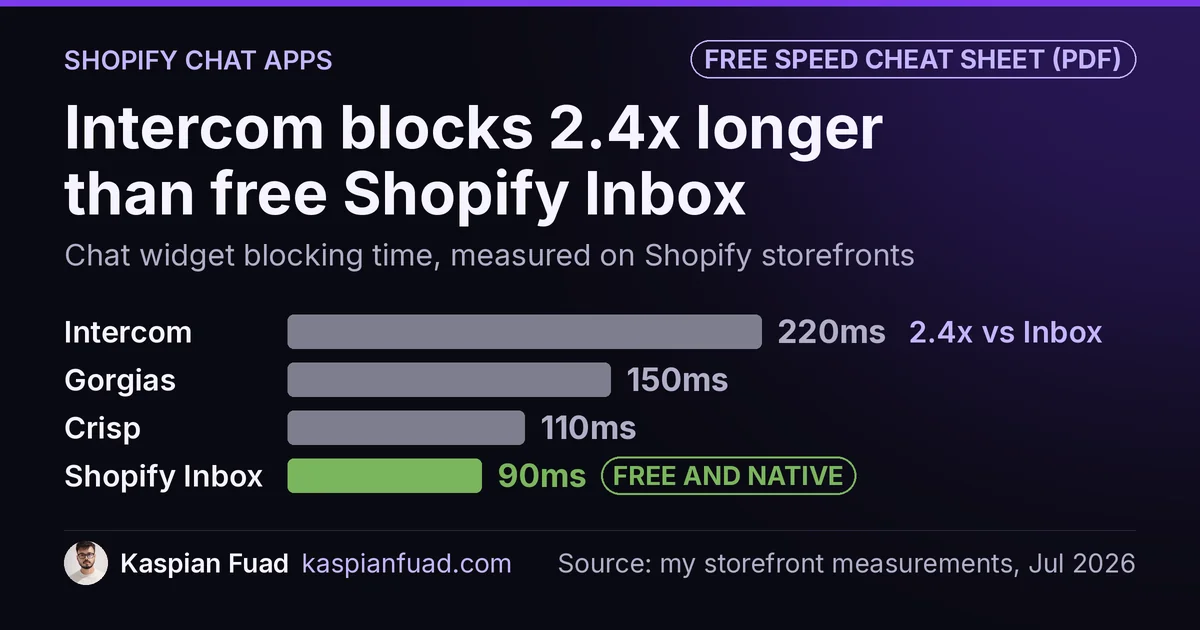
Chat is the third-heaviest app category I measured, at a 145ms median across 14 apps. Only page builders and social apps cost more. Here is the group most Shopify merchants actually choose between:
| App | Blocking time | Price | Best for |
|---|---|---|---|
| Intercom | 220ms | $39 to $139 per seat | General purpose, B2B |
| Gorgias | 150ms | $10 to $900 | Shopify helpdesk |
| Tidio | 130ms | Free to $39 | SMB chat plus bots |
| Crisp | 110ms | Free to $295 | Lightest third-party |
| Shopify Inbox | 90ms | Free | Chat, no helpdesk |
The pattern runs the wrong way. The free native option is the lightest, and the priciest per-seat product is the heaviest. Intercom costs 2.4 times what Shopify Inbox costs on the main thread, and your customer cannot tell which one you are paying for.
Blocking time is the single thread that also answers taps. While a widget’s JavaScript runs, the page looks finished and does nothing. Google counts a task as blocking past 50ms, and flags any page whose third-party code blocks the main thread for 250ms or longer. One chat widget can eat most of that budget on its own.
Is Gorgias or Intercom better for Shopify?
Gorgias, for most stores, and the speed gap is the smaller half of the reason.
Gorgias is built for ecommerce support. Tickets tie to orders, refunds happen inside the ticket, and it starts at $10 a month on Starter, rising through Basic at $60 and Pro at $360 to Advanced at $900, per its App Store listing. Watch the overage: Starter bills $0.40 per additional ticket, which is how a $10 plan quietly stops being a $10 plan. Many of those tickets are order tracking and returns, which a tracking and returns app can deflect. A partial refund, like refunding only the shipping, takes one screen in Shopify itself.
Intercom is the better general-purpose product and the worse storefront citizen. It is the heaviest chat app I measured at 220ms, and it prices per seat from $39 to $139 a month. Per seat matters: five agents on Expert is a different number than Gorgias Advanced, and it is worth doing that arithmetic before the demo call rather than after.
If you run B2B or sell software, Intercom earns its weight. If you run a Shopify store, you are paying a premium in both currencies for a product aimed at someone else.
Are the free chat apps actually any good?
This is where the category gets interesting, because the free tiers are not the consolation prize.
Crisp is the lightest third-party widget I measured at 110ms, with a free forever tier at 2 seats, then Mini at $45, Essentials at $95 and Plus at $295 per workspace. Per workspace, not per seat, which is a materially different bill at five agents.
Tidio is 130ms with a genuine free plan covering live chat for 50 users, then $29 a month for Customer Service and $39 for its Lyro AI chatbot. One warning from audits: turn off auto-open. A popup that fires on load costs you the blocking time and the bounce.
Shopify Inbox is free, built by Shopify, and the lightest option at 90ms, rated 4.7 across 5,028 reviews. It is native, so it is the only one on this list not bolting a third-party script onto your theme. My Shopify Inbox setup notes cover the AI auto-reply most stores never switch on.
The catch is real and it is not about speed. Inbox is chat, not a helpdesk. No shared ticket queue, no macros, no SLAs, no multi-channel. If two people answer your support and you measure first response time, you will outgrow it. When you do, my Gorgias vs Zendesk vs Gladly vs Re:amaze helpdesk cost breakdown prices each one for a 4-agent team.
What does a chat widget actually cost you?
Take the arithmetic seriously for a second, because this is the part that changes decisions.
Google’s budget for all third-party code is 250ms. Intercom alone is 220ms. That leaves 30ms for your reviews app, your email capture, your pixels and everything else, on a store that has not yet loaded a product image. I laid out the full picture in the App Bloat Report, where a normal five-app stack came to 860ms.
So the honest way to read this table is not “install Crisp, it is fastest”. It is: a chat widget is a 90ms to 220ms line item, and you should know which one you signed up for.
Shopify says the same thing in its own docs, telling merchants that too many apps loading assets on your storefront can slow performance and to weigh each app’s value against its cost. Chat is one of the easier places to take that advice, because the cheapest option is also the lightest.
How do I make my chat widget faster?
You do not have to switch apps to win most of this back. Three fixes, in the order I apply them on audits:
- Idle-load the widget. Nobody opens chat in the first second. Defer the script until the visitor scrolls, moves toward the bubble, or the main thread goes quiet. This alone removes most of the cost from your Core Web Vitals, because the work no longer lands during load.
- Kill auto-open. An auto-opening widget spends its blocking time and interrupts the visitor. It is the one setting I turn off on every store, every time.
- Scope the pages. Chat belongs on the PDP, cart and support pages. It does not belong on the homepage of a store whose visitors are browsing.
Then check the result against real users with the CruxGrader, not a lab run. Field data decides.
Should you switch?
Only if the app is not earning its cost. That test is the same one I apply to reviews apps and email platforms, and it beats any millisecond figure.
If Gorgias is closing tickets that would otherwise be refunds, 150ms is cheap. If you are paying Intercom per seat for a B2B feature set on a DTC store, you are paying twice, in dollars and on the main thread, for capability you do not use.
And if you are a two-person store running a $139 seat because it was the default in a template stack, Shopify Inbox is free, native, and 2.4 times lighter. Start there.
The takeaway
- Shopify Inbox wins on speed at 90ms and free, but it is chat, not a helpdesk.
- Pick Gorgias for a helpdesk, at 150ms from $10 a month, with $0.40 ticket overages to watch.
- Intercom is the heaviest, at 220ms, and prices per seat. Do the seat math before the demo.
- Crisp leads the third-party field at 110ms, and bills per workspace rather than per seat.
- Idle-load whatever you pick. Killing auto-open wins back most of the cost without switching.
I am Kaspian Fuad, a Shopify CRO consultant. Every blocking-time figure here is my own measurement, and the full 191-app dataset is public at the App Speed Index. Scan your own store with the App Bloat Detector.