

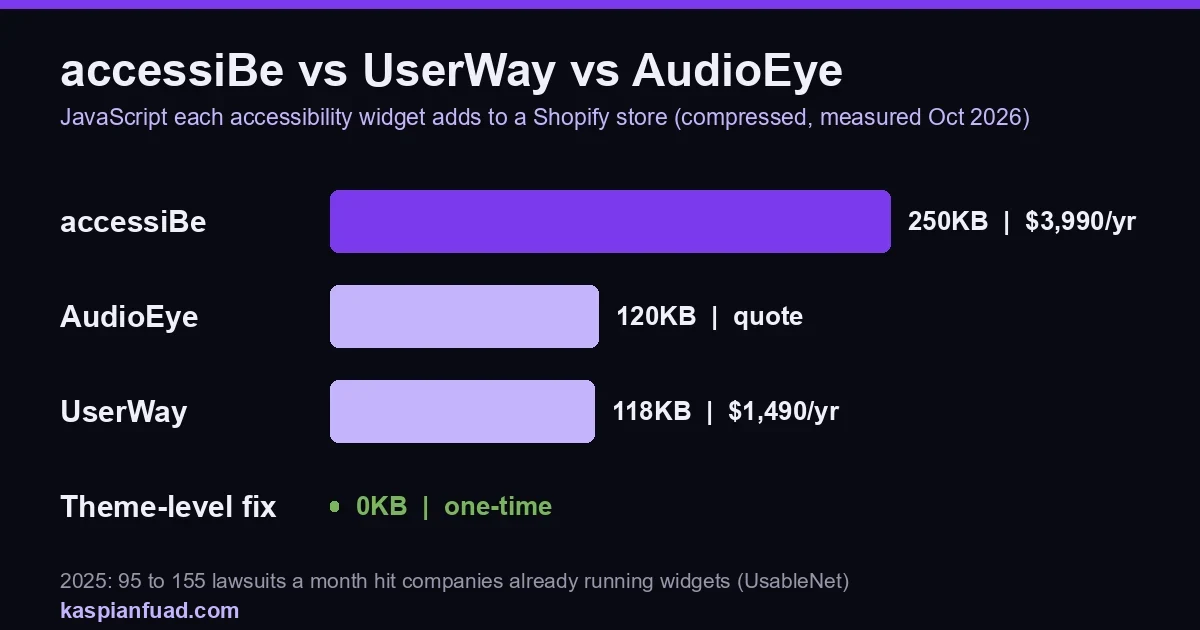
TL;DR: I pulled the files that accessiBe, UserWay and AudioEye download into a store. accessiBe ships about 250KB of compressed JavaScript, AudioEye about 120KB and UserWay about 118KB. For a store doing $2M a year, the annual bill runs $1,490 (UserWay) to $3,990 (accessiBe), and none of them stops a lawsuit. Lawsuits named companies running widgets 95 to 155 times a month in 2025. Fix the theme instead.
“Should I install accessiBe, UserWay, AudioEye or EqualWeb?” I asked ChatGPT that exact question this week, framed as a $2M Shopify store worried about ADA lawsuits. It ranked all four, then admitted every speed figure it had was the vendor’s own claim and told me to test them on a real theme.
So I did the testing. Here is what each widget costs you in dollars, in kilobytes, and in legal cover.
What do accessiBe, UserWay and AudioEye cost on Shopify in 2026?
I checked the live Shopify App Store listings and vendor pricing pages on October 7, 2026. The three price on different meters, which makes the sticker prices hard to compare.
| Widget | Cheapest paid plan | Meter | Plan for a $2M store | Annual cost |
|---|---|---|---|---|
| UserWay | $49/mo (Starter) | Page views | Small Biz, up to 1M views | $1,490 |
| accessiBe | $59/mo (Micro) | Visits | Scale, up to 100K visits | $3,990 |
| AudioEye | Not published | Quote | Managed (with Assurance) | Quote only |
The meter is the trap. accessiBe’s Shopify listing counts visits, and its own pricing page says it estimates them from Similarweb over the past six months. UserWay’s listing counts page views, but its Small Biz tier stretches to 1 million of them.
Here is the math for a typical $2M store. At a $90 average order and a 2% conversion rate, that store sees about 92,600 visits a month. That lands on accessiBe’s $479 Scale plan, or $3,990 paid yearly. The same traffic at four pages a visit is about 370,000 page views, well inside UserWay’s $1,490 a year plan.
AudioEye is the odd one out. Its pricing page lists three tiers and no prices, and third-party listings such as Capterra show a $49 a month starting point. The Managed tier with its legal protection is a sales conversation.
How much JavaScript does each accessibility widget add?
None of these vendors publishes an independent speed number for a Shopify store. AudioEye states its script is about 100KB compressed. accessiBe and UserWay sell on “no impact” claims. I wanted a number I measured myself.
Method: I loaded each vendor’s own homepage in Chrome, listed every file the widget pulled from its own CDN, then downloaded each file and recorded the compressed and uncompressed size. A vendor’s own site is the best case, because the vendor tuned it.
| Widget | Files loaded | Compressed | Uncompressed | Blocking time (my library) |
|---|---|---|---|---|
| accessiBe | 1 bundle | 250KB | 908KB | 80ms |
| AudioEye | 5 scripts | 120KB | 388KB | Not measured |
| UserWay | 8 files | 118KB | 383KB | Not measured |
| Theme-level fix | 0 | 0KB | 0KB | 0ms |
AudioEye’s own figure holds up roughly: I measured about 120KB against its claimed 100KB. accessiBe is the heavy one. It ships a single 908KB script that a phone must parse and compile before the widget does anything.
The blocking-time column comes from the App Speed Index, my library of measured app costs across real Shopify stores. accessiBe is the only one of the three I have measured there, at about 80ms of blocking time. I left the others blank rather than guess.
Why care about 80ms? Google’s guidance puts a good Total Blocking Time under 200ms on mobile. One compliance widget eating 40% of that budget leaves very little for reviews, upsells and tracking. The third-party script deferral guide covers how that stacking hurts INP.
Does an accessibility widget protect my store from an ADA lawsuit?
No, and the evidence is now public record.
On April 22, 2025, the FTC approved a final order requiring accessiBe to pay $1 million. The order bars it from claiming its automated products can make any website WCAG compliant, or keep it compliant, without evidence to support the claim.
The lawsuit data points the same way. UsableNet’s review of 2025 filings counted more than 5,000 digital accessibility lawsuits. Suits against companies already running widgets ran 95 to 155 a month all year, and e-commerce took nearly 70% of all ADA web cases.
The size data should end the “only big brands get sued” belief. UsableNet found 64% of sued companies make under $25 million a year. A $2M Shopify store sits squarely in that group.
More than 1,000 accessibility practitioners have signed the Overlay Fact Sheet, which states the core problem plainly:
“No overlay product on the market can cause a website to become fully compliant with any existing accessibility standard.”
What do the “litigation support” plans actually cover?
This is where the comparison gets interesting, because the vendors know widgets alone do not hold up.
- accessiBe’s Shopify listing includes $15K of litigation support on Growth and $20K on Scale, plus manual testing on Scale.
- UserWay says its annual plans include a Litigation Support Program.
- AudioEye’s Managed tier adds AudioEye Assurance, which its pricing page describes as a limited financial safeguard against WCAG demand letters and lawsuits.
Read those as insurance-shaped products, not immunity. A support budget helps pay for a response after a demand letter lands. It does not stop the letter, and it does not fix the barrier the plaintiff found. Get the written terms, exclusions and caps before you count any of it as cover.
UserWay is now owned by Level Access, which completed the acquisition in 2024. Level Access also sells audits and manual remediation, which tells you where the vendor itself sees the real work.
Is my Shopify store legally required to be accessible?
For US sales, courts keep applying ADA Title III to retail sites, and the filing numbers above show plaintiffs focus on e-commerce. There is no federal web regulation for private businesses, so WCAG 2.1 AA is the working benchmark in demand letters.
For EU sales, the rules are now written down. The European Accessibility Act has applied to online shops selling to EU consumers since June 28, 2025. Microenterprises with fewer than 10 employees and no more than 2 million euros in turnover are exempt, so a $2M store with a real team should not assume it qualifies.
If you also sell into Europe, the cookie consent comparison covers the other compliance script most EU-facing stores carry.
What actually lowers lawsuit risk on a Shopify store?
Fixing the barriers in the theme code, then keeping proof that you did. Almost every barrier an automated scan or a screen reader user hits on a Shopify store lives in the theme or in the apps layered on top of it.
Shopify sets a floor here too. Themes on the Theme Store must average a Lighthouse accessibility score of 90 across home, collection and product pages. Most of the failures I see come from what stores added afterwards: custom sections, app blocks, popups and cart drawers.
The repeat offenders I check first:
- Color contrast on sale badges, light gray prices and buttons over images.
- Keyboard focus that disappears, or gets trapped inside a cart drawer or popup.
- Form fields without labels, especially newsletter and search inputs.
- Product images with empty or duplicated alt text.
- Heading order broken by sections that ship their own H1.
That last one is common. On a luxury jewelry store I worked on, six standard pages, including the Accessibility page itself, carried a second H1 from a content block using the wrong heading level. On a pet gear bundle build, the accessibility pass was one of nine audits I ran before launch, and it fed into the 15 fixes that shipped.
What does a theme-level accessibility fix cost?
A theme-level pass on a standard Online Store 2.0 theme typically scopes at 15 to 40 hours in my experience. At my published $50 an hour that is $750 to $2,000, once, against $1,490 to $3,990 a year for a widget. Heavily customized themes with many app blocks sit at the top of that range.
That work is permanent, adds zero JavaScript, and improves the store for every shopper using a keyboard or screen reader. It also makes your speed work easier: the same audit that finds a focus trap in the cart drawer usually finds the app script that built it. My Shopify technical audit checklist shows how I run both passes together.
If your legal counsel wants a formal WCAG audit report as documentation, budget for that separately with an accessibility specialist firm. A developer fixes the code; an auditor certifies it. You want both on file.
Download the Shopify Accessibility Fix Checklist (PDF)
Is there ever a case for keeping a widget?
Yes, a narrow one. Some shoppers like the text size and contrast toggles, and a widget can sit alongside real fixes as a convenience. If you keep one, treat it like any other third-party script.
- Pick the lightest option that does the job; on my measurements that is UserWay or AudioEye, not accessiBe.
- Load it after the page is interactive, never as a blocking script in the head.
- Remove any marketing copy on your site that calls the store “ADA compliant” because of the widget.
Then check what it costs you. Run your homepage through the App Bloat Detector before and after, and watch the blocking time number move.
How do I check my store’s accessibility in 5 minutes?
- Run Lighthouse in Chrome DevTools on your homepage, a collection and a product page, and note the Accessibility score for each.
- Unplug your mouse and Tab through the product page: add to cart, open the cart drawer, close it. If you lose the focus outline or cannot escape the drawer, you found a real barrier.
- Open your cart drawer and newsletter popup and confirm every input has a visible or screen-reader label.
If any page scores under 90 or step 2 fails, that is the work a widget will not do for you.
The takeaway
- Stop treating an overlay as lawsuit protection; the FTC order and 2025 filing data both say it is not.
- Price the widget on your real traffic: about $1,490 a year for UserWay and $3,990 for accessiBe at $2M revenue.
- Measure the JavaScript before you install, because accessiBe alone adds about 250KB compressed.
- Fix contrast, focus, labels, alt text and headings in the theme, once, for roughly $750 to $2,000.
- Keep a dated record of the fixes, and add a formal audit report if counsel asks for one.
If you want the theme-level pass done properly, my rates and engagement terms are public, and the Shopify expert cost breakdown shows how I scope work like this.
Kaspian Fuad is a Shopify developer and CRO specialist with 12 years and 100+ stores behind him. He measures the apps he writes about and publishes his rates on kaspianfuad.com.