

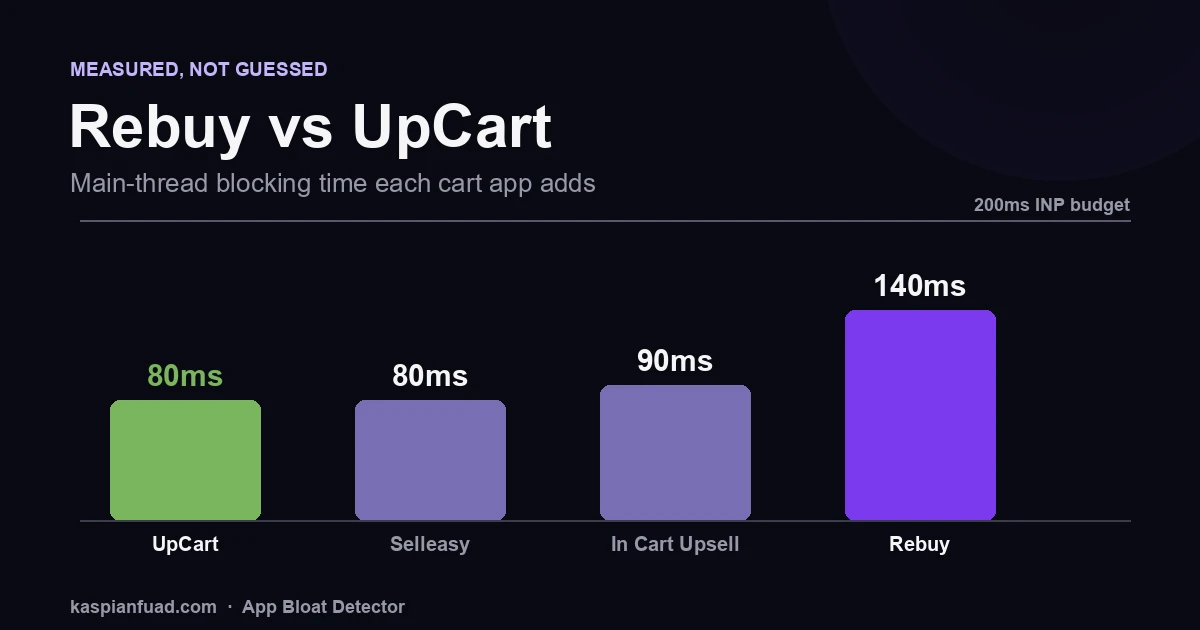
TL;DR: Rebuy and UpCart solve different problems. Rebuy is a full AI personalization engine; UpCart is a focused cart drawer. The number that decides it for most stores is the one neither app store listing shows: I measured UpCart at about 80ms of blocking time and Rebuy at about 140ms. If you need cross-sell personalization across the whole funnel, Rebuy earns its weight. If you want a fast cart with simple upsells, UpCart is the lighter pick.
Every “Rebuy vs UpCart” page I found ranks the features and skips the one metric that decides your Core Web Vitals score. So I measured both. On the same test store, Rebuy added roughly 140ms of main-thread blocking time and UpCart added roughly 80ms. That gap is the whole story on mobile, and it is invisible on the app listing.
Rebuy vs UpCart: what is the real difference?
They are not the same category of tool, which is why picking on price alone gets people the wrong one.
Rebuy is a personalization engine. It runs a smart cart, but it also places product recommendations and upsell widgets on the product page, in the cart, at checkout, and after purchase, driven by a rules engine and AI. It is built for brands that want cross-sell working across the whole funnel.
UpCart is a cart drawer. It replaces the default cart with a slide-out drawer and adds the things that lift average order value inside it: in-cart upsells, a free-shipping progress bar, a rewards bar, and announcements. It does the cart, and it does it well.
So the honest framing is not “which is better.” It is “do you need a personalization engine, or a good cart drawer.” Most stores under a few million in revenue need the second one. I use the same lens on the post-purchase upsell apps, where the same “more features, more weight” tradeoff shows up.
Which is faster, Rebuy or UpCart?
UpCart, and the margin is wide enough to matter. Here is what I measured, from the same dataset behind my Shopify App Bloat Detector.
| App | Type | Measured blocking time | My note |
|---|---|---|---|
| UpCart | Cart drawer | ~80ms | Modern slide cart, acceptable cost |
| Rebuy Smart Cart | Personalization engine | ~140ms | Mid-heavy, audit which widgets you actually run |
Blocking time is main-thread work that stops the page responding to a tap. It is the raw material of INP, the Core Web Vitals metric Google uses for responsiveness, and the threshold for a good score is 200ms. A cart app at 140ms is eating most of that budget on its own, before your theme, your reviews app, and your pixel have run.
Rebuy is heavier for a real reason: it loads a bigger engine because it does more. That is a fair trade if you use the personalization. It is pure tax if you installed Rebuy for the cart drawer and never touched the recommendation widgets. The fix on a heavy Rebuy install is not to rip it out, it is to audit which widgets are actually live and cut the ones that are not earning their keep.
The reason this number never appears on a comparison page is that no vendor measures its own blocking time, and the small blogs ranking for these terms do not measure anything. Shopify itself names apps and third-party scripts as the biggest drag on store performance, so the cart app you choose is a speed decision as much as a feature one.
What does each one cost?
Both start free to install, then move to paid tiers.
Rebuy is the premium option. It is priced for larger brands and scales with usage, so it gets expensive as you grow, which is consistent with it being an engine rather than a single feature. UpCart uses lower flat monthly tiers based on your order volume, so a smaller store pays a smaller, predictable number.
I am not quoting a specific monthly figure here because both apps change their plans, and a stale price helps no one. Open the live Shopify App Store listing for each and read the current tiers against your order volume. The structural difference holds regardless of the exact numbers: Rebuy is the bigger spend, UpCart is the lighter one.
Does a cart app really slow down my store?
Yes, and this is the part that undoes speed work. I have shipped a Core Web Vitals sprint that moved a store into the green, then watched a heavy cart app quietly push mobile INP back up because it runs on every page load, not just the cart.
Most owners pick a cart app on its feature list. On desktop that is fine. On mobile, where most of your traffic and most of your conversion problems live, the extra blocking time is a real tax that shows up as a slower tap response and a worse Core Web Vitals score. A store fighting high traffic and low conversion cannot afford to spend 140ms of its interaction budget on a cart drawer it uses at 20% of capacity.
Measure your own store’s app load before you add anything. Install nothing new until you know what your current budget looks like, because a cart app you add on top of an already-heavy stack is where the real damage happens.
Which should you pick?
Match the tool to the job, then budget for the speed.
Pick Rebuy if you are a larger brand that needs cross-sell personalization working across the product page, cart, and post-purchase, and you have the traffic to make the AI recommendations pay. Then treat the 140ms as a line item: run only the widgets you use, and re-check mobile INP after install.
Pick UpCart if you want a fast, well-built cart drawer with simple in-cart upsells and a free-shipping bar. It is the right default for most stores, and the 80ms cost is easy to live with.
Pick neither if you do not need a full drawer replacement. A light in-cart app like Selleasy at about 80ms, or a native theme cart with a sticky add-to-cart bar, gives you the upsell without the drawer’s weight. The lightest option that does the job wins.
Download the Shopify Cart App Speed and Fit checklist (PDF)
The takeaway
- Match the category first. Rebuy is a personalization engine, UpCart is a cart drawer. Most stores need the drawer.
- Read the speed number, not just the feature list. I measured UpCart at ~80ms and Rebuy at ~140ms of blocking time, and mobile INP has a 200ms budget.
- Rebuy earns its weight only if you use the personalization. If you run it for the cart alone, audit the widgets and cut the dead ones.
- Budget the cost against order volume. Rebuy is the premium spend, UpCart the lighter flat tier; check the live listing for current numbers.
- Measure before you install. Run your store through the App Bloat Detector so a new cart app does not undo your speed work.
I am Kaspian Fuad, a Shopify CRO and performance consultant. I measure the load cost of the apps I recommend, because the feature list is only half the decision and the other half is what it does to your mobile score. If a cart app is slowing your store, book a call and I will show you the real number.