

TL;DR: On Tuff Pupper, a dog gear brand that sells mainly on Amazon, the Shopify store’s biggest landing page was the warranty page Amazon buyers used to register, and its printed URL was dead. Support chat showed 68% of questions were about the product or its fit, and 3 of 8 harness size charts were wrong. Fix the Amazon buyer’s landing path first, then make product pages answer what the listing used to.
The busiest page on the Shopify store wasn’t the homepage. It was the warranty activation page, and the people landing on it had already bought the harness somewhere else.
Amazon-first brands usually read a quiet Shopify store as a traffic problem and go buy ads. The Tuff Pupper audit pointed at something cheaper: the store was failing the visitors it already had. Below is what I found, the fix order, and a 5-minute check for your own store. One honest limit: at 1 to 3 orders a day I won’t quote a conversion lift, because any percentage from a sprint that size would be noise.
Download the Amazon brand Shopify fix checklist (PDF)
Why this matters for your store
- Your Amazon buyers already visit your Shopify store, so every broken page they hit is a lost second sale.
- Amazon reviews and Q&A don’t follow the shopper to your domain, so your product pages carry the full burden of trust.
- Every extra item in a direct order is margin Amazon doesn’t take, which makes order value the economics of the channel.
Why does an Amazon brand’s Shopify store sell so little?
On Amazon, the listing does half the selling for you. The shopper sees a review count, a checkout they’ve used a hundred times and a delivery promise they trust. On your own domain, none of that is automatic.
Baymard Institute’s cart abandonment research puts the average documented abandonment rate at 70.22% across 50 studies. Among the reasons it lists, 19% of shoppers left because they didn’t trust the site with their card details, and 40% left over extra costs like shipping. A brand domain the shopper has never bought from starts on the wrong side of both.
Tuff Pupper, run by founder Logan Edwards, sells harnesses, leashes, collars and accessories. Amazon is the main channel, with thousands of reviews there. The Shopify store was the underdeveloped one, and its gaps had a pattern: each one sat where Amazon would have done the work.
Who actually lands on an Amazon brand’s Shopify store?
Microsoft Clarity answered this one. The warranty activation page was the single biggest landing page on the site, ahead of the homepage, because Amazon buyers come to register what they bought.
The URL printed on the insert card in every package had stopped resolving after an earlier site rebuild. So the brand’s most reliable traffic source, its own packaging, sent people to an error page. I set up URL redirects for that path and the other spellings people type.
The page itself was where most of the site’s dead clicks happened. Clarity defines a dead click as a click that gets no feedback, often a sign of broken elements or misleading layout. A spin-to-win popup was firing over the warranty form. I excluded both warranty pages from it, moved the form to the top on phones and grew the fields and button from 38 to 48 pixels.
Then the page got a job beyond registration. There’s an Activate Warranty button in the top navigation, a row of real products under the form and a thank-you offer once the warranty is registered. A visitor who came to register a harness bought on Amazon now has a reason to buy the leash on Shopify.
One caution: Amazon has its own rules on package inserts, so leave the card’s wording to whoever manages your Amazon account. The fix here is the page the card points to.
What do shoppers ask that the Shopify product page doesn’t answer?
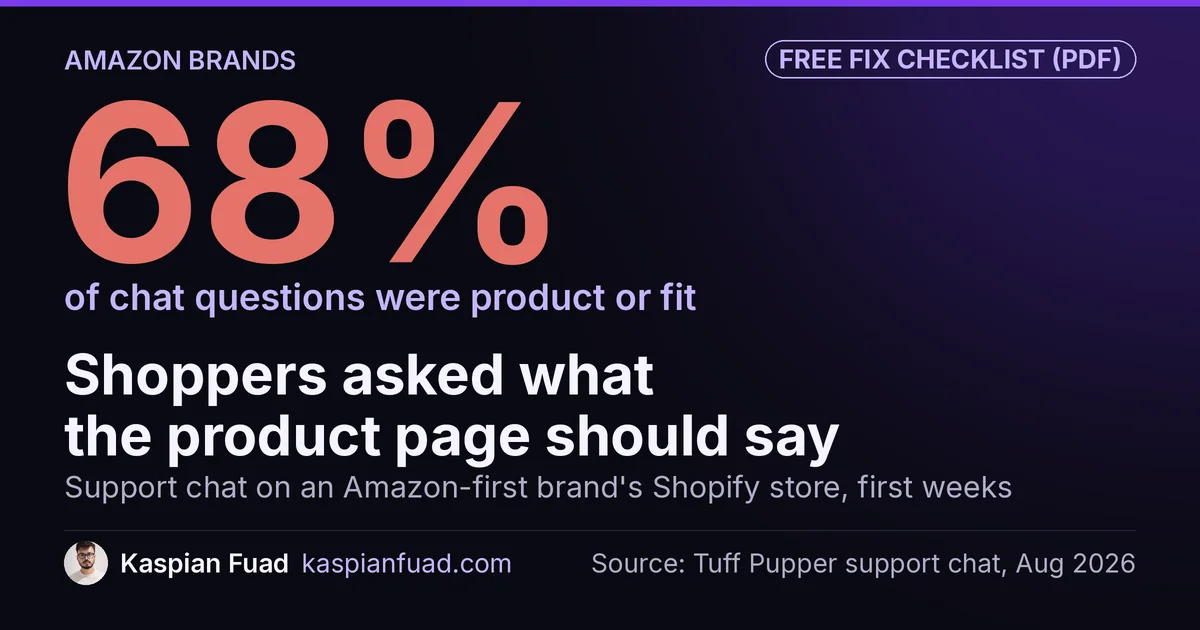
In August I launched a custom support chat on the store, built without a chat app. In its first weeks, real customers asked product questions 44% of the time, sizing and fit questions 24% of the time and order status questions 8% of the time. The other 24% covered everything else.
That’s 68% of questions about the product or its fit. On Amazon, a shopper answers those from hundreds of reviews and the listing’s Q&A. On Shopify, the product page has to do it alone, and here it couldn’t.
Sizing showed the problem clearest. I audited all eight harness size charts against the brand’s own chart images and 3 of 8 were wrong. Tracker was wrong on all four rows and missing its X-Small tier, Fast Fit was wrong on all six, and one harness had no chart at all. After corrections, I moved the charts into structured product data, and products with a size chart went from 15 to 52. Every chart now fits a 360 pixel phone screen; the worst one used to run 680 pixels off the edge.
Each harness also got a numbered fit guide and the questions people actually ask, written from that product’s own chart and description. Two of the eight had this before. If you want the build pattern, I wrote up Shopify size charts without an app.
Why can’t Google match your Shopify products to searches?
Amazon teaches sellers to put the search term in the listing title. That habit hadn’t reached the Shopify catalog. The rounded-bristle brush was showing in search for “dog brush” and “pet brush” under the title “Rounded Bristle - Brush”, an internal name no shopper types.
Google’s own title link guidance asks for descriptive, concise titles and warns against vague ones. In July, 26 of 112 products had no SEO title at all. I rewrote titles, meta descriptions and opening copy in waves, starting with products closest to page one, and by the end of September 133 of 133 active products carried a unique title and description.
The index needed the same care. Google had 164 pages indexed against 979 not indexed, with 544 crawled and not indexed, so I blocked the feed and filter crawl traps and noindexed paginated pages. If that report is worrying you on your own store, my post on crawled, currently not indexed explains when it’s normal.
What gives a buyer a reason to order direct instead of on Amazon?
A kit. In May, Tuff Pupper had zero kit SKUs, even though a harness, a leash and a collar are a natural set and the brand sold all three. Competitor Wild One already sold a Walk Kit assembled inline on one product page, with over 1,400 reviews on that kit alone.
I built a Build-the-Kit picker into every harness page with three tiers: Just the Harness, Walk Set and Full Kit. One button adds the whole kit. The $3 and $5 savings run on Shopify’s own automatic Buy X Get Y discounts, so the picker price matches the cart to the cent and there’s no bundle app fee.
Free shipping is the other lever, and it sat at $35. A $13.96 collar alone falls more than $20 short, and nothing in the cart helped close the gap. The cart drawer now says the exact amount left and offers add-ons that need no size decision. I covered the six leaks around that threshold, including a label that promised free shipping and didn’t deliver it, in the Shopify AOV case study.
Is the product page steady enough to buy from?
Trust is also physical. If the page jumps while a shopper reaches for a size, the store feels broken.
The bungee leash page scored a Cumulative Layout Shift of 0.40 to 0.64 across runs. Google’s CLS guidance on web.dev calls 0.1 or less good and anything above 0.25 poor. The cause was the color gallery filtering after first paint, plus a stray margin on the kit picker. Resolving the gallery in Liquid made the first paint the final one, and CLS dropped to 0.03. The same fix took Trailblaze from 0.16 to 0.03 and Fast Fit from 0.18 to 0.03.
How do you measure a Shopify store doing 1 to 3 orders a day?
Honestly, or not at all. At this volume a confident lift percentage inside a sprint would be fiction, so I don’t claim one.
Bundle adoption is counted from a line-item property written on every kit add, which gives a clean count instead of a noisy ratio. I also set up GA4 key events and then cross-checked GA4 against real Shopify orders. GA4 was undercounting purchases, which is common enough that I keep a GA4 tracking fix guide for it. You can’t read a trend off numbers that are wrong at the source.
What should an Amazon-first brand fix first on Shopify?
Here’s the order I’d follow on any Amazon-first brand, with what each step found on Tuff Pupper:
| Order | Fix | What it found on Tuff Pupper | Time to check |
|---|---|---|---|
| 1 | Amazon buyer landing path | Insert-card URL dead, popup over the warranty form | 5 minutes |
| 2 | Product answers | 3 of 8 size charts wrong, 68% of chat questions on product or fit | 1 hour |
| 3 | Titles Google can match | 26 of 112 products with no SEO title | 30 minutes |
| 4 | A reason to buy direct | No kits, nothing to close a $35 free shipping gap | 30 minutes |
| 5 | Page stability | Product page CLS of 0.40 to 0.64 | 10 minutes |
| 6 | Honest measurement | GA4 undercounting purchases | 20 minutes |
The order matters. The landing path comes first because those visitors already exist and cost nothing to reach. Product answers come next because they decide every sale after that. Kits and free shipping come fourth on purpose: a bundle can’t sell from a page that loses the shopper on sizing.
None of this added an App Store app. If your stack is already heavy, the App Bloat Detector shows which scripts each page loads before you add anything new.
How to check your own store in 5 minutes
- Type the URL printed on your Amazon insert card into a phone browser. If it doesn’t load a working form, fix that today.
- Open your best seller on a phone and try to pick a size using only that page. Note every question you’d have asked a review.
- Search Google for your product type plus your brand name and read your own titles back. If they’re internal names, rewrite them.
The takeaway
- Test the URL on your Amazon insert card from a phone, because it may be your biggest Shopify landing page.
- Clear popups and dead clicks off every page Amazon buyers use for warranty or registration.
- Audit every size chart against the brand’s own source, then make each one fit a 360 pixel screen.
- Give direct shoppers a reason to order on Shopify, like a matched kit priced by native discounts.
- Measure in counts you can trust at your volume, and check GA4 against real orders first.
I’m Kaspian Fuad, a Shopify developer and CRO consultant. Every number above comes from a live engagement, with the dates and caveats published in the Tuff Pupper case study. If Amazon is your main channel and Shopify barely sells, send me your store and I’ll run this fix order on it.