

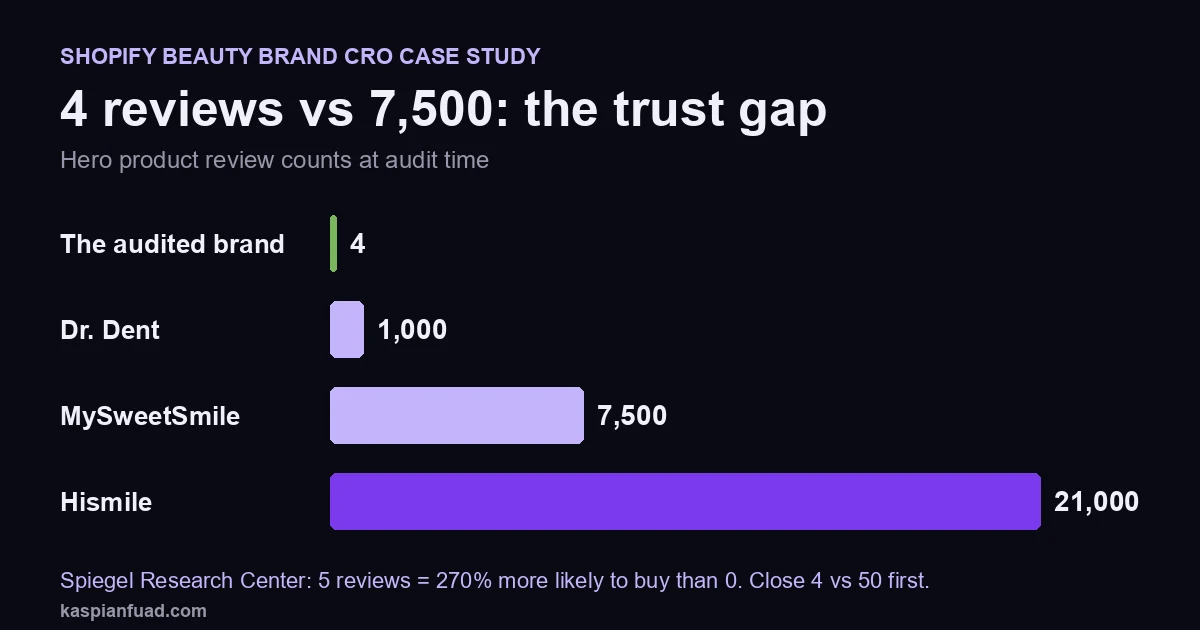
TL;DR: A new DTC teeth whitening brand on Shopify had 4 reviews on its hero product. Its competitors had 1,000, 7,500 and 21,000. My audit found 12 to 15 friction points, a 64/100 mobile score, a better formula nobody could see, and a per-treatment price that beat Hismile but never appeared on the page. The fix order: get to five reviews, surface the hidden wins, then polish.
I asked ChatGPT for Shopify beauty CRO case studies with real numbers. It came back with Murad, The Skin Nerd and a German natural cosmetics brand, all with healthy lifts. Then it added that “platform migration and CRO should not be treated as identical interventions.” It was right. Murad’s 56% conversion lift came from moving a 30-year-old skincare brand onto Shopify.
None of that helps a founder whose product page shows four stars from four people. Here is the audit I ran on exactly that store, with the numbers I found and the order I told them to fix things in.
Download the beauty brand trust-gap audit (PDF)
Why this matters for your store
- Health and beauty shoppers put your product on their skin or in their mouth, so trust decides the sale before price does.
- The steepest conversion gain sits between zero and five reviews, which a new brand can reach in weeks.
- A price or formula advantage the page hides is worth exactly $0 in revenue.
What did the store look like before the audit?
The brand sells LED whitening kits and gel refills on Shopify. Its formula uses PAP (phthalimidoperoxycaproic acid) instead of the hydrogen peroxide most mass-market kits use. That matters to the large group of buyers who get sensitivity from peroxide, and it was the brand’s real edge.
The competition was brutal. At audit time, MySweetSmile showed 7,500+ reviews and a Dermatest 5-star badge. Hismile showed 21,000+ reviews backed by clinical trials. Dr. Dent, the smallest of the three, still had 1,000+ reviews and an Amazon number-one badge.
The brand had 4. Traffic was decent, the conversion rate was low, and the owner wanted to know whether a redesign would fix it. My answer was no, and the full case study has the original roadmap.
Why did 4 reviews matter more than the design?
Because every competitor had paid for a specific, checkable trust signal, and this store had none. No before-and-after gallery, no press bar, no certification, no third-party test. In a category where a stranger asks you to put a chemical on your teeth, four reviews reads as “untested.”
The research backs the instinct. Northwestern’s Spiegel Research Center found that a product with five reviews is 270% more likely to be bought than one with none. For higher-priced products the jump was 380%, against 190% for cheaper ones.
Here is the part most review-app marketing leaves out. The same study says the marginal benefit of more reviews “begins diminishing rapidly after the first five.” The gap this brand had to close first was 4 versus a few dozen, not 4 versus 7,500.
That changes the plan. Chasing Hismile’s count is a five-year project. Getting to five reviews, then to around 50 with photos, is a few weeks of post-purchase emails. The 50 figure is my working rule for trust-heavy categories, not a number from the study.
What else did the audit find?
I logged 12 to 15 friction points across the funnel. The trust gap was the biggest, but two findings were pure lost money, because the brand already had the advantage and simply did not show it.
The formula advantage sat below the fold
The product page never explained what PAP is or why a sensitive buyer should care. Ingredient and safety details sat below the fold, after generic copy. “Sensitivity-free, enamel-safe” should have been the first line under the title. Instead a buyer had to scroll past three sections to find the one reason to pick this kit over Hismile.
The price win was invisible
The kits sold for $34 to $42 against competitor kits at $69 to $89. Per treatment, that worked out to $1.07 to $2.14 against Hismile’s $2.76 to $4.14. The page showed only the kit price, so the brand looked comparable when it was clearly cheaper per use. Professional whitening at $300 to $600 was the other anchor nobody mentioned.
The page was slow to respond
Mobile Lighthouse scored 64/100, with a 3.0 second LCP (Google’s LCP target is 2.5 seconds or less) and 1,250ms of Total Blocking Time. Google’s TBT guidance asks for under 200 milliseconds on average mobile hardware, so taps sat unanswered for over a second. Popups and tracking scripts fought for the main thread. For a brand buying Meta traffic, that is a tax on every paid click. You can run the same first-visit scan on your own store.
The cart missed the refill
Gel refills are the repeat purchase, yet there was no subscription option and no post-purchase refill upsell. Shipping cost appeared only at checkout, and the payment step had no trust badges. Each one is small. Stacked on a 4-review product page, they gave a nervous buyer four more exits.
Which fixes did I put first, and why?
I split the roadmap into what a developer ships in a week and what the brand has to grow over months, and ran both tracks at once. Here are the 8 quick wins with my time estimates:
| Fix | Time | What it answers |
|---|---|---|
| Money-back guarantee badge above the fold | 15 min | “What if it does not work?” |
| Review count in the product hero, even at 4 | 20 min | “Has anyone bought this?” |
| Sticky add-to-cart on mobile | 30 min | Keeps the buy button in reach while scrolling |
| PDP FAQ: sensitivity, enamel, results timeline | 1 to 2 h | Puts the PAP advantage in plain words |
| Per-treatment price and a comparison chart | 2 h | Shows $1.07 vs $2.76, and $300 at the dentist |
| Before-and-after section from existing customer photos | 1 h | Real proof, even 2 or 3 photos |
| Subscription pre-selected on gel refills | 1 h | Captures the repeat order |
| Exit-intent offer for abandoning visitors | 1 h | One last reason to stay |
The first three take about an hour combined. Not one of them needs a redesign.
How do you grow reviews without breaking the rules?
The second track was a review generation campaign: post-purchase email and SMS asks timed after the first use, plus a photo incentive. That last part needs care. The FTC rule announced on August 14, 2024 bans incentives “conditioned on the writing of consumer reviews expressing a particular sentiment,” and bans suppressing negative reviews.
So reward every honest review, positive or not, and publish the three-star ones. The FTC’s Q&A on the rule walks through incentive scenarios if you want the detail. Spiegel’s data even helps here: purchase likelihood peaks at ratings of 4.0 to 4.7 and falls as ratings approach a perfect 5.0. A wall of flawless five-star reviews on a new brand looks staged.
Pick the review app with speed in mind, because this store was already at 1,250ms of TBT. In my own App Bloat Detector measurements, Judge.me adds about 80ms of blocking time and Yotpo about 250ms. That is the difference between a widget you barely notice and one that alone eats past Google’s whole 200ms budget. My Judge.me vs Loox vs Okendo vs Yotpo comparison has the full table and pricing.
Reviews alone do not finish the job either. The brand also needed one third-party signal of its own: a dental professional endorsement, a sensitivity study, or an ingredient safety certification. That is the brand’s answer to MySweetSmile’s Dermatest badge.
What does this case study not prove?
This was an audit and a roadmap. I am not publishing a before-and-after conversion rate for this store, so do not read the table above as a measured lift. The 8 quick wins are standard, low-risk changes, and their payoff depends on traffic quality and how fast the review count grows.
The competitor counts are from audit time and keep moving. The per-treatment math depends on how many uses a kit gives, so redo it with your own pack sizes. If you want a store where the outcome was measured, my high-ticket CRO case study publishes the funnel numbers and the dates.
Should a beauty brand hire a CRO consultant at this stage?
Hire for the audit, not for a redesign. A focused audit at my published $50 an hour runs about $500 and covers the product page, cart, trust signals and mobile speed, which is where this brand’s problems were. The audit cost breakdown shows the hours behind that number and what a $5,000 agency audit adds.
What you should not buy is a custom rebuild at $15,000 to $45,000 while the hero product has four reviews. A new theme with the same thin proof converts like the old one. If you want to run the first pass yourself, start with my CRO audit checklist and the product page diagnosis.
How to verify your own trust gap in 5 minutes
- Open your best seller on a phone. Count the reviews visible before the first scroll, then do the same on your top two competitors.
- Write your price per use next to theirs. If yours wins and the page does not say so, that is your first fix.
- List every third-party proof on their pages (badges, studies, press). Pick the one you can earn in 90 days.
The takeaway
- Count reviews against the first-five threshold, not against your biggest competitor’s total.
- Surface any formula or safety advantage in the first line under the product title.
- Show price per use when you win on it, with professional treatment as the high anchor.
- Reward every honest review, never only positive ones, and keep the three-star ones live.
- Ship the one-hour trust fixes this week, before you price a redesign.
I am Kaspian Fuad, a Shopify developer and CRO consultant. I publish my rates, my audit findings and what each case study does not prove. If your beauty brand is losing on proof rather than design, book a call and bring your hero product page and your top two competitors.