

TL;DR: A Shopify CRO retainer runs $2,000 to $10,000+ a month, and the biggest problem is not the price, it is that almost nobody tells you what you get for it. One agency page ranking for this exact term quotes $10,000 a month flat with no published results at all. A retainer is priced by one thing: the hours per week times the hourly rate. Here is the honest economics, a real eight-sprint results breakdown from a store I run, and the checklist to make sure you are buying shipped code, not slide decks.
I searched “shopify cro retainer” the way a store owner would. The first page is agencies quoting monthly flat fees, and not one of them shows you a real before-and-after. That is the whole problem with CRO pricing: the number is easy to find, the value behind it is hidden. So I am going to publish both.
How much does a Shopify CRO retainer cost?
The market range is $2,000 to $10,000+ per month, and where you land is set by two numbers: the hourly rate and the hours per week. Everything else is packaging.
- A senior solo consultant billing 15 to 20 hours a week at roughly $50 an hour lands around $3,000 to $4,000 a month. You pay for the person doing the work and nothing else.
- A mid-tier agency is usually $5,000 to $10,000 a month for similar output, because the rate also carries account managers, sales, and overhead. Some quote a flat five-figure monthly fee with the hours left deliberately vague.
My own model is public on the engagements page: $50 an hour, a weekly retainer at $750 to $1,000 a week for 15 to 20 hours, billed every Friday, with a monthly option that locks the rate and saves 10%. I publish it because the cost of hiring a Shopify expert should not be a negotiation you walk into blind. If a quote will not break down to a rate and a number of hours, that is the first red flag.
What do you actually get for a CRO retainer?
A real CRO retainer is a weekly loop, not a support inbox. The cadence I run, and the one you should look for, is fixed:
- A full cross-source audit every week: Shopify Analytics, GA4, Search Console, Microsoft Clarity, and Lighthouse, read together so the data agrees before anything ships.
- A prioritized sprint of shipped changes against that audit, scored so the highest-impact fix goes first.
- A Friday review that reports what shipped, what it moved, and what the next week attacks.
The deliverable is deployed code and measured results, every week. If what lands in your inbox is a monthly report with recommendations you still have to hire someone to build, that is a consulting retainer wearing a CRO label. The point of the retainer is that the person finding the leak is the same person fixing it, which is the whole case for a hands-on operator over an advice deck.
Does a retainer actually move the numbers?
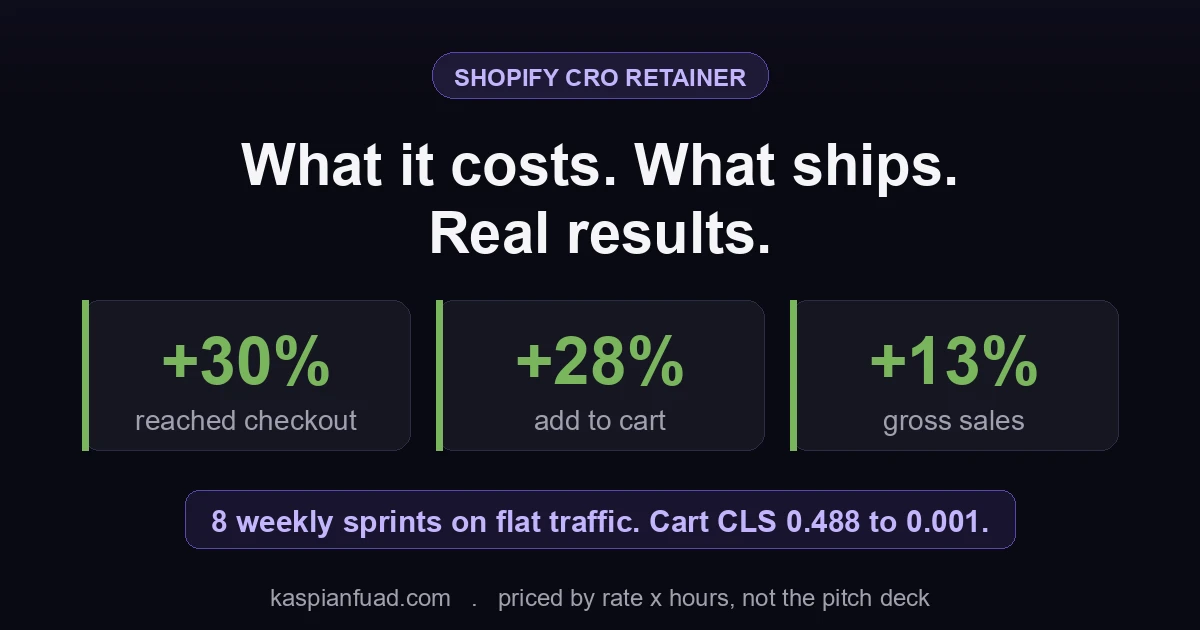
This is where every agency page goes quiet, so here is a real one. WD Electronics is a Shopify Plus store selling high-ticket UTV and automotive kits, mostly in the $400 to $2,000 range. It started as a one-off audit and became a weekly retainer that is now eight sprints deep. On the four-week rolling trend, on roughly flat traffic (+4% sessions):
- Added to cart up 28% and reached checkout up 30%. The funnel did the work, not more ad spend.
- Gross sales up 13% on the rolling window, about $492,000, with one recent week hitting a 0.77% conversion rate, up 24% week over week.
- Cart CLS from 0.488 to 0.001 after a server-rendered shipping bar and a reserved cart height, with checkout abandonment falling alongside it.
- A new channel opened: $4,285 from 62 AI-agent visits in 30 days as agentic commerce came online.
None of that came from one big redesign. It came from a checkout fix, then a search fix, then a speed fix, each shipped in its own week and each compounding into the same funnel. That compounding is the entire argument for a retainer over a single project, and it is the same pattern behind the 51% sales lift I documented on a furniture store.
Download the CRO Retainer Buyer's Checklist (PDF)
Retainer, one-off audit, or project: which do you need?
They are not the same purchase, and buying the wrong one wastes money.
- A $500 to $2,500 one-off audit is right when you need to know where the leaks are before committing. It produces a prioritized, ICE-scored plan you can hand to anyone. Start here if you are not sure.
- A fixed-scope project is right when the work is known and finite: a checkout rebuild, a speed sprint, a search fix. You pay for a defined outcome, not open hours.
- A retainer is right when the leaks are many and the wins compound, which is most stores doing real volume. You are buying sustained shipping, not a single fix.
On a very low-traffic store, an open retainer can outrun the data, because you cannot read a weekly signal from a few hundred sessions. There, a project beats a retainer. Be honest about your traffic before you sign one.
How do you avoid overpaying for a CRO retainer?
Four checks separate a real retainer from an expensive report:
- Ask for the rate and the hours. A retainer that will not resolve to an hourly rate times hours per week is hiding either a high markup or low output.
- Ask what ships weekly. The answer should be deployed code, not a document. “Strategy” with no implementation is the most common overcharge.
- Ask for measured before-and-after numbers from a store they actually ran, not a testimonial. If they cannot show a funnel moving, they are selling activity, not results. Every consultant should be able to point you at real dollar-impact numbers.
- Check your own baseline first. Grade your store’s real-user Core Web Vitals and read your Clarity heatmaps before anyone quotes you, so you know what you are paying to fix.
The takeaway
- A Shopify CRO retainer costs $2,000 to $10,000+ a month, set by the hourly rate times the hours per week, not by the size of the pitch deck.
- A real retainer ships code weekly, not a monthly report. Audit, sprint, Friday review, repeat.
- Compounding is the point. On one store, eight weekly sprints drove add-to-cart +28% and reached-checkout +30% on flat traffic.
- Match the purchase to the problem. Audit to find leaks, project for a known fix, retainer to compound, and a project (not a retainer) on very low traffic.
- Demand the rate, the hours, and real numbers. If a quote hides all three, you are overpaying.
I run these CRO retainers directly, at a published rate, and I put the real numbers on the record. If you want to know what your store’s biggest leaks are and whether a retainer or a one-off fix is the right buy, my 30-minute diagnostic call is free.