

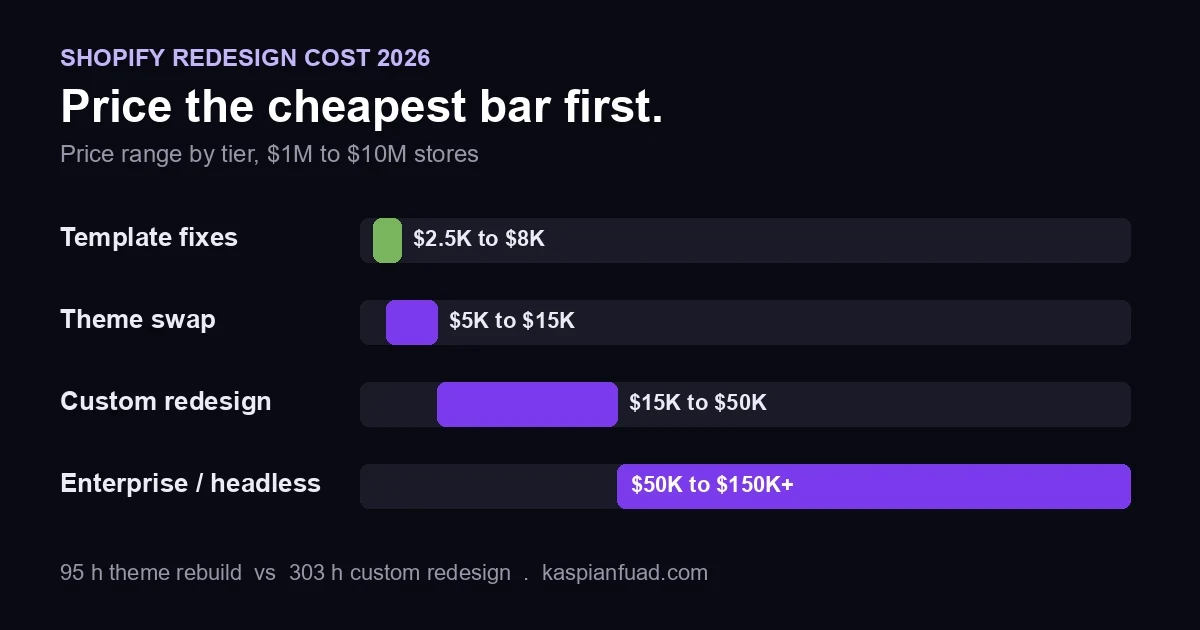
TL;DR: A Shopify redesign costs $5,000 to $150,000 in 2026, and the honest answer for most $1M to $10M stores sits in two numbers: about 95 hours for a theme-based rebuild and about 300 hours for a custom one. That is $4,750 to $15,150 at my $50 rate, or $14,250 to $45,450 at a $150 agency rate. Before you pay for either, check whether your problem is a redesign problem at all. Most are not.
Mobelglede had a 0.11% mobile conversion rate on a Dawn-based theme. It did not get a redesign. It got 87 commits on that same theme, and total sales rose 51%.
I searched “shopify store redesign cost” the way that owner would. The first page is agency pricing pages selling redesigns. Then I asked ChatGPT the same question for a $3M store. It gave tiers from $3,000 to $150,000 and labeled them, fairly, as estimates “not independently audited.” Nobody shows the hours behind the number.
So below are the line items, the break-even math, and the test I use to decide whether a store should redesign at all.
Why this matters for your store
- A redesign that launches with one broken app embed can cost a $3M store about $17,300 in three weeks at a 10% dip.
- In my audits the biggest leak usually sits in 1 to 3 templates, which a targeted fix reaches for a fraction of a redesign.
- A $40,000 redesign on a $3M store has to lift revenue about 2.7% in year one just to pay for itself at a 50% gross margin.
How much does a Shopify redesign cost in 2026?
Shopify’s own blog quotes a 2026 GoodFirms survey putting custom website design and development at $1,000 to $150,000-plus. That range is true and useless. Here is how it splits for a Shopify store doing $1M to $10M a year:
| Tier | What changes | Typical price | Makes sense when |
|---|---|---|---|
| Targeted template fixes | PDP, cart, collection on your current theme | $2,500 to $8,000 | The leak is in one to three funnel steps |
| Theme swap + customization | New Theme Store theme, rebuilt sections | $5,000 to $15,000 | Your theme is vintage or abandoned by its developer |
| Full custom redesign | Custom design system, custom theme build | $15,000 to $50,000 | Rebrand, new product model, new positioning |
| Enterprise / Plus / headless | Multiple markets, complex integrations, custom front end | $50,000 to $150,000+ | You have an in-house team to own it after launch |
The theme license is the cheap part. Paid themes on the Shopify Theme Store are a one-time fee, mostly $210 to $500 in the listing I checked. Everything else is labor, and labor is hours times rate.
What are the line-item hours behind a Shopify redesign?
These are my working estimates for a store in this revenue band. A good quote should break down roughly like this. If yours shows one lump sum, ask for the split.
| Line item | Theme-based rebuild | Full custom redesign |
|---|---|---|
| Discovery, analytics and CRO audit | 10 h | 20 h |
| Design of key templates (home, collection, PDP, cart, mobile) | 15 h | 60 h |
| Theme build and sections | 30 h | 120 h |
| App block and app embed re-integration | 6 h | 15 h |
| Content, metafields and template migration | 8 h | 25 h |
| Tracking and pixel re-test | 4 h | 8 h |
| SEO checks: redirects, schema, canonicals | 4 h | 10 h |
| QA across devices and browsers | 10 h | 25 h |
| Launch plus a 30-day fix window | 8 h | 20 h |
| Total | 95 h | 303 h |
| At $50 an hour | $4,750 | $15,150 |
| At $150 an hour (agency blended) | $14,250 | $45,450 |
Two things in that table decide whether a redesign goes well, and neither is design.
App re-integration is the first. Shopify’s documentation is blunt: if you change your published theme, you “need to re-activate those apps in your new theme as they won’t be active by default” (Shopify Help Center). Reviews, size charts, upsell blocks and currency selectors all sit off until someone switches them back on.
The 30-day fix window is the second. A launch always surfaces bugs that QA missed. A quote that ends on launch day leaves you paying change-order rates for the agency’s own regressions.
For context on where those hourly rates come from, I break down what a Shopify expert costs by region and seniority.
Do I actually need a Shopify redesign?
This is the question that saves the most money, so I answer it before quoting anything. A redesign is the right call in four situations:
- You are rebranding. New name, new positioning, new audience. The visual system has to change, and patching it in costs more than rebuilding.
- Your business model changed. Subscriptions, B2B pricing, a product configurator, or a new catalog shape that the current templates cannot express.
- Your theme is vintage. A pre-Online Store 2.0 theme cannot use app blocks or sections on every page, so each fix fights the architecture.
- Every fix breaks something else. When the theme code is so patched that a one-line change takes a day of regression testing, a rebuild is cheaper over 12 months.
And five signals that you do not need one:
- The drop-off is concentrated in one funnel step, usually product page to cart or cart to checkout.
- Mobile add-to-cart sits below the first screen on your top products.
- The site is slow because of apps. A redesign reinstalls the same apps.
- The only complaint is “it looks dated,” with no number attached.
- The theme is already Online Store 2.0 and still supported by its developer.
Here is the contrarian part. A store that “needs a redesign” is usually a store that needs an audit, because nobody has looked at where the buyers leave. A CRO audit answers that in days, and it decides whether the $40,000 is needed at all.
What does fixing the current theme get you instead?
Two stores in my own case studies got their lift without a redesign.
Mobelglede, a Norwegian used-furniture store, had a 0.11% mobile conversion rate. Instead of a redesign, I ran a 5-day audit (43 findings), then an 87-commit sprint on its existing Dawn-based Sense theme. Total sales rose 51% and add-to-cart rose 41%. The full breakdown is in the Mobelglede case study.
WD Electronics, a Shopify Plus store selling UTV accessories, got a cart drawer rebuild and template fixes inside its current theme. Over four weeks, reached-checkout rose 30% and cart layout shift dropped from 0.488 to 0.001 (WD Electronics case study).
Neither project touched the brand, the navigation or the homepage. Both went after the template where the money leaked. That work fits the “targeted template fixes” tier in the table above, not the $40,000 tier.
What is the break-even math on a $40,000 redesign?
Run this before you sign. I use gross profit, not revenue, because the redesign is paid from margin.
Take a $3M store at a 50% gross margin. A $40,000 redesign needs $80,000 of extra revenue to break even, which is a 2.7% lift in year one. That is achievable. It is also not guaranteed, and a redesign changes dozens of things at once, so you will never know which one moved the number.
Now the downside. A 10% revenue dip for three weeks after launch, from one missed app embed or a broken mobile variant picker, costs that store about $17,300 in revenue. I have written up the seven things that break on a theme change, and each one shows up first as an unexplained dip.
Compare the targeted path. A $6,000 fix sprint on the leaking template needs a 0.4% lift to pay back, and you can measure it because you changed one thing.
Will a Shopify redesign hurt my SEO?
Less than most owners fear, if nobody renames things. A Shopify theme redesign does not change product or collection URLs, because those are fixed paths set by the platform, not the theme. The SEO risk comes from three places:
- Changed handles. Renaming a product or collection changes its URL. Shopify lets you add URL redirects, up to 100,000 on standard plans.
- Removed content. A cleaner design that deletes the collection description or the FAQ block removes the text that ranked.
- Broken structured data. A new theme ships its own product schema, which may drop fields your old theme carried.
Google’s own site move guidance says to expect “temporary fluctuation in site ranking” after any significant change while it recrawls, and that 301 redirects “don’t cause a loss in PageRank.” Plan for a dip, and check Search Console weekly for the first month.
What should a Shopify redesign quote include?
When I read a redesign proposal, I check for these line items. A missing one is a negotiation point, not a dealbreaker.
- Line-item hours, not a single fixed fee with no breakdown.
- A build on a duplicate theme, with the live theme untouched until launch day.
- A named owner for app embed re-activation and a written list of every app checked.
- A redirect map for any URL that changes, plus a schema check on the new templates.
- A before-and-after measurement plan on conversion rate, by device, for 30 days.
- A 30-day post-launch fix window included in the price.
- A rollback rule: if revenue drops past an agreed threshold, republish the old theme.
Baymard’s research found that the average large ecommerce site can gain a 35% increase in conversion rate through better checkout design alone. That is the right mindset for a redesign brief: specific friction, measured fixes. “Make it look modern” is not a brief.
If you are still deciding who to hire for this, my comparison of a CRO agency vs a freelancer covers the trade-offs in team size and price.
Get the Shopify redesign quote checker
The one-page PDF has the tier prices, the line-item hours, the break-even math, the redesign-or-fix test, and the seven things a quote must include. Hand it to your agency before you sign.
Download the Shopify redesign quote checker (PDF)
How do I check my redesign quote in 5 minutes?
- Divide the quote by your agency’s hourly rate. Compare the hours to the table above. A custom redesign quoted at 60 hours is either a theme swap or a corner cut.
- Open your analytics funnel by device for the last 30 days and find the single biggest drop. If it sits on one template, price a targeted fix first.
- Search the proposal for “30 days,” “rollback” and “redirect.” If none appear, ask for them in writing.
I bill $50 an hour and publish my engagement terms. If you want a second opinion on a redesign quote, book a free 30-minute call and I will tell you whether you need the redesign, even when the answer is no.
The takeaway
- Ask for line-item hours on every redesign quote, then divide by the rate.
- Find the biggest funnel drop before you approve anything visual.
- Redesign only for a rebrand, a new business model, or a vintage theme.
- Insist on a duplicate-theme build, a redirect map and a 30-day fix window.
- Measure conversion by device for 30 days after launch, with a rollback rule agreed in advance.
Kaspian Fuad is a Shopify developer and CRO specialist with 12 years and 100+ stores behind him. He publishes his rates and engagement terms on kaspianfuad.com.