

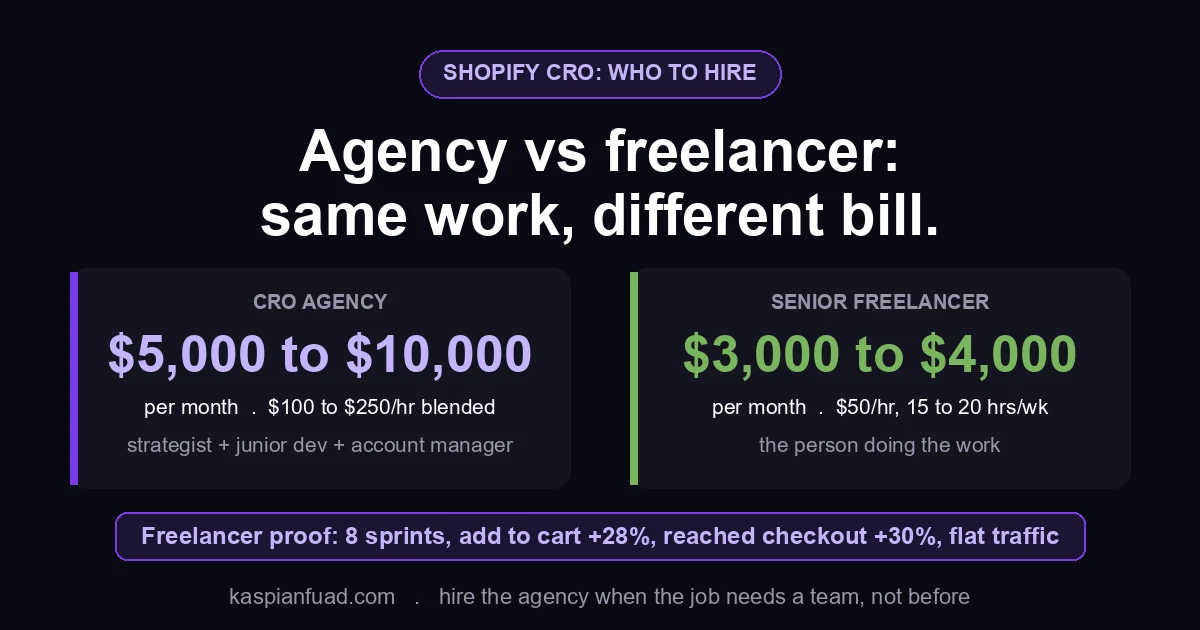
TL;DR: For a Shopify store under about $10 million a year, a senior freelance CRO specialist usually ships the same fixes as an agency for a third to half the price: $3,000 to $4,000 a month against $5,000 to $10,000. The agency wins when the job needs a whole team at once (parallel A/B tests, multi-region rollouts, a dedicated PM, 24/7 coverage). Below that scale, the extra spend buys coordination on top of the same shipped work. The decision scorecard is below.
I searched “shopify cro agency vs freelancer” the way a store owner would. Nine results, and every single one is written by an agency, a freelancer, or a marketplace that sells one of the two. Not one of them publishes its own rate next to a measured result. So here is the version with both, from a freelancer who will tell you when to hire the agency instead.
Should you hire a Shopify CRO agency or a freelancer?
Pick by the shape of the work. The label on the invoice matters less. Conversion work on a Shopify store is a weekly loop: read the data, find the biggest leak, ship the fix in theme code, measure it, repeat. One senior person who does both the analysis and the Liquid can run that loop alone. The moment the loop needs four specialists in parallel, you need an agency.
That is the whole decision. Everything else is pricing.
The reason most guides get it wrong is that they compare a team against a person and conclude the team is safer. It is safer for the agency. For you, the question is who finds the leak in your add-to-cart rate and who fixes it, and on stores between $500,000 and $10 million that is almost always one pair of hands.
What does a Shopify CRO agency cost vs a freelancer?
Agency pricing is public if you dig. Glued’s 2026 CRO agency pricing breakdown puts DTC retainers at $3,000 to $12,000 a month, with $5,000 to $10,000 typical for brands doing $2 million to $10 million, and projects at $8,000 to $30,000 over 6 to 16 weeks. The blended hourly rate hiding inside those numbers is usually $100 to $250, because the fee carries account managers, sales, and office overhead alongside the person actually in your theme.
A senior freelancer bills the person only. The market rate for a direct hire is $40 to $75 an hour; mine is published on the engagements page at $50 an hour, $750 to $1,000 a week for 15 to 20 hours, billed every Friday, with a monthly option that locks the rate and saves 12%. A $500 audit delivered in 2 to 3 days is the low-commitment entry. Marketplace rates spread far wider, and the full cost of a Shopify expert runs from about $25 to $200 an hour once you include agencies, which is why price alone tells you nothing.
| Senior freelancer | CRO agency | |
|---|---|---|
| Monthly retainer | $3,000 to $4,000 (15 to 20 hrs) | $5,000 to $10,000 |
| Effective hourly rate | $40 to $75 | $100 to $250 blended |
| One-off audit | $500 to $2,500 | $5,000 to $15,000 |
| Who does the work | The person you hired | A strategist plus a rotating junior dev |
| Who finds the leak and who fixes it | Same person | Two or three different people |
| Parallel A/B tests | 1 to 2 at a time | 3 to 6 at a time |
| Bus factor | One person | A team, with turnover |
| Breakeven on a $2M store | About 2% more annual revenue | About 3% to 6% |
That last row matters more than any other. A $4,000 a month hire costs $48,000 a year, which is 2.4% of a $2 million store. A $10,000 a month agency needs 6% just to pay for itself. Both are clearable, but one of them has three times the runway before you should be worried.
What do you actually get from each?
Same deliverable, different plumbing. What you should get from either is shipped code and a measured number every week, which I broke down in what a CRO retainer actually includes. The difference is the path the work takes to reach your theme.
With a freelancer, the person who reads your GA4 funnel and your Microsoft Clarity recordings on Monday is the person editing sections/main-product.liquid on Tuesday. No handoff, no ticket, no “let me check with the dev.” Diagnosis and fix are one motion.
With an agency, the strategist writes a hypothesis, a designer mocks it, a developer builds it, an account manager reports it. That is four salaries in the loop, and it is why the rate is 2 to 5x. It is also why agencies are better at volume: a team can run six experiments in a month where one person runs two.
So the honest read is this. If your store has the traffic to run six statistically valid tests a month, the agency’s volume pays. Optimizely’s own guidance treats 95% significance as the standard threshold for a business decision, and most stores under $5 million cannot feed six tests to that bar at once. They can feed one or two. One person is enough for one or two.
When is the agency the right call?
I turn work away for these, so take them as the real list, not a straw man.
- Multi-region or multi-store rollouts where three markets need the same change shipped and QA’d the same week.
- A 24/7 support desk with SLAs. One person sleeps.
- A large experimentation program that needs a designer, a copywriter, and a developer producing variants in parallel, usually stores past $10 million with the sessions to match.
- A dedicated project manager your team can hand a roadmap to, because nobody internal owns CRO.
- Bus-factor risk you cannot carry: if one person going on leave for two weeks would stall the business, buy the team.
Pay for those when you have them. If you do not, the extra $2,000 to $6,000 a month buys coordination between people you did not need in the first place.
When does a freelancer win?
When the bottleneck is a specific leak and not a shortage of hands, which is the case on most stores that search this term. Three of my own engagements show the shape.
WD Electronics, a Shopify Plus store selling $400 to $2,000 UTV kits, started as a one-off audit and became a weekly retainer. Over eight sprints on roughly flat traffic (sessions up 4%), added to cart rose 28% and reached checkout rose 30%, gross sales climbed 13% to about $492,000 on the rolling window, and cart CLS went from 0.488 to 0.001 after a server-rendered shipping bar replaced an app widget. A checkout fix, then a search fix, then a speed fix, one person, one week each.
Mobelglede, a Norwegian furniture marketplace, got an 87-commit CRO sprint: add to cart up 41%, checkout up 40%, total sales up 51%. Varsity Gripz went from $0 to seven figures in 12 months with conversion up 15 to 25% and AOV up 20 to 30% from bundles, which I wrote up in the CRO levers behind that growth.
None of those needed a designer, a copywriter, and a PM. They needed someone who could read the funnel, open the theme, and ship before Friday. The pattern behind the wins is the same one I use in the Shopify CRO audit guide: the leak is usually in the PDP, the cart, or the checkout, and Baymard puts the average documented cart abandonment rate at 70.22% with a 35.26% conversion gain available from better checkout design alone. That is a fix list, and a fix list does not need a headcount to work through it.
How do you vet either one before paying?
The same five questions expose a weak agency and a weak freelancer. Ask them on the first call.
- Show me a before-and-after with dates on a store like mine. A logo wall proves nothing. A funnel chart with a deploy date on it does.
- Who exactly touches my theme, and what is their rate? If the quote will not break down into a rate times hours, you are paying for the fee to be vague.
- What ships in week one? “Discovery” for a month at $8,000 is a red flag on either side. The cheapest checks come first, and the first fix should land inside seven days.
- How do you measure it, and where do I see it? Shopify Analytics plus GA4 on flat traffic, reported weekly, with the test called if it fails.
- What happens when you are wrong? A good answer names a reverted change. A bad answer has never had one.
I turned those into a one-page scorecard you can fill in during the call, with the price decoder, the red flags for each side, and the 90-day plan to hold them to.
Download the Shopify CRO Hiring Scorecard (PDF)
One more filter that most guides skip: the person’s own site. If a CRO agency’s homepage takes six seconds to load on mobile or has a layout shift on the hero, they are selling something they do not practice. I apply the same test to speed optimization services, and it removes about half the field.
What results should you expect in 90 days?
Set the bar before you sign, because both sides will happily let you skip this. On flat traffic, a competent hire should move at least one funnel step in a measurable way by the end of month one, and the gains should compound by day 90 as each fix stacks on the last. The WD Electronics numbers above took eight weeks. The Mobelglede sprint took less.
Benchmark against your category, not the internet. Shopify’s conversion rate benchmarks (Dynamic Yield data, June 2026) put the global average at 2.66%, with fashion at 2.77%, beauty at 5.32%, and home and furniture at 1.29%. A furniture store at 1.2% is normal; a furniture store at 1.2% with a 70% cart abandonment rate has a checkout problem someone can fix in a week.
And insist on the metric set. Conversion rate alone can be gamed by discounting. Ask for revenue per session, add-to-cart rate, reached-checkout rate, and AOV, side by side, weekly. Anyone who reports only one of those is choosing the one that looks best.
If you want a second opinion before you commit either way, book a free 30-minute call and I will audit your store live and tell you which kind of hire your funnel actually needs. Sometimes the honest answer is the agency.
The takeaway
- Decide by the shape of the work: one leak needs one senior person, six parallel tests need a team.
- Budget $3,000 to $4,000 a month for a senior freelancer and $5,000 to $10,000 for an agency, and make either quote break down to rate times hours.
- Hire the agency for multi-region rollouts, 24/7 coverage, a dedicated PM, or an experimentation program your traffic can feed.
- Demand a dated before-and-after on a store like yours before you pay anyone, agency or freelancer.
- Hold the hire to a 90-day bar: one funnel step moved by month one, compounding gains by day 90, reported weekly on flat traffic.
Kaspian Fuad is a Shopify CRO consultant and Liquid developer. 12 years on Shopify, 100+ stores, Top Rated Plus on Upwork (top 3%, 4.96 out of 5 across 105+ jobs). Rates and terms are on the engagements page; the results are in the case studies.