

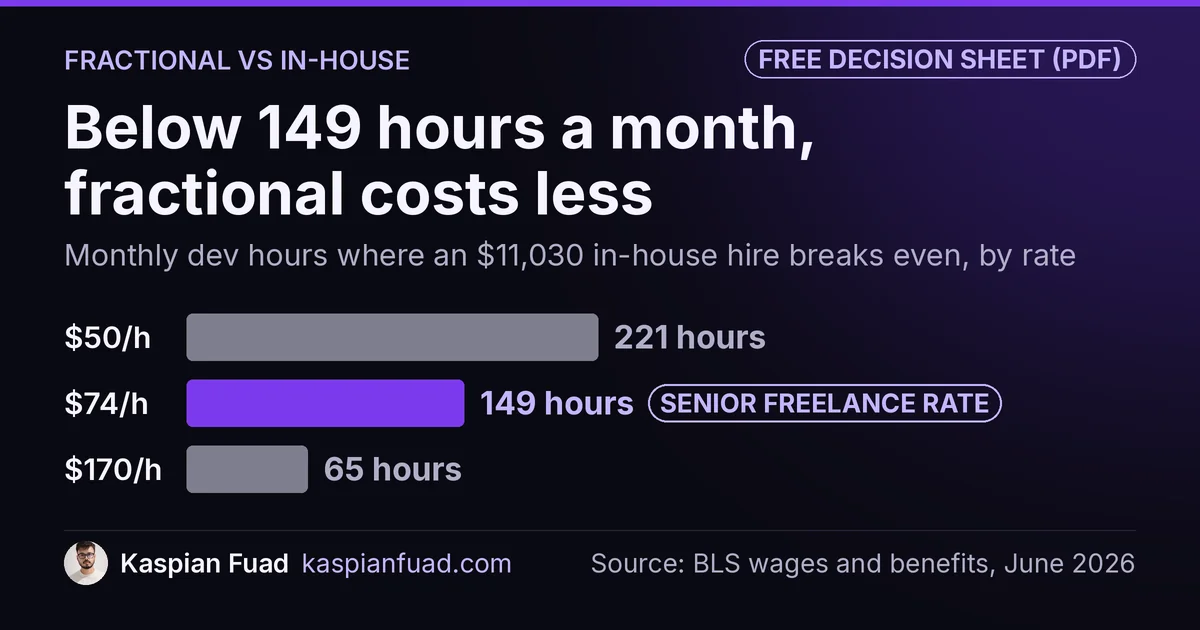
TL;DR: A full-time web developer costs about $11,030 a month once benefits are paid. At a senior freelance rate of $74 an hour, that buys 149 hours of fractional work. So if your Shopify backlog needs fewer than 149 hours every month, a fractional developer costs less. Above that, steadily, hire. My own monthly retainer books 60 to 80 hours.
Benefits add 43 cents to every wage dollar a US private employer pays. That is the Bureau of Labor Statistics average for June 2026, and it is the line that most hire-versus-fractional math leaves out.
This is for a Shopify owner whose developer bills keep growing and who is wondering if a salaried hire would be cheaper. Below is the cost of each option, the break-even hours at three common rates, and the four signals that say hire full-time anyway. One honest limit: I sell fractional work, so check my math against your own invoices, not my word.
Download the fractional vs in-house decision sheet (PDF)
Why this matters for your store
- Price the hire at total cost, not salary, or the comparison starts $39,700 short.
- Count the hours your store really uses, because idle salaried weeks still cost $2,545 each.
- Match the model to the work, since launch-heavy stores pay for slack they never use.
What does a full-time Shopify developer cost in 2026?
The BLS reports a median web developer salary of $92,650 for May 2025. There is no separate federal category for Shopify developers, so that is the most reliable US baseline. Senior Shopify Plus specialists sit above it.
Salary is only part of the bill. The BLS Employer Costs for Employee Compensation release puts private industry at $32.82 an hour in wages and $14.07 in benefits for June 2026. Benefits make up 30.0% of total compensation, which works out to 43% on top of salary.
Apply that to the median salary:
| Cost line | Per year | Per month |
|---|---|---|
| Median web developer salary | $92,650 | $7,721 |
| Benefits at the BLS private-industry average | $39,719 | $3,310 |
| All-in employer cost | $132,369 | $11,031 |
I round that to $11,030 a month below. It still leaves out recruiting fees, a laptop, software seats and the hours you spend managing someone. Those vary too much to average, but none of them are zero.
The full-time month gives you 173 paid hours (40 hours times 52 weeks, divided by 12). Paid holidays and leave come out of those, and the benefits line above already includes them.
What does a fractional Shopify developer cost?
A fractional developer works a fixed bank of hours on your store every month and keeps the context between tasks. A freelancer, by contrast, takes one project and leaves. The rate depends on who you hire.
Lemon.io’s 2026 rate data puts senior Shopify developers in North America at $48 to $74 an hour. US agency retainers I compared in my maintenance retainer cost breakdown work out to about $170 an hour effective. I bill $50 an hour, and my monthly retainer books 60 to 80 hours for $2,700 to $3,600.
So a store using 20 hours a month pays $1,000 at my rate, and a store using 80 pays about $4,000. Both are well under the $11,030 an in-house hire costs.
When does a full-time hire become cheaper?
Divide the all-in monthly cost by the fractional hourly rate. The answer is how many hours you must use, every month, before the salaried hire wins on price.
| Fractional rate | Who bills it | Break-even hours a month |
|---|---|---|
| $50 | My published rate | 221 |
| $74 | Senior North American freelancer, top of range | 149 |
| $170 | US agency retainer, effective | 65 |
At $50 an hour, the break-even is 221 hours, which is more than the 173 a full-time month contains. At that rate, fractional is cheaper per hour at any volume, so cost alone never decides it. At the top senior freelance rate, the line sits at 149 hours. Against an agency, a hire pays off at only 65.
The hours have to be steady. A store that needs 200 hours in November and 30 in February averages 115, and a salaried developer is paid for all 173 in both months.
My Shopify expert cost guide covers why seniority moves the total more than the rate does. A cheap hire who needs three attempts burns the same hours twice.
When should you hire full-time anyway?
Cost is one input. Four signals point to a salaried hire even when the hours sit below the line:
- Same-hour fixes. If a broken wholesale order form or a daily product drop needs someone inside the hour, in your timezone, a fractional developer with other clients cannot promise that.
- Custom software you own. A custom app, an ERP sync or a Hydrogen storefront is a system, and systems need an owner on call.
- Six months of steady backlog. One big launch is a project. A queue that refills every week for half a year is a job.
- Someone to manage them. A developer with no technical reviewer drifts. If nobody on your team can read a pull request, the hire carries more risk than the contract.
I have worked both sides. At Varsity Gripz I joined at day 0 as Founding Ecommerce Lead and owned Shopify end to end while the brand went from $0 to 7-figure revenue in under 12 months. That role made sense because launches, B2B and pricing changed weekly and someone had to own all of it.
When does a fractional developer beat a hire?
Most Shopify work comes in bursts: a sale, a theme update, a platform deadline. Shopify Scripts stopped running on June 30, 2026, and Plus stores with discount Scripts needed a Functions migration measured in tens of hours, then nothing. A salaried developer is paid through the quiet months after.
Fractional also buys range. One full-time hire rarely covers CRO, Core Web Vitals, Liquid and tracking equally well. A senior fractional developer has seen the same broken pattern on other stores and fixes it faster the second time.
Here is what a steady fractional engagement shipped on a UTV parts store on Shopify Plus. WD Electronics runs a weekly retainer with a fixed cadence: a cross-source audit, a prioritized sprint, a written recap every Friday. Eight sprints in, the 4-week rolling trend showed added-to-cart up 28% and reached-checkout up 30% on flat traffic. That is the shape fractional work should have: measured weekly, not billed and forgotten.
On Factory Direct Blinds, a retainer client, Phase 1 of a rebuilt product configurator shipped in 24 hours of focused work over 5 days. A new in-house hire would still be in onboarding.
What are the hidden risks of each model?
Each model fails in its own way:
- In-house: one person holds all the knowledge. If they leave, the store stalls until you hire again, and you pay recruiting a second time.
- In-house: idle weeks cost the same as busy ones, at about $2,545 a week all-in.
- Fractional: response time has a ceiling. Agree on it in writing, by severity, before the first invoice.
- Fractional: classification. The IRS says the key is the right to direct and control the worker. If you set someone’s hours and direct how they work, ask your accountant whether they are still a contractor.
Protect yourself the same way under either model. Give access through a collaborator account with only the permissions the work needs. Keep theme code in your own repository through Shopify’s GitHub integration, so the code stays with you when the person leaves.
How do you check which one your store needs in 5 minutes?
- Add up the developer hours on your last three months of invoices and divide by three.
- Divide $11,030 by the hourly rate you pay now. If your monthly average sits below that number, fractional is cheaper.
- Check the four signals above. Two or more yes answers make a hire worth pricing out even below the line.
Before you sign with anyone, run them through my questions to ask before hiring a Shopify developer. The same 12 questions work for a salaried candidate and a fractional one.
The takeaway
- Price a full-time developer at about $11,030 a month, not the salary.
- Divide that by the fractional rate to get your break-even hours.
- Stay fractional below the line unless you need same-hour fixes or own custom software.
- Hire when a steady queue fills the hours for six months or more.
- Keep code in your GitHub and access on a collaborator account either way.
I am Kaspian Fuad, a Shopify developer and CRO consultant who publishes his rates. If you are weighing a hire against a retainer, send me your last three months of dev work and I will tell you which side of the line you sit on.