

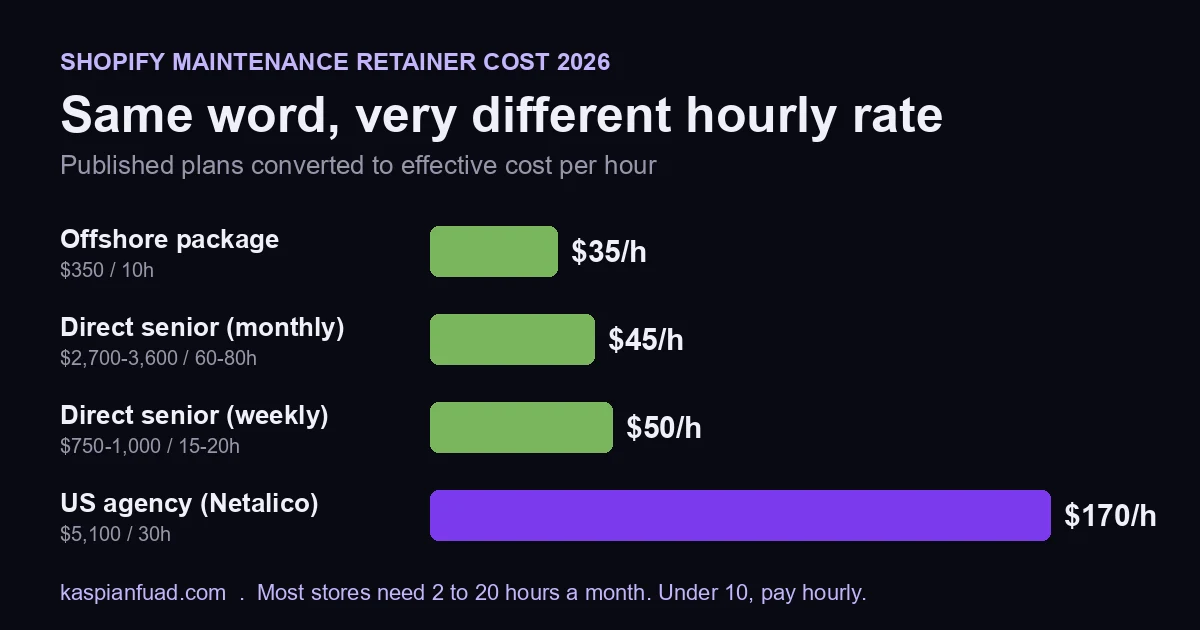
TL;DR: A Shopify maintenance retainer costs anywhere from $149 to $10,000 a month in 2026, and the headline price hides the only number that matters: the effective hourly rate. Published plans work out to about $35 an hour offshore, $45 to $50 for a direct senior developer, and about $170 at a US agency. Most stores need 2 to 20 hours a month. Under 10 hours, skip the retainer and pay hourly. The scope sheet is below.
I searched “shopify maintenance retainer cost” the way a store owner would. The first page sold plans from $149 to $10,000 a month. Same word, 67 times the price, and almost none of them say how many hours you get.
Then I asked ChatGPT the same question for a $2 million store. It recommended $3,000 to $4,500 a month for 15 to 25 hours. That is anywhere from $120 to $300 an hour, a spread wide enough to hide a bad deal in.
I sell retainers myself and publish the terms on my engagements page. So below is the math every quote should survive, including mine.
Why this matters for your store
- A $149 care plan often sells uptime checks and security patches that Shopify already runs for free, so you pay for zero hours of real work.
- An agency retainer at $170 an hour spends a 30-hour bank in about 4 working days, so scope creep ends the month early.
- One missed platform deadline in 2026 turned off checkout tracking on stores that ignored it, which means ad spend with no conversion data behind it.
What does Shopify already maintain for you?
Most maintenance plans are WordPress thinking sold to Shopify owners. On WordPress you patch the server, update the core, and pray the plugins agree. On Shopify, most of that is gone.
Shopify says it plainly: it is certified Level 1 PCI DSS compliant, and that compliance “extends by default to all stores powered by Shopify.” Hosting, SSL, uptime, the checkout, and platform security come with every plan. Nobody needs to “update Shopify core” for you.
So when a care plan lists uptime monitoring, security scans and server backups as the headline items, you are paying for work that does not exist on this platform. Here is what does exist, and what the hours actually go to:
- Theme updates. Shopify’s theme update docs say automated updates only fix bugs and security issues, uploaded themes do not get them at all, and during a manual update Shopify will warn you when “code edits could not be included.” Someone has to redo those edits on a duplicate theme.
- App conflicts and speed drift. Every app you install adds script weight. My app bloat report measures the blocking time app by app, and it adds up quietly over a year of installs.
- Dated platform changes. These are the real maintenance load, and 2026 had four with hard dates (below).
- Tracking. Pixels and GA4 events break silently when checkout or theme code changes. Nobody notices until the ad account does.
- Data backups. Shopify keeps a version history of theme code edits, but product, customer and content data is on you. A backup app like Rewind starts at $19 a month, which beats paying a retainer to “monitor” it.
What did Shopify maintenance actually involve in 2026?
This is the part that decides your hours. In 2026, Shopify shipped four changes with fixed dates that a maintained store had to act on:
| Date (2026) | Change | What broke if ignored |
|---|---|---|
| June 17 | Customer accounts redesign | Account and order page customizations, retention links |
| June 22 | Default subscription disclosure | Subscription wording at checkout changed for uncustomized stores |
| June 30 | Shopify Scripts shut off | Line item, shipping and payment Scripts stopped running on Plus |
| August 26 | Additional scripts stop on non-Plus | Thank-you page pixels and GA4 purchase tracking |
A store with no custom checkout code and no subscriptions sailed through most of these. A Plus store with Scripts, a subscription app and five ad pixels needed a real migration, measured in tens of hours.
That is the honest answer to “how much maintenance do I need”: it depends on how much of your store is custom, not on your revenue line.
How much does a Shopify maintenance retainer cost per month?
Here are published prices I verified on the providers’ own pages this week, converted to the number a quote rarely shows you: cost per hour.
| Provider type | Published plan | Hours included | Effective hourly |
|---|---|---|---|
| Care plan (WebCare Studios) | from $149/mo | Not in the listing | Unknown |
| Offshore package (Webkul Standard) | $350/mo | Up to 10, unused hours lapse | $35 |
| Direct senior developer (my monthly retainer) | $2,700 to $3,600/mo | 60 to 80, 25% rollover | $45 |
| Direct senior developer (my weekly retainer) | $750 to $1,000/wk | 15 to 20 | $50 |
| US agency (Netalico Essential) | $5,100/mo | 30 | $170 |
| US agency (Netalico Enterprise) | $10,000/mo | 60 | $167 |
Netalico says its retainers “run $2,700 to $10,000 per month,” aimed at $2 million to $50 million brands, mostly on Plus. That is a fair price for an agency team with project managers and integration specialists. It is also 3 to 4 times the hourly rate of a senior developer working direct.
The $149 plan is the one to question hardest. With no stated hours, you cannot tell whether a broken cart drawer is included or billed extra. Ask before you sign.
How many hours does my store actually need?
Size it by change rate. This is the rule I use when a new store asks me to quote maintenance:
| Store profile | Typical hours/month | What I would buy |
|---|---|---|
| Stable theme, under 10 apps, few promos | 2 to 5 | No retainer. Hourly as needed, plus a $19 backup app |
| Weekly promos, 15 to 30 apps, some custom sections | 10 to 20 | Small retainer or weekly blocks |
| Plus, custom integrations, subscriptions, active CRO | 30 to 80 | Monthly retainer with locked rate and rollover |
The cost of 15 hours a month shows how much the rate matters: about $525 on an offshore package with overage, $750 at my $50 rate, and roughly $2,550 at an agency’s $170.
Here is the contrarian part. Most stores under $1 million do not need a maintenance retainer at all. They need a developer they trust, a backup app, and a calendar reminder to check Shopify’s changelog before each deadline. A retainer earns its price when you use it, and 3 unused hours a month at a lapse-policy vendor is money gone.
What should a Shopify maintenance retainer include?
Get these written into the agreement, not promised on the call:
- Duplicate-theme rule. Every change ships on a copy first, never on the live theme. Shopify’s duplicating themes guide makes this free, so there is no excuse.
- Response time in hours. “Priority support” means nothing. “Checkout-down issues answered within 4 business hours” means something.
- Rollover terms. Webkul’s hours lapse monthly. Mine roll 25% forward, capped at 20 hours. Know which one you are buying.
- Collaborator access, not your password. A developer should request access through Shopify’s collaborator accounts with a request code you control.
- A monthly written report. What shipped, hours used, what is next, and one number that moved.
- Notice period and code ownership. Mine is 30 days notice. Get in writing that the theme code belongs to you.
- Clear exclusions. Ad management, copywriting and design from scratch are usually out. If they are in, the price should say so.
Also ask how they keep maintenance from slowing the store. Shopify publishes its own theme performance best practices. A good developer measures blocking time before and after a change, not just “it works.”
Can a maintenance retainer grow the store, or only keep it running?
The best retainers do both, and that is where the money is. Keeping the lights on is the floor.
On Factory Direct Blinds, a multi-sprint retainer over four months took mobile PageSpeed from 38 to 81, rebuilt a 6,221-line product builder, and ran a Search Console recovery audit. None of that was “maintenance” on a care-plan checklist, but it came out of the same monthly hours.
On WD Electronics, a Shopify Plus store on my weekly retainer, reached-checkout rose 30% on a 4-week rolling funnel while cart layout shift fell from 0.488 to 0.001. The weekly cadence is what made it compound: audit, ship, measure, repeat.
If your retainer has run six months and you cannot name one number that moved, you are paying for a help desk. That can be fine. Just price it like one.
What are the red flags in a Shopify maintenance quote?
Walk away, or push back hard, if you see any of these:
- No hours stated, only “unlimited small tasks.” Someone decides what “small” means, and it is not you.
- Uptime and security monitoring as the lead feature, on a platform that already provides both.
- Edits made on the live theme “to save time.”
- A 12-month lock-in with no notice clause.
- No mention of platform deadlines. In 2026 there were four. A maintainer who did not bring them up first was not maintaining.
For a broader view of rates beyond maintenance, see what a Shopify expert costs, and for growth-focused monthly work, what a Shopify CRO retainer costs.
Get the maintenance retainer scope sheet
The one-page PDF has the hours sizing table, the effective-rate math, the seven contract terms, the red flags, and a monthly maintenance checklist you can hand to any developer.
Download the Shopify maintenance retainer scope sheet (PDF)
How do I check my current retainer in 5 minutes?
- Divide last month’s invoice by the hours in the report. If you cannot, the report is missing the one number you need.
- Open Online Store, Themes, and check whether your theme shows an available update. If it has sat there for months, nobody is maintaining it.
- Ask your developer what they did for the August 26 additional-scripts deadline. The answer tells you whether they watch the platform or wait for tickets.
If the numbers do not hold up, book a free 30-minute call and I will tell you how many hours your store really needs, even if the answer is “fewer than you are paying for.”
The takeaway
- Convert every maintenance quote to an effective hourly rate before comparing plans.
- Skip plans that lead with hosting, uptime or security, because Shopify already provides them.
- Size the retainer by how often your store changes, and pay hourly below 10 hours a month.
- Demand rollover terms, response times in hours, and a duplicate-theme rule in writing.
- Judge a retainer by one number that moved each quarter, not by tickets closed.
Kaspian Fuad is a Shopify developer and CRO specialist with 12 years and 100+ stores behind him. He publishes his rates and retainer terms on kaspianfuad.com.