

TL;DR: A Shopify SEO consultant costs $75 to $200 an hour at most providers, per an Ahrefs survey of 439 of them, and the most common retainer is just $501 to $1,000 a month. Hire someone who edits Liquid, not someone who sends reports. Demand Search Console access on day one, a URL-level fix list, and no ranking guarantees.
On a US custom blinds store I audited, an earlier SEO decision had noindexed two core collection pages to “consolidate ranking power.” The rankings did not move to the sibling pages. They left.
That is the real risk in this hire, and it costs more than the retainer. This guide is for a Shopify brand deciding whether to bring in SEO help: what the work should cost, what to demand on day one, and the questions that screen out consultants who only send reports.
Download the Shopify SEO consultant hiring scorecard (PDF)
Why this matters for your store
- A wrong SEO call on a collection page removes it from Google, so the hire can cost you revenue, not just the fee.
- Most Shopify ranking problems live in theme code, so a consultant who cannot edit Liquid hands you a report you then pay a developer to implement.
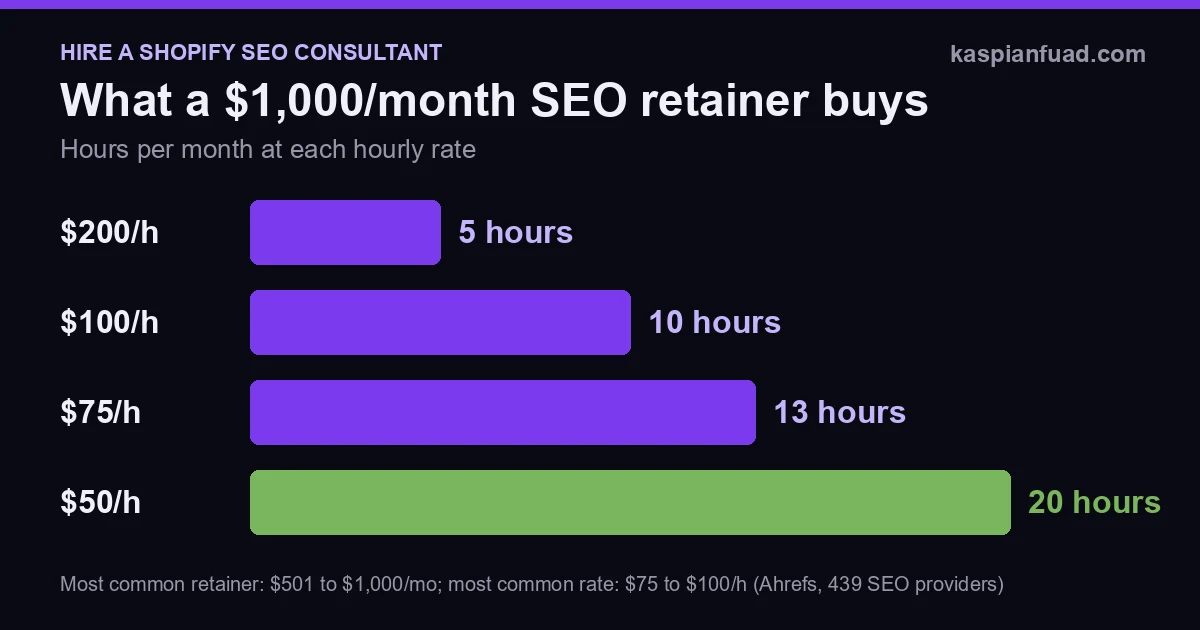
- The most common retainer buys roughly 5 to 13 hours a month, which is not enough to fix anything and report on it too.
How much does a Shopify SEO consultant cost in 2026?
The best public pricing data is old but large. Ahrefs polled 439 SEO service providers (the page was last updated in August 2024). Here is what they found, next to what I charge:
| Pricing model | Most common price | Share of providers | What it usually buys |
|---|---|---|---|
| Hourly | $75 to $100 an hour | 24% (47% charge $75 to $200) | Advice, audits, calls |
| Monthly retainer | $501 to $1,000 a month | 20.4% | Reporting plus a few fixes or posts |
| Per project | $2,501 to $5,000 | 21.2% | One audit or one migration review |
| Me | $50 an hour, $2,700 to $3,600 a month | n/a | 60 to 80 hours a month, including the code fixes |
None of that is Shopify-specific. A general SEO quote assumes your developer will implement the findings, so add developer hours on top. I break down Shopify developer rates in what a Shopify expert costs.
What does $1,000 a month actually buy?
Do the division before you sign. At the most common hourly rate of $75 to $100, a $1,000 retainer buys 10 to 13 hours a month. At $200 an hour it buys five. A monthly report, a Search Console review and a call can eat most of that.
This is the 30% point of the whole decision. A cheap retainer is fine for monitoring a healthy store. It is the wrong tool for a store with a real problem, because the hours run out before any theme file changes.
I bill $50 an hour and keep the same rate for SEO, CRO and build work. A monthly retainer books 60 to 80 hours for $2,700 to $3,600, and those hours include shipping the fixes in your theme. The full rate card sits on my services page.
What should a Shopify SEO consultant fix that a generic SEO cannot?
Shopify handles a lot for you. Its sitemap documentation says sitemap files “are generated automatically” and update when you add products, collections or posts. So anyone selling you “sitemap setup” is selling you nothing.
The real Shopify SEO work sits in places a generic SEO rarely touches:
- Collection-scoped product URLs. Themes link to
/collections/rings/products/ringalongside the canonical/products/ring. On Enea Studio, fixing the product card snippet removed 25,285 duplicate internal links across 191 collection pages. My canonical and duplicate URL guide shows the Liquid change. - Filter and sort URLs. Parameter pages like
?sort_by=and?filter.p.product_type=can multiply into thousands of crawlable URLs with nonoindex. - robots.txt.liquid. Shopify’s robots.txt docs say the default “works for most stores” and tell you to save a copy of your current output before you publish changes. A consultant who edits it casually can block a whole section of the store.
- Dead URLs from removed apps. On the blinds store, 28% of spot-checked redirects were broken and the export came to 348 URLs to fix, including two trust pages returning 404. Shopify’s URL redirect feature only works on paths that are already broken.
- Schema in Liquid. Product, FAQPage and Organization JSON-LD live in theme templates, and a broken field silently drops rich results.
Every item on that list is a theme or admin change. That is the hiring filter: ask who ships the fix.
Why do cheap SEO retainers make Shopify stores worse?
Most SEO advice says a bad consultant just wastes your money. On Shopify, a bad consultant can actively remove pages from Google.
The 70% organic traffic drop I audited had five causes. Two were self-inflicted, including the noindexed collections. The store also had 232 pages stuck in “Crawled, currently not indexed,” which no amount of resubmitting fixes. That status needs content and internal links, page by page, which I walk through in the crawled not indexed fix.
A retainer that bills for monthly blog posts while those pages sit unindexed is busy, not useful.
How do I tell a good Shopify SEO consultant from a bad one?
Start with Google’s own list. Its guidance on hiring an SEO suggests asking for examples of previous work, whether they follow Google Search Essentials, and how they measure success. It also warns plainly:
“No one can guarantee a #1 ranking on Google.”
Then add five Shopify questions Google does not ask:
- Can you show me a theme commit or a Liquid diff from an SEO fix you shipped?
- How do you handle collection-scoped product URLs on my theme?
- What would you change in
robots.txt.liquid, and what would you leave alone? - Which of my pages are already earning clicks, and how will you protect them?
- What do you need from Search Console in week one?
The good answer to the last one is specific: access to the Performance and Page indexing reports, sorted by lost clicks. My hiring questions for Shopify developers cover the code side of the same vetting.
Which red flags should end the call?
Walk away from four pitches. A guaranteed top ranking, which Google itself says no one can promise. An offer to buy links, which Google’s spam policies list as link spam (“Buying or selling links for ranking purposes”). A plan that starts by rewriting your best-performing pages. And any proposal that never asks for Search Console access.
One more, softer: a report built around Domain Authority alone. On the blinds store, DA sat at 38 against competitors at 39 to 44. The scores looked close. The backlink counts did not: about 1,500 links against 6,000+.
What results should I expect, and how fast?
Fast wins come from pages already on page two. On WD Electronics, a Shopify Plus store, rewriting three collection titles moved one page from position 13.4 to 6.95 in 7 days. Over a 4-week window, Search Console clicks rose 18% and impressions 29%.
The blinds store had the same kind of upside waiting: 186 keywords at positions 11 to 20, with 2.69 million combined impressions. Each one that moves up is new traffic.
Slow wins are index recovery and links. Google recrawls on its own schedule, and no theme fix closes a 4x backlink gap. A consultant who explains which bucket each fix sits in is giving you an honest forecast.
Should I hire a consultant, an agency, or a freelancer on a platform?
Hire a consultant who edits code when your problems are technical: indexing, duplicates, schema, speed. That covers most Shopify stores between $500K and $10M a year. Hire an agency when you also need a content team or a monthly digital PR program, which a solo consultant cannot staff. The same tradeoff applies to CRO, and I lay out the numbers in agency vs freelancer.
Marketplaces like Upwork and Fiverr work for a defined, small task. They are a weak fit for a diagnosis, because the cheapest gig rarely includes the Search Console analysis that finds the cause.
How to check your store in 10 minutes before you hire anyone
- In Search Console, open Page indexing and write down the counts for “Crawled, currently not indexed” and “Not found (404).”
- Paste your store into the free robots and crawler checker, then run a product URL through the schema validator.
- Open Performance, filter to positions 11 to 20, and count the queries with real impressions.
Bring those three numbers to every sales call. A good consultant will tell you which one to fix first and why. A weak one will pitch the same package regardless.
The takeaway
- Divide any retainer by the hourly rate before you sign, and ask what those hours ship.
- Hire someone who edits Liquid, because Shopify SEO fixes live in the theme.
- Demand Search Console access in week one and a fix list at the URL level.
- Reject ranking guarantees and link buying on the first call.
- Protect the pages already earning clicks before anyone touches the rest.
I am Kaspian Fuad, a Shopify developer and CRO consultant who ships SEO fixes in the theme myself. If your organic traffic is flat or falling, send me your store URL and your three numbers from the check above, and I will tell you which one to fix first.