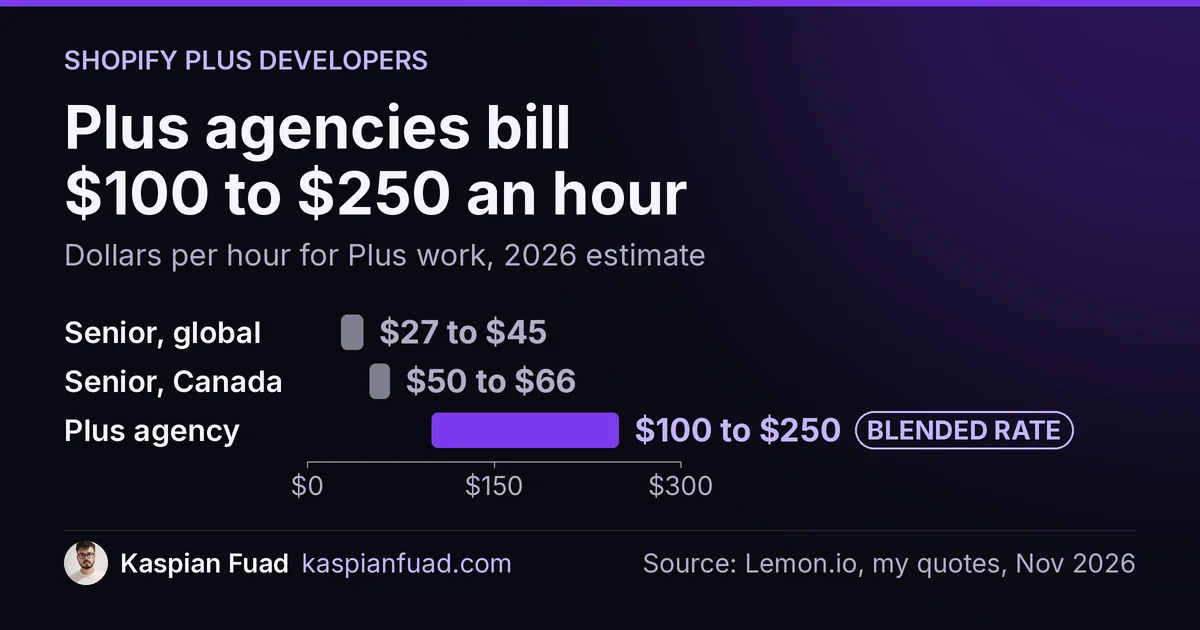
TL;DR: A Shopify Plus developer earns a Plus price on four jobs: custom apps with Shopify Functions, checkout steps, per-company B2B catalogs and expansion stores. Everything else on a Plus store is normal Shopify work. Plus agencies bill about $100 to $250 an hour, while senior freelancers mostly bill $27 to $66. Hire for the job, not the plan.
The best funnel gains on a Shopify Plus store I work on came from code that runs on every Shopify plan. On WD Electronics, a UTV parts store on Plus, added-to-cart rose 28% and reached-checkout rose 30% on roughly flat traffic, from theme, cart and speed fixes.
This is for a brand doing $1M to $10M that just moved to Plus, or is about to, and is now collecting quotes from “Shopify Plus agencies.” Below is the short list of work that really needs Plus skills, what it costs by the hour and by the job, and five questions that show whether someone has built it. One honest limit: none of this tells you whether Plus itself is worth $2,300 a month for your store.
Download the Shopify Plus developer hiring scorecard (PDF)
Why this matters for your store
- Paying a $150 agency rate for theme work a $50 to $66 senior freelancer ships can triple that part of your budget.
- A developer who has never built a checkout extension learns on your checkout, the one page every order passes through.
- Shopify Scripts stopped running on June 30, 2026, so a skipped migration shows up as wrong tiered discounts and shipping rates.
What does a Shopify Plus developer do that a regular developer can’t?
Four kinds of work. Plus opens parts of the platform that other plans can’t touch, and those are the only parts where Plus experience changes the result. Shopify’s docs say only Plus stores can use custom apps that contain Function APIs, and that checkout UI extensions for the information, shipping and payment steps are Plus-only.
| Job | Plus only? | What it looks like on a real store |
|---|---|---|
| Custom app with a Shopify Function | Yes | Tiered discounts, hiding a payment method, blocking a cart that breaks a rule |
| Checkout UI extension on information, shipping or payment | Yes | A delivery notes field, a PO number, a required confirmation before payment |
| B2B with a catalog per company | Yes | A price list per account, deposits and partial payments |
| Expansion stores | Yes, up to 9 included | A wholesale store or a second region on the same plan |
| Theme, speed and CRO work | No | Sections, Core Web Vitals, product page and cart tests |
| App setup and integrations | No | Klaviyo, reviews, subscriptions, analytics |
The expansion store count comes from Shopify’s Plus pricing page, which lists up to 9 free expansion stores. The B2B row narrowed this year. Since April 2026, Basic, Grow and Advanced include native B2B with up to 3 catalogs, so only per-company catalogs and deposits still need Plus. I cover that split in how to hire a Shopify B2B developer.
Scripts are the other piece. Shopify says Scripts and the Script Editor were retired on June 30, 2026 and no longer run on any store. Any rule your old Scripts handled is now a Function job, and that’s Plus work.
Does every Plus store need a Plus developer?
No. Most hours on a Plus store go to the theme, the product page, the cart and speed, and that’s the same Liquid on every plan. A Plus badge on a proposal tells you nothing about how well someone writes it.
WD Electronics shows the pattern. The work started as an audit and became a weekly retainer. Two months in, a server-rendered free shipping bar plus a reserved cart height took cart CLS from 0.488 to 0.001, and mobile LCP held at 0.736 seconds.
Those gains came from the storefront a shopper sees before checkout. A senior Shopify developer on a Basic store would have written the same code.
The test I use is simple. If the job touches checkout logic, a Function or a second store, it’s Plus work. If it touches what a shopper sees before checkout, it isn’t, and you shouldn’t pay a Plus premium for it.
What does a Shopify Plus developer cost in 2026?
Lemon.io’s Q3 2026 rate data puts the senior Shopify median at $35 an hour, with the middle 50% between $27 and $45. The US senior median is $58, and Canada runs $50 to $66. In my experience, Plus agencies bill about $100 to $250 an hour blended, because that rate also covers account managers and junior developers.
I bill $50 an hour, and I break the market down further in what a Shopify expert costs. The hourly rate matters less than the hours, so price the job:
| Plus job | Hours (my estimate) | At $50/h | At $150/h |
|---|---|---|---|
| Extension-only app: a checkout UI extension or a Function, no server | 10 to 40 | $500 to $2,000 | $1,500 to $6,000 |
| B2B setup plus a server-side gate, no ERP | 25 to 80 | $1,250 to $4,000 | $3,750 to $12,000 |
| Server-backed custom app | 60 to 150 | $3,000 to $7,500 | $9,000 to $22,500 |
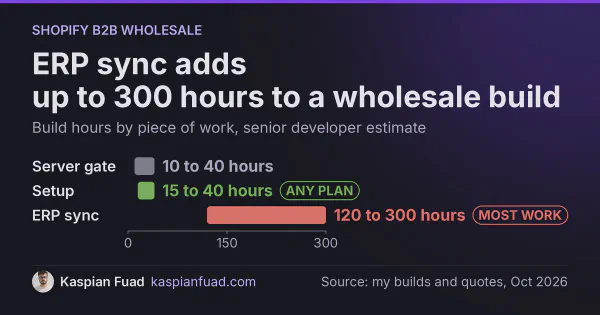
| Two-way ERP or 3PL sync | 120 to 300 | $6,000 to $15,000 | $18,000 to $45,000 |
These are scoping estimates for a store doing $1M to $10M, not quotes. The line-item hours behind an ERP sync are in my custom Shopify app development cost breakdown.
Ask any Plus quote which row the money is in. A $20,000 proposal with no ERP sync and no server is mostly design, meetings and theme work.
What does real Shopify Plus work look like?
The clearest example I have is a regulated UK aesthetics and pharmacy group. I built it solo on Plus: three storefronts on one design system, three custom apps across five extensions, and a B2B gate with six layers.
Five of those layers lived in the theme, and a cart permalink could walk around all five. Only the sixth, a cart and checkout validation Function, couldn’t be bypassed. That’s the Plus skill in one sentence: knowing which controls are cosmetic and which run on Shopify’s servers.
The first version of that Function also taught me something. It gated a fixed list of product types and silently let everything else through, so I flipped it to fail closed: unknown means gated. The full build is in the Shopify Plus B2B case study.
How do you vet a Shopify Plus developer?
Ask for proof of Plus work, not a Plus badge. The five questions below take about ten minutes on a first call, and each one has an answer that separates someone who has shipped checkout extensions and Functions from someone who has only read about them. Then decide who carries the on-call risk, and check the quote line by line.
Five questions for the first call
- “Show me a checkout UI extension you shipped. Which target did it render on?” You want a named target, such as the delivery address step, and code or a live checkout to back it.
- “What replaced our Scripts, or what would you use?” You want Function types by name: Discount, Payment Customization or Delivery Customization.
- “A shopper posts a gated variant ID to /cart/add. What stops them?” You want a server-side control: a validation Function or a B2B catalog. “We hide the button” ends the call.
- “Will you fork our theme?” You want new files under their own prefix and a written list of any core edits, so the theme stays upgradeable.
- “What in this build runs on a server, and who pays to host it?” You want as little as possible. An extension-only app has no hosting bill and nothing to patch.
For the general vetting list, covering code ownership, staging and handover, use my 12 questions to ask before hiring a Shopify developer.
Freelancer, agency or in-house?
Hire a senior freelancer for extensions, Functions and theme work. Those are focused jobs measured in tens of hours, and one person who writes the code ships them faster than a team with handoffs.
Hire an agency, or a freelancer who names a backup in writing, when the build includes an ERP sync or several expansion stores. When an order sync fails on a Saturday, someone has to answer. An in-house developer makes sense only with a full-time roadmap, since one costs about $11,030 a month all-in.
Check a Plus quote in 5 minutes
- Mark each line of the quote Plus or not Plus, using the table above.
- Price the not-Plus lines at a senior freelancer rate and compare.
- Ask for one shipped checkout extension or Function before you sign.
The takeaway
- Split every Plus proposal into Plus-only jobs and normal Shopify work before you compare prices.
- Pay a Plus premium only for Functions, checkout steps, per-company B2B catalogs and expansion stores.
- Budget 10 to 40 hours for an extension-only app and 120 to 300 for an ERP sync.
- Ask what stops a /cart/add request, and hire the person who names a server-side control.
- Request one shipped extension as proof, because a Plus badge isn’t proof of Plus work.
Print the scorecard above and score each candidate on the call. If you want a senior developer for the Plus jobs and the storefront work, see how I work and what I charge.
Kaspian Fuad is a Shopify developer and CRO consultant who builds checkout extensions, Shopify Functions and custom apps for Shopify Plus brands.