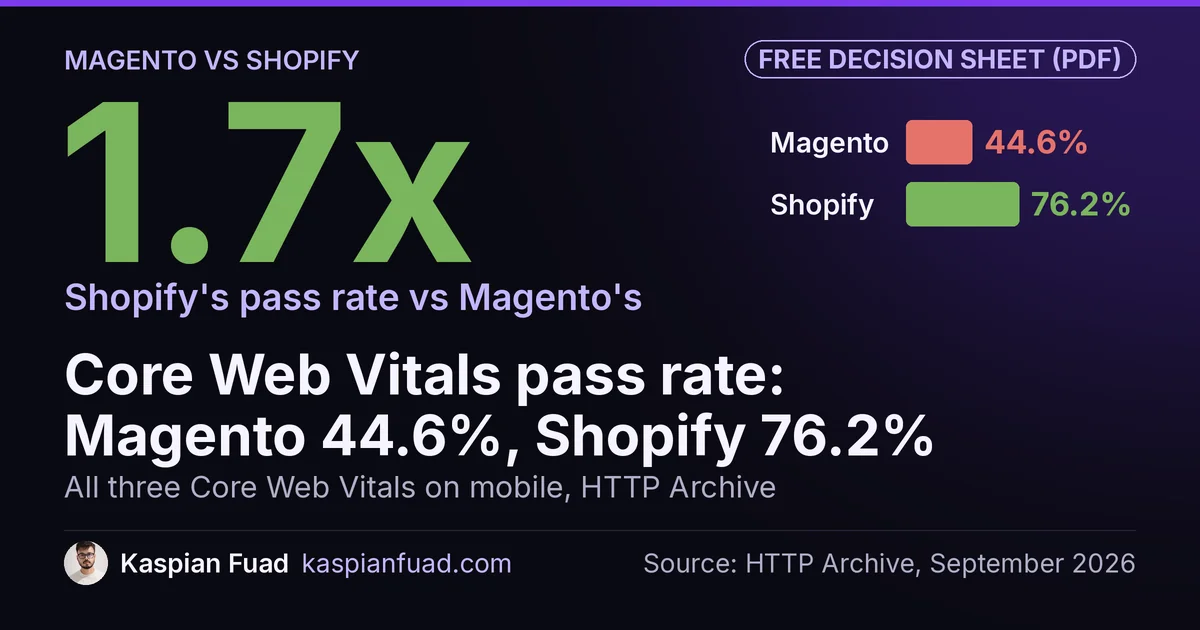
Only 44.6% of Magento sites pass Google’s Core Web Vitals on mobile. For Shopify it’s 76.2%. That’s HTTP Archive’s September 2026 data, and there’s a second number owners miss: Magento 2.4.6 left Adobe’s regular support on 11 August 2026.
I work on both sides of Magento vs Shopify. I audit and fix Magento 2.4 stores, I’ve run a 100,000+ SKU Magento catalog day to day since 2021, and most of my week is Shopify. If your store is stuck and the old agency is gone, I work as a Magento consultant and developer on exactly that.
TL;DR: Magento is free to license but expensive to run: hosting, patches and developers who know it. Shopify costs $39 to $399 a month on standard plans and handles hosting, security and checkout. Stay on Magento for complex B2B and catalogs; move if your store is standard and the upkeep outweighs the payoff.
Download the Magento vs Shopify decision sheet (PDF)
What’s the real difference between Magento and Shopify?
Who carries the platform. Magento Open Source is free software under the OSL 3.0 license: you, or your agency, run the servers, apply Adobe’s patches, keep extensions compatible and deploy every change. Shopify is hosted: the plan includes hosting, SSL, PCI compliance and the checkout, and Shopify patches the platform itself.
That’s why Magento stores feel heavy when the agency leaves. The software still works, but nobody owns the patch level, the extensions or the custom modules the old team wrote. Shopify has its own lock-in (apps and plan fees), but there’s no server for you to keep alive. Magento gives you the source code, so almost anything is possible; you pay for that freedom every time something has to change.
When does each Magento version lose support?
No. Adobe still ships it: Magento 2.4.9 arrived on 12 May 2026 with 580 core fixes. What expires is each version, about three years after release:
| Version | Released | End of standard support |
|---|---|---|
| 2.4.4 | 12 Apr 2022 | 12 Apr 2025 |
| 2.4.5 | 9 Aug 2022 | 12 Aug 2025 |
| 2.4.6 | 14 Mar 2023 | 11 Aug 2026 |
| 2.4.7 | 9 Apr 2024 | 31 May 2027 |
| 2.4.8 | 8 Apr 2025 | 31 May 2028 |
| 2.4.9 | 12 May 2026 | 31 May 2029 |
What the dates mean for your store
Adobe Commerce customers get extra time on some versions, but Adobe’s lifecycle policy ties Magento Open Source support to the end of regular support. So if your store runs 2.4.6 or older today, it’s outside Adobe’s regular fixes, and the real decision is upgrade or move, not “do nothing”.
An upgrade across several minor versions rarely touches Magento alone. Each release supports newer PHP versions (2.4.7 runs on PHP 8.2 and 8.3), so the server, every extension and every custom module has to move with it. That’s where stuck stores burn their budget: the quote looks like one upgrade and turns into four projects. Before you pay for either path, get the exact version, patch level and extension list on paper.
How much does Magento cost vs Shopify?
The license is the small part on both. The running costs:
Fixed costs side by side
| Cost | Magento | Shopify |
|---|---|---|
| License or plan | $0 | $39 Basic, $105 Grow, $399 Advanced, Plus from $2,300 |
| Hosting | Entry managed plans: $74 (Liquid Web), EUR 129 (Hypernode), EUR 149 (MGT-Commerce) | Included |
| Security patches | Your developer applies them | Included |
| Checkout | Yours to maintain | Included, Shopify Payments 2.9% + 30¢ on Basic |
| Developer time | The biggest line: upgrades, extensions, fixes | Theme and app work only |
Adobe Commerce, Hyvä and the Shopify extras
Adobe Commerce, the paid edition, is licensed on revenue and order tiers, and Adobe’s pricing page shows no figures, only “Get pricing”. One cost fell recently: the Hyvä theme, the fast Magento front end, has been free and open source since November 2025, while Hyvä Checkout still costs EUR 1,000 once. If speed is your main complaint, a faster front end on the Magento you already own can cost far less than a full move, so price both before you decide.
On Shopify the hidden cost is apps and, if you skip Shopify Payments, a 2% fee per order on Basic. I break those down in WooCommerce vs Shopify, and the same plan math applies here.
Is Shopify faster than Magento?
On average, by a wide margin. HTTP Archive, September 2026, mobile:
| Mobile, Sep 2026 | Shopify | Magento |
|---|---|---|
| Passed all three Core Web Vitals | 76.2% (339,538 of 445,297) | 44.6% (14,408 of 32,325) |
| Good loading speed (LCP) | 87.7% | 58.1% |
For context, WooCommerce sites pass at 39.3%, so Magento sits between the two.
The 2025 Web Almanac puts Magento’s median mobile Lighthouse score at 34. Most of that is fixable: cache misses, third-party scripts and extensions doing work on every page. On one Magento audit I traced slow pages to ad tracking links that skipped the full page cache entirely. Measure your real-user numbers first, because lab scores and field data often disagree.
Can Shopify handle B2B like Magento now?
Mostly, and most comparison pages are out of date on this. On 2 April 2026 Shopify opened native B2B to the Basic, Grow and Advanced plans. Limits worth knowing:
- Non-Plus plans are capped at 3 active B2B catalogs. Company-specific catalogs, deposits and partial payments need Plus.
- A Shopify product can have 2,048 variants and 3 options. Magento’s configurable and custom-option products go further.
Read the plan feature table before you price a move: whether your B2B setup needs Plus or not moves the list price from $399 a month on Advanced to $2,300 on Plus.
Magento still wins on deep B2B: customer groups with their own pricing rules, quote workflows and ERP integrations built into the catalog. If that’s your business, fixing Magento usually beats moving.
When should you stay on Magento?
Stay when:
- B2B pricing is complex. Many customer groups, contract prices and quote-based orders.
- The catalog is large or heavily configured. Magento ranks second among the top 1,000 ecommerce sites in the 2025 Web Almanac for a reason.
- ERP or warehouse links run through Magento. Rebuilding them on Shopify is often the most expensive part of a move.
Move when the catalog is standard, the store is on 2.4.6 or older, and the next upgrade quote is bigger than a year of Shopify. Magento now runs about 2% of ecommerce sites, against 21.5% for Shopify in the same Web Almanac data. If you do move, the redirect map decides whether you keep your rankings, and it works the same way as in my WooCommerce to Shopify migration guide.
How do you decide in 10 minutes?
- Which Magento version are you on? Check the admin footer. 2.4.6 or older: you’re out of regular support.
- Who holds the server, Git and admin access? If nobody knows, that’s the first fix, whatever you decide.
- How much of your revenue needs B2B rules Shopify can’t do? Under a few accounts: Shopify B2B likely covers it.
- What did your last upgrade or fix cost? Compare a year of that with a year of Shopify plus apps.
- What’s your mobile Core Web Vitals status in Search Console? Failing after a speed pass: the platform and its extensions are part of the problem.
The takeaway
- Magento isn’t dead, but 2.4.6 and older are out of regular support, so stuck stores face an upgrade or a move.
- Shopify sites pass Core Web Vitals far more often: 76.2% against 44.6% for Magento on mobile.
- Shopify B2B reached non-Plus plans on 2 April 2026, with a 3-catalog cap below Plus.
- Magento’s real cost is hosting and developer time, not the free license.
- Stay for complex B2B and catalogs; move when the store is standard and the upkeep outweighs the payoff.
I’m Kaspian Fuad. I audit and fix Magento 2 stores and build on Shopify, so I don’t need you to pick a side. If your Magento store is stuck, book a free 30 minute call.