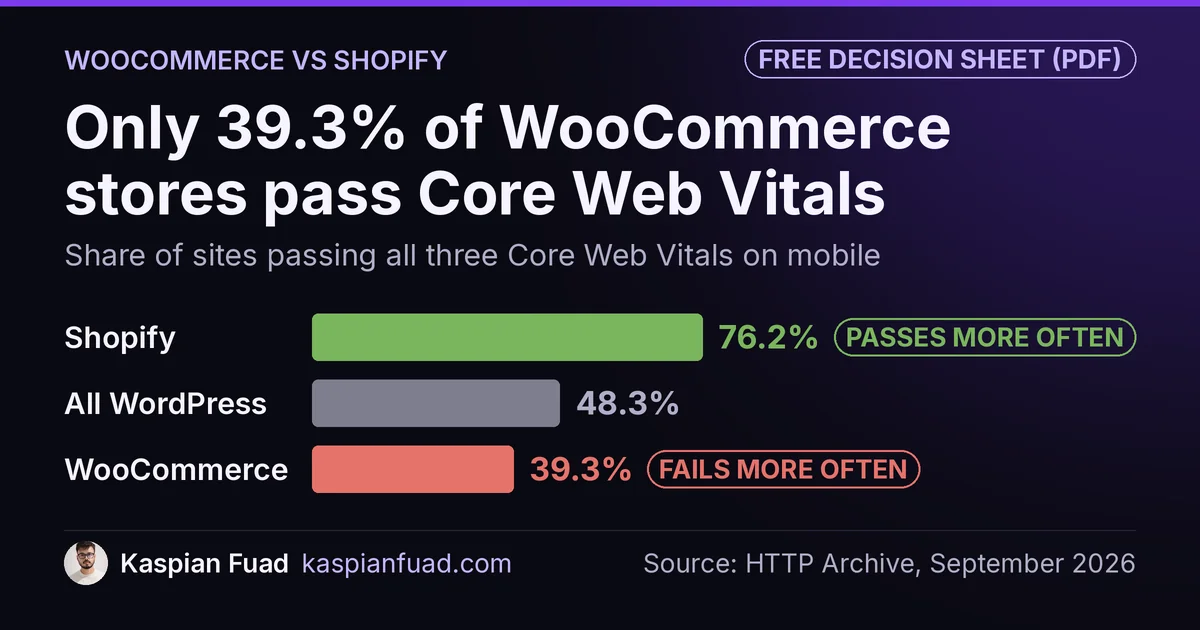
Only 39.3% of WooCommerce stores pass Google’s Core Web Vitals on mobile. For Shopify stores it’s 76.2%. That’s HTTP Archive’s September 2026 data across nearly a million live stores, and it says more about this choice than any feature table.
I build on both. Most of my week is Shopify, and my latest WordPress build, a custom block theme from Canva designs, scores 98 on mobile PageSpeed. So this isn’t a pitch for one side of the Shopify vs WooCommerce debate. If you’re weighing the move or want WordPress work done properly, here’s how I work on WordPress.
TL;DR: Card fees are the same on both (2.9% + 30¢ on Shopify Basic and on WooPayments), so the real difference is plan fee vs hosting, plugins and upkeep. For a $40,000-a-month store, Shopify Basic comes out about $126 a month cheaper in my worked example below, and Shopify sites pass Core Web Vitals about twice as often. WooCommerce still wins for content-led sites and stores that need full control.
Download the WooCommerce vs Shopify decision sheet (PDF)
What’s the real difference between WooCommerce and Shopify?
Who does the upkeep. Shopify is a hosted platform: hosting, SSL, PCI compliance and the checkout come with the plan, and Shopify’s engineers keep them running. WooCommerce is a free plugin that turns a WordPress site into a store, and everything around it is yours: the host, the updates, the backups and the security.
WooCommerce says so plainly. Its own self-service guide tells you to back up the whole site and update third-party plugins before updating WooCommerce, and its support doesn’t cover those plugins. That’s not a flaw. It’s the deal you sign up for in exchange for control.
How much does WooCommerce cost vs Shopify per month?
Here’s a store doing $40,000 a month online: 500 orders at an $80 average, US cards, one subscription product and one bundle. Prices are the US list prices on 8 November 2026.
| Cost | WooCommerce | Shopify Basic | Shopify Grow |
|---|---|---|---|
| Plan or hosting | $35 | $39 | $105 |
| Card fees | $1,310 | $1,310 | $1,230 |
| Subs and bundles | $30 | $0 | $0 |
| Upkeep | $100 | In plan | In plan |
| Total | $1,475 | $1,349 | $1,335 |
WooCommerce hosting is Kinsta’s entry managed plan, cards run through WooPayments at 2.9% + 30¢, Subscriptions ($279/yr) plus Product Bundles ($79/yr) come to $30 a month, and upkeep is 2 hours at $50 (my estimate). Shopify Payments charges 2.9% + 30¢ on Basic and 2.7% + 30¢ on Grow, and subscriptions and bundles use Shopify’s own apps.
Three things in that table surprise people.
The card fees are a wash
Shopify Payments on Basic and WooPayments both charge 2.9% + 30¢ for a standard US card. Card processing is most of the bill either way, so arguments about “Shopify’s fees” usually miss the point. At this volume, Grow is already $14 a month cheaper than Basic because its lower card rate covers the higher plan price.
The 2% trap on Shopify
Use a payment provider other than Shopify Payments and Shopify adds its own fee: 2% on Basic, 1% on Grow, 0.6% on Advanced, 0.2% on Plus. On $40,000 a month that’s $800 on Basic before the provider charges a cent. If you’re moving from WooCommerce with Stripe, switch to Shopify Payments or price the plan around this.
WooCommerce’s cost is time, not software
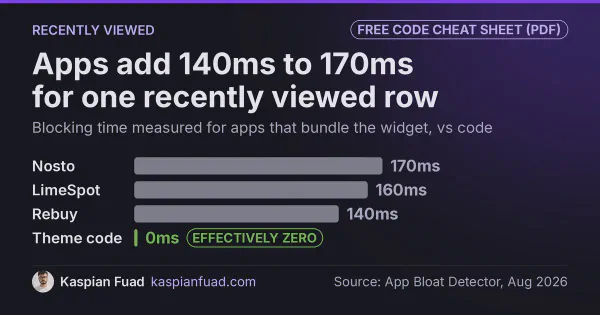
WooCommerce estimates $25 to $350 a month for hosting and $29 to $299 a year per extension. The line nobody prices is the hours: plugin updates, a broken layout after one of them, a security patch on a Friday night. My 2 hours a month is a light estimate for a store with 20 plugins. On Shopify the same features usually come from apps, which cost money too, so price your stack with the app stack cost calculator before you compare.
Is Shopify faster than WooCommerce?
On average, yes, and loading speed is where the gap sits. In the September 2026 HTTP Archive Core Web Vitals report, mobile:
- Passed all three Core Web Vitals: Shopify 76.2% (339,538 of 445,297 sites), WooCommerce 39.3% (213,342 of 542,541).
- Good loading speed (LCP): Shopify 87.7%, WooCommerce 43.5%.
- All WordPress sites, stores or not: 48.3% pass, so WooCommerce sits below WordPress’s own average.
- Magento sites, for comparison: 44.6%, which I break down in Magento vs Shopify.
Shopify serves every store from one tuned platform and CDN. A WooCommerce store’s speed depends on its host, its theme and every plugin that loads scripts on every page, so the average drags. A fast WooCommerce store is possible, and so is a slow Shopify store, because apps add weight on both. If speed is the reason you’re switching, measure your current real-user Core Web Vitals first.
Which is more secure, WooCommerce or Shopify?
Shopify, by default, because there’s less for you to patch. Patchstack counted 11,334 new vulnerabilities in the WordPress ecosystem in 2025, up 42% on 2024. 91% were in plugins and only 6 were in WordPress core.
That’s the real risk on WooCommerce: not WordPress itself, but the plugins a store runs, each one updated on its own developer’s timetable. Shopify is PCI DSS Level 1 on every plan and patches the platform for you. Your exposure there is apps and staff accounts.
When is WooCommerce the better choice?
WooCommerce wins when:
- The site is mostly content. A blog, guides and service pages with a small catalog. WordPress is a better publishing tool than Shopify’s blog, which sorts posts with tags and separate blogs rather than categories.
- You need full control. Custom checkout logic, unusual pricing rules or data you want on your own server.
- It already works. A stable WooCommerce store with a good developer behind it doesn’t need a migration because a blog post said so.
Shopify wins when you sell online, you’d rather spend Friday on marketing than plugin updates, and checkout speed matters. If you’re on that side, here’s how the move works without losing rankings.
Shopify vs WordPress: can you run both?
Yes, and for content-heavy brands it’s often the best setup. Keep WordPress for the blog and service pages, and sell through Shopify:
- The Buy Button channel is included on every Shopify plan and drops products into any page that accepts custom HTML, with checkout on Shopify.
- Shopify’s own WordPress plugin shows products and collections through the Sell on WordPress channel. It needs the block editor and is officially supported only on the default block themes.
- A store on a subdomain (shop.yourbrand.com) with matching navigation works too, and it’s the cleanest option once the catalog grows.
The catch is two systems to keep consistent: one look, one navigation and one set of analytics across both, which is a developer’s job, not a plugin’s.
How do you decide in 10 minutes?
Answer these with your own numbers:
- What share of revenue comes from online orders? Under 20% and content drives leads: stay on WordPress, add a Buy Button if needed.
- How many plugins does your WooCommerce store run, and who updates them? More than 20 and nobody in particular: that’s the cost Shopify removes.
- What’s your mobile Core Web Vitals status in Search Console? Failing on WooCommerce after a speed pass: the platform is part of the problem.
- Which payment provider would you use on Shopify? Anything but Shopify Payments on Basic: add 2% to every order in your math.
- What breaks if you move? Custom checkout rules, B2B pricing and subscriptions with stored cards need a plan before you commit. Run the plan and fee math next.
The takeaway
- Card fees match, 2.9% + 30¢ on Shopify Basic and WooPayments, so compare plan fee against hosting, extensions and upkeep.
- Shopify Basic costs about $126 a month less than WooCommerce for a $40,000-a-month store in my worked example, mostly from upkeep time.
- Speed favors Shopify: 76.2% of Shopify sites pass Core Web Vitals on mobile against 39.3% of WooCommerce sites.
- Watch the 2% fee on Shopify Basic if you keep a third-party payment provider.
- WooCommerce still wins for content-led sites, full control and stores that already run well.
I’m Kaspian Fuad. I build and fix Shopify stores and WordPress sites, so I don’t need you to pick a side. If you want a straight answer for your store, book a free 30 minute call.