

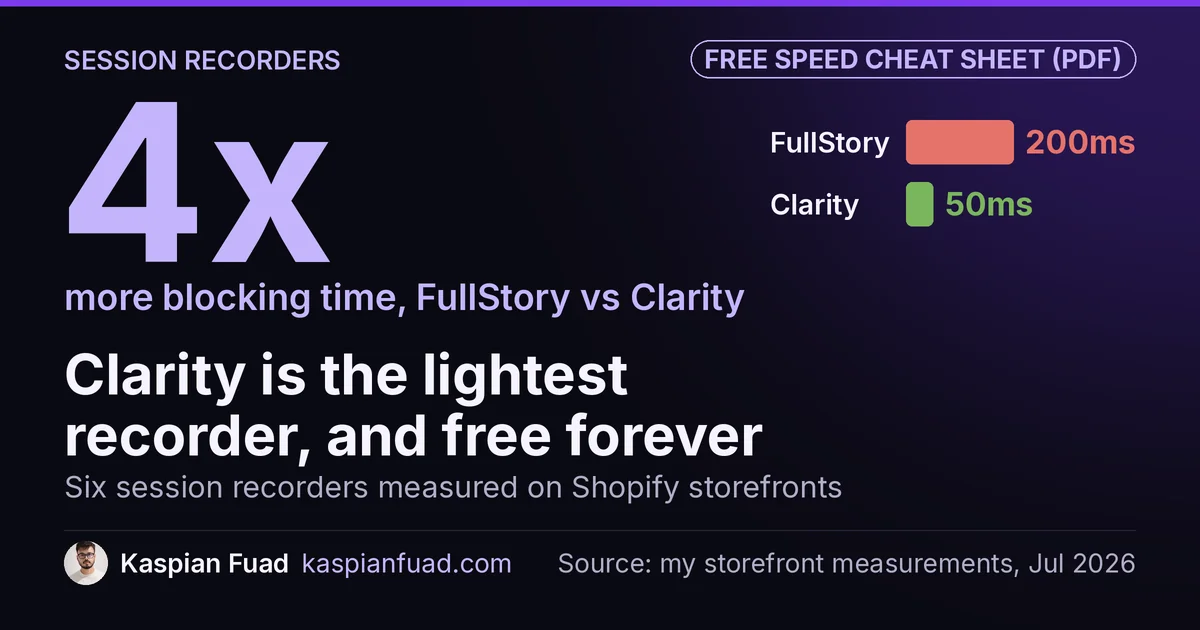
You installed a session recorder to find out why your store feels slow. On a Shopify storefront, FullStory costs 200ms of blocking time. Google flags third-party code at 250ms.
TL;DR: I measured six session recorders on Shopify storefronts. Microsoft Clarity is the lightest at 50ms and free forever with no traffic limits. FullStory is the heaviest at 200ms, four times Clarity. Five of the six have a free tier, so the real difference is not price. It is weight.
Download the session recorder comparison (PDF)
There is a joke buried in this category and nobody tells it. Heatmaps and session recordings exist so you can watch where visitors rage-click, hesitate, and abandon. The usual verdict after an hour of watching is that the site feels sluggish on mobile.
Then you check what the recorder itself is doing to the main thread.
I do not sell an analytics tool, so here is the number none of these vendors puts on their comparison page.
Which session recorder is fastest on Shopify?
Six tools, measured on Shopify storefronts. The spread is the widest of any category I have measured, wider than chat and much wider than loyalty.
| Tool | Blocking time | Price | Free tier |
|---|---|---|---|
| FullStory | 200ms | Paid tiers quote-only | Yes, 30k sessions |
| Lucky Orange | 150ms | $32 to $839 | No |
| Hotjar | 110ms | Free, then from $49 | Yes |
| Mouseflow | 110ms | Free, then $25 to $319 | Yes, 500 sessions |
| Crazy Egg | 80ms | Free, then $29 to $599 | Yes |
| Microsoft Clarity | 50ms | Free forever | Unlimited traffic |
Read the price column again, because it kills the obvious theory. Five of the six have a free tier. This is not a story about cheap tools being worse. Price barely separates these products at the entry point.
What separates them is what they do to your storefront. Clarity is 50ms. FullStory is 200ms. Same job, four times the cost on the main thread.
Why 200ms is worse than it sounds
Blocking time is the single thread that also answers taps. While a recorder’s JavaScript runs, the page looks finished and does nothing.
Google counts a task as blocking past 50ms, and Lighthouse flags any page whose third-party code blocks the main thread for 250ms or longer. That 250ms is the budget for all your third-party code, not one app.
So FullStory at 200ms consumes about 80% of the entire budget on its own. Add one chat widget from the chat comparison and you are over the line before your theme renders a product image.
The self-defeating part: the metric these tools help you diagnose is usually Interaction to Next Paint, and a heavy recorder degrades exactly that metric. The instrument distorts the measurement.
Is Microsoft Clarity actually free?
Yes, and this is the part people do not believe. Microsoft’s own documentation puts it in one line: Clarity is a free service forever, and you never encounter traffic limits or get pushed to upgrade to a paid version. The same page adds that there is no credit card required to sign up.
That is unusual enough to be worth explaining. Clarity is not a freemium funnel with a wall at 10,000 sessions. It sits inside Microsoft’s advertising and analytics ecosystem, so the product does not need a subscription line.
For a Shopify store the practical upshot is blunt: the lightest tool in the category is also the one with no bill and no traffic cap. I use it on client stores for exactly that reason, and it is the same tool behind the AI visibility citation data Microsoft added this year.
What happened to Hotjar?
If you are comparing tools today, know this before you read anyone’s Hotjar review: Hotjar has folded into Contentsquare. As of July 2026, hotjar.com/pricing permanently redirects to contentsquare.com/pricing.
The plan structure changed with it. The Observe and Ask tiers that every older comparison quotes no longer exist. What the live page shows is a free tier, a Growth tier starting from $49 on annual billing, and Pro and Enterprise quoted on request.
That matters for two reasons. Any comparison still listing Observe and Ask pricing is stale, including several ranking on page one. And Hotjar’s centre of gravity has moved toward an enterprise experience-analytics platform, which is a different product from the $0 heatmap tool many stores installed years ago.
At 110ms it is still mid-weight, twice Clarity’s cost for a job Clarity does free.
When is a heavier recorder worth it?
Sometimes, and I want to be fair about this rather than just point at milliseconds.
FullStory earns its 200ms in one situation: you have a dedicated product or UX team running structured research, and you need its retroactive search across every session, its funnel analysis, and its data pipeline. That is a real capability Clarity does not match. If a team of five uses it daily to find revenue bugs, 200ms is a rounding error against what they find. Worth knowing before you scope it: FullStory quotes every paid tier rather than publishing a price.
Lucky Orange is the odd one out on cost. It is the only tool here with no free tier, and its plans start at $32 a month on annual billing and run to $839. At 150ms it is three times Clarity’s weight. Its live chat and conversion funnels bundle several jobs into one install, which is the argument for it.
The trap is paying either of those on a small store where nobody opens the dashboard twice a month. A recorder nobody watches is pure blocking time.
How do I stop the recorder slowing my store?
You do not have to give up recordings to protect your Core Web Vitals. Three fixes, in the order I apply them on audits:
- Defer it. Hold the recorder script until the main thread goes idle or the visitor scrolls. Recording starts a beat later and you lose almost nothing analytically, while the blocking time stops landing during load.
- Sample sessions. You do not need 100% of them to find a rage-click pattern. Most tools expose a sampling rate, including Mouseflow, whose free plan caps you at 500 sessions a month anyway.
- Run one, not two. I regularly find a store carrying both Hotjar and Clarity because someone installed one and forgot. That is 160ms to do one job. Pick one and remove the other.
Then check the result against real users with the CruxGrader, and scan the whole stack with the App Bloat Detector to see the recorder next to everything else competing for the thread.
The takeaway
- Clarity wins on both axes, lightest at 50ms and free forever with no traffic cap.
- FullStory is heaviest at 200ms, about 80% of Google’s entire third-party budget, and its paid tiers are quote-only.
- Price is not the differentiator. Five of six have a free tier, so choose on weight and on features you will actually open.
- Hotjar now redirects to Contentsquare. Any comparison quoting Observe and Ask plans is out of date.
- Never run two recorders. Defer whichever one you keep and sample sessions instead of recording all of them.
I am Kaspian Fuad, a Shopify CRO consultant. Every blocking-time figure here is my own measurement and every price came from the vendor’s own page, checked today. The full 191-app dataset is public at the App Speed Index.