

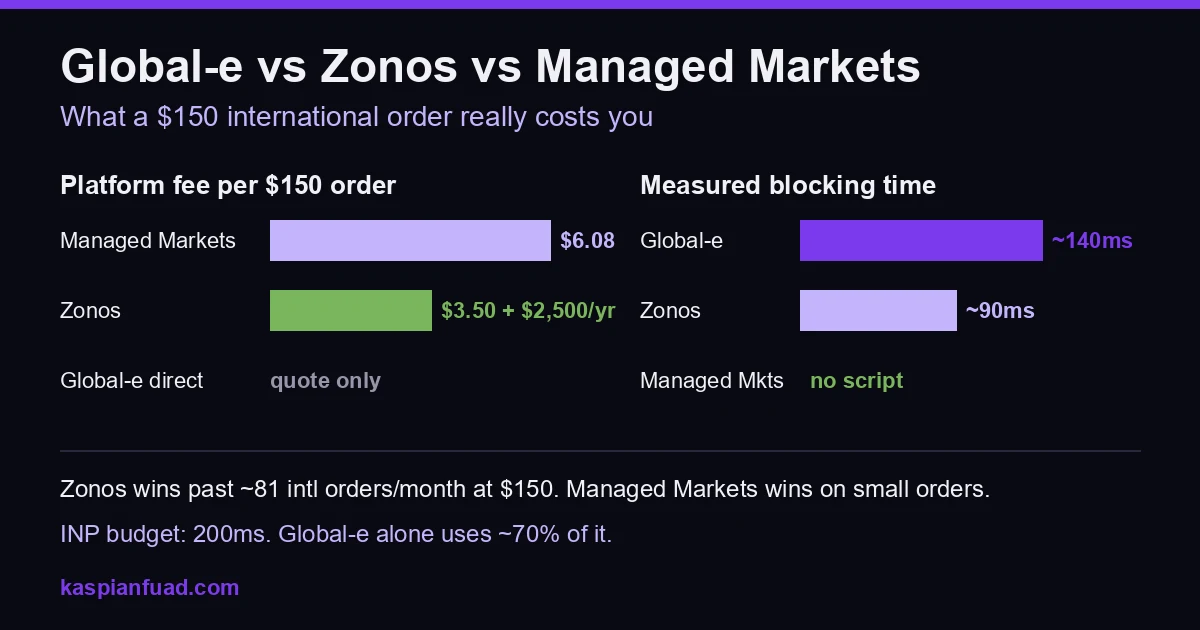
TL;DR: On a $150 international order with $15 of duties, Shopify Managed Markets takes $6.08 and Zonos takes $3.50, plus Zonos’ $2,500 yearly plan. That makes Zonos cheaper past roughly 80 international orders a month at that order size, and more expensive on small orders because of its flat $2 fee. Global-e standalone does not publish a price. On speed, Managed Markets adds no cross-border script, Zonos adds about 90ms, and the Global-e script about 140ms.
I asked ChatGPT the question a $3M US brand asks before opening the UK, EU, Canada, and Australia: Managed Markets, Global-e, or Zonos? The answer was fine on features. Then it admitted Shopify “doesn’t publish a credible ‘Managed Markets adds X ms’ number,” and that Global-e’s standalone pricing is quote-only.
So nobody shows the founder the two numbers that decide the choice: the fee on an order at their price point, and what each option costs their storefront in speed. I measure app load cost for a living, so here are both.
Download the Cross-Border Fee and Setup Sheet (PDF)
Why this decision matters for your store
- Surprise costs are the top fixable checkout killer: 40% of shoppers who abandoned a checkout in Baymard’s research did it because extra costs such as shipping, tax, and fees were too high.
- The fee comes out of every international order, so a 2-point gap on 150 orders a month at $150 is real margin.
- The storefront script loads for every visitor, including your US customers who never see a foreign currency.
What are the three options, really?
They are not three versions of the same product. Two of them are the same company.
Shopify Managed Markets is Shopify’s packaged cross-border service. Shopify’s Managed Markets overview says Global-e becomes the merchant of record, registers for tax in the countries you sell to, assigns HS codes, and guarantees the duty and tax amounts. You run it from Shopify admin. It is available to stores based in the continental US and to some stores in Canada and the UK.
Global-e standalone is the same engine sold directly, with its own storefront script and its own contract. There is no public pricing page. You talk to sales and get a quote.
Zonos Duty and Tax is a different model. The Zonos app listing sells guaranteed landed-cost calculation at checkout, VAT remittance, threshold monitoring, and carrier connections. You stay the seller and ship on your own carrier accounts.
One rule people miss: Shopify’s requirements page states that Managed Markets and the Global-e app cannot be used at the same time. You pick one lane.
What does each one cost per international order?
Here are the published prices as of September 2026.
| Managed Markets | Global-e standalone | Zonos Duty and Tax | |
|---|---|---|---|
| Subscription | None | Quote | $2,500/yr Standard, $4,000/yr Premium |
| Per-order fee | 3.5% (3.25% on Plus) | Quote | $2 + 10% of duties, taxes, fees |
| Currency conversion (US store) | 1.5% | Quote | 1.5% via Shopify Payments if you sell in local currency |
| Merchant of record | Global-e | Global-e | You |
| Who can pay the fee | Built into the local price | Contract | Customer at checkout, per Zonos |
The detail that changes the math is where Managed Markets applies its percentage. Shopify’s international pricing example starts with a $150 product, adds $15 of guaranteed duties, then adds a 3.5% fee of $6.08 and a 1.5% conversion fee of $2.61. Those fees are charged on the final landed price, not on your $150.
Zonos charges a flat $2 plus a percentage of the duty and tax bill, not of the product. Its landed cost pricing docs confirm the $2 plus 10% structure and note it is usually paid by the shopper.
What does that come to at your order size?
I ran the platform fee at four order values, using Shopify’s own ratio of duties at 10% of the product price. The currency fee is left out because it is the same 1.5% on both sides when you sell in local currency through Shopify Payments.
| Product price | Duties | Managed Markets fee | Zonos per-order fee |
|---|---|---|---|
| $50 | $5 | $2.03 | $2.50 |
| $100 | $10 | $4.05 | $3.00 |
| $150 | $15 | $6.08 | $3.50 |
| $300 | $30 | $12.16 | $5.00 |
Two things fall out of this table.
First, on small orders Zonos costs more per order. The flat $2 is heavier than 3.5% of a $58 landed price. If you sell $40 candles, Managed Markets wins before you even count the subscription.
Second, Zonos needs volume to earn back its $2,500 a year. At a $150 order the gap is $2.58 per order, so the plan pays for itself at about 81 international orders a month. At a $100 order the gap is $1.05 and you need about 198 a month. At $300 you need about 29.
Now the honest caveat. Zonos’ 10% is on duties and taxes, so a VAT-heavy destination raises it. If duties plus VAT on that $150 order come to $45, the Zonos fee becomes $6.50. Run your top destination through the sheet before you trust anyone’s average, mine included.
Does a cross-border app slow down your Shopify store?
This is the part nobody in the SERP measures. I track the storefront cost of about 190 Shopify apps in the App Bloat Detector. Here is the cross-border and currency group, in main-thread blocking time.
| App | Measured blocking time |
|---|---|
| Global-e cross-border script | ~140ms |
| Bold Multi-Currency | ~120ms |
| Weglot | ~120ms |
| Zonos Duty and Tax | ~90ms |
| Shopify Geolocation app | ~60ms |
| Hextom or BEST Currency Converter | ~50ms |
| Managed Markets | no separate script |
Google’s INP guidance puts a good interaction at 200ms or less. Global-e alone uses roughly 70% of that budget before your reviews widget, chat, and pixels load. That is why its entry in my detector reads “audit for unused markets.”
Managed Markets has no separate storefront library to measure, because the pricing runs through Shopify Markets and the purchase runs through Shopify checkout. If you add the Geolocation app for a country selector, count its 60ms.
The speed trap I see most often is stacking. A store adds Zonos, keeps an old currency converter app, and runs Weglot on top. That is about 260ms of blocking time for jobs Shopify Markets now does natively. My Weglot vs Langify vs Translate and Adapt breakdown covers the translation half of that stack.
Which one should you pick?
- Pick Managed Markets if you are testing international demand, your average order is under about $150, or you do not want tax registrations anywhere. No subscription, no script, and Global-e carries the compliance.
- Pick Zonos if your international orders are above roughly $150, you ship more than about 80 a month, and you want your own DHL, UPS, or FedEx rates. Check that your plan supports carrier-calculated shipping, because the app listing marks it as required.
- Talk to Global-e directly only when a quote beats 3.5% at your volume. Since Managed Markets already runs on Global-e, that published rate is your benchmark in the negotiation.
Whichever you choose, fix hardcoded prices first. A theme that prints “$29” in a section setting will show dollars to a UK shopper paying in pounds. I wrote up that failure in hardcoded prices under multi-currency, and the Hardcoded Price Detector finds them in a minute.
How do you check your setup in 5 minutes?
- Open your store with a VPN set to the UK. The product price, cart, and checkout should all show pounds, and checkout should say duties are included.
- Run your homepage through the App Bloat Detector. If it finds two currency or translation apps, one of them is dead weight.
- Take last month’s international orders and average order value, and put them into the fee table above. That tells you which lane you should be in.
If the scripts are already slowing your pages, my guide to deferring third-party scripts for INP shows how to load them after first interaction. For the SEO side of new markets, see hreflang and international SEO on Shopify.
Download the Cross-Border Fee and Setup Sheet (PDF)
The takeaway
- Price at your order size. Managed Markets wins on small orders, Zonos wins on large ones.
- Count the subscription. Zonos’ $2,500 a year needs about 81 international orders a month at $150 to pay off.
- Use 3.5% as your Global-e benchmark, since Managed Markets runs on the same engine.
- Budget the script. Global-e costs about 140ms of blocking time, Zonos about 90ms, Managed Markets none.
- Remove duplicate currency and translation apps before adding anything new.
I am Kaspian Fuad, a Shopify CRO and performance consultant. I measure the load cost of the apps I recommend and I publish my rates. If you are opening international markets and want the setup, pricing, and speed done right the first time, book a call.