

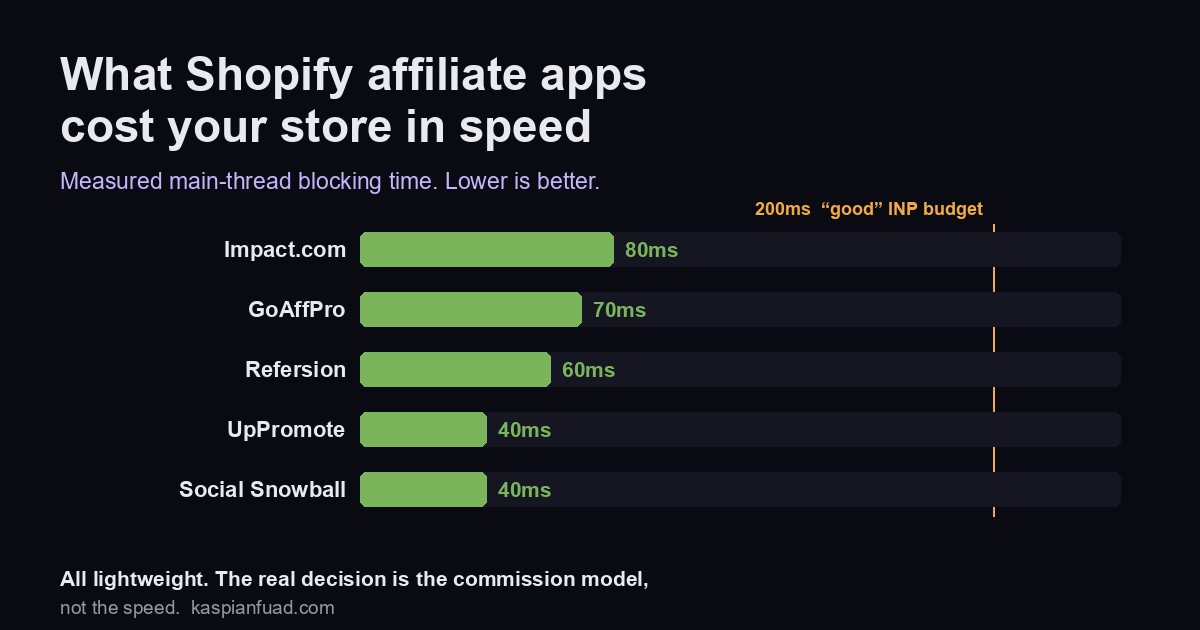
TL;DR: Affiliate apps have two prices, and most stores only compare the first. The monthly fee is the small number. The big one is the percentage of your affiliate sales most of them charge on top: UpPromote 1 to 2 percent, Refersion 2 to 3 percent, Social Snowball 3 percent. GoAffPro is the only popular one that takes none. On $100,000 of affiliate revenue a month, that gap is $3,000. None of these apps will hurt your store speed, I measured them all at 40ms to 70ms. So the decision is the fee, the tracking, and the fraud protection, not the speed. Here is how they actually compare.
Affiliate is a real channel again. The Performance Marketing Association estimates affiliate marketing drove about $113 billion in US ecommerce sales in 2024, and eMarketer forecasts US affiliate ad spend near $14 billion in 2026. For a Shopify store, standing up an affiliate or referral program means picking one of four apps that all look similar on the surface and price very differently underneath. I pulled the real pricing, the tracking model, and the blocking time I measured for each, so you can choose on the numbers that matter.
Does Shopify have a native affiliate program?
No, and this trips up a lot of merchants. Shopify has no built-in way to run your own affiliate program: open enrollment, commission tiers, an affiliate portal, and automated payouts to the people referring your products. Two Shopify features get confused for it, and neither does the job.
The Shopify Affiliate Program is Shopify’s own scheme for educators and creators who promote Shopify itself and earn a commission when someone signs up for a paid plan. It has nothing to do with selling your products. Shopify Collabs is closer, a creator and influencer marketplace where you can gift product, send discount codes, and track some creator sales, but it is built for influencer gifting, not for running a structured affiliate program with tiers, a self-serve portal, and rules-based payouts. The moment you want real affiliate mechanics, you need a third-party app. That is why this category exists and why there is no shopify.com result competing with the apps below.
What do affiliate apps cost you in speed?
I keep a library of Shopify apps with their measured main-thread blocking time, the proxy for how much an app delays a shopper’s next tap. Affiliate apps are among the lightest things you can install.
| App | Blocking time | Cheapest paid | Sales fee | Rating |
|---|---|---|---|---|
| Impact.com | 80ms | Quote only | Varies | Enterprise |
| GoAffPro | 70ms | $49/mo | None | 4.6 (883) |
| Refersion | 60ms | $39/mo | 2 to 3% | 4.8 (460) |
| UpPromote | 40ms | $29.99/mo | 1 to 2% | 4.9 (3,609) |
| Social Snowball | 40ms | $249/mo | 3% | 4.5 (194) |
Nothing here breaks 80ms. Affiliate tracking is light because it is fundamentally a pixel, not a rendered widget: it reads a referral parameter, stores an attribution value, and later fires a single event when a sale completes. There is no carousel, no video player, no live search index. So unlike the heavier categories in my app bloat report, speed is not how you should choose an affiliate app. It is a tie. The decision lives in the money and the tracking.
UpPromote vs Refersion vs GoAffPro vs Social Snowball: the real price
Here is the part the pricing pages bury. Most affiliate apps charge you twice: a monthly subscription, and then a percentage of the affiliate sales they help you generate. That second charge scales with your success, so it is small when you start and large exactly when the program is working.
UpPromote is the value leader and the default most stores should start with. It has a genuine free plan, then Growth at $29.99 a month plus a 2 percent fee on approved affiliate sales, Professional at $89.99 plus 1.5 percent, and Enterprise at $199.99 plus 1 percent. At 4.9 stars across 3,609 reviews it is by far the most-reviewed affiliate app on Shopify, and I measured it the lightest at 40ms. The fee drops as you move up tiers, which is the right shape: heavy programs pay a smaller percentage.
Refersion starts at $39 a month on its Launch plan plus 3 percent of affiliate sales, with Growth at $199 plus 2 percent, and a custom Scale tier for brands over $1M in affiliate GMV that switches to a flat subscription with no percentage. Its 3 percent entry fee ties Social Snowball for the highest in the group, so Refersion earns its keep on tracking quality rather than price, which is the next section.
GoAffPro is the one that breaks the pattern: no percentage fee at all. It is free under 100 orders a day, then Premium at $49 a month and Business from $99, and you keep 100 percent of the commission structure you set. For a store doing serious affiliate volume, that alone can save more than the entire subscription of a percentage-based rival. The trade-off is weaker tracking, covered below, and a 4.6 rating that sits just under the others.
Social Snowball is the premium, DTC-focused option and the only one with no free plan. Snow Day is $249 a month plus 3 percent, and Blizzard is $899 a month with no percentage and white-glove onboarding. It is built around turning customers into affiliates automatically after purchase, so it suits established brands with the volume to justify the floor, not stores testing the channel.
To make the fee real: on $100,000 of monthly affiliate revenue, GoAffPro’s percentage cost is zero, UpPromote’s 2 percent is $2,000, and Refersion’s or Social Snowball’s 3 percent is $3,000, every month, on top of the subscription. That is the number that should decide it once your program has traction.
Which affiliate app tracks best?
If the fee is the cost, tracking is the quality. An affiliate app that misses sales pays affiliates poorly and reports numbers you cannot trust, and modern browsers make this harder every year.
Refersion is the strongest here because it is first-party and cookieless. Its own help center states plainly that it does not use cookies for conversion tracking, matching a click to a sale through a first-party tracking domain and the browser’s local storage instead. That means it is not broken by Safari’s Intelligent Tracking Prevention or the wider death of the third-party cookie, which is exactly the failure mode that quietly under-reports affiliate sales on iOS-heavy stores.
UpPromote and Social Snowball attack a different problem: coupon leakage. When an affiliate’s discount code ends up on a coupon-aggregator site, random shoppers use it and the affiliate gets credited for sales they did not drive. UpPromote’s anti-leak protection and Social Snowball’s single-use Safelink codes, which generate a unique code per visitor, are both designed to shut that down. GoAffPro is cookie-based with a merchant-set cookie window, which is fine for many stores but is the model most exposed to Safari and cookie-clearing users.
So which Shopify affiliate app should you use?
- Starting out or unsure: UpPromote. Free to trial, cheapest paid at $29.99, the lightest I measured, the lowest fee, and the deepest review history. It is the low-risk default.
- You live on paid and iOS traffic: Refersion. The cookieless first-party tracking is worth its higher 3 percent entry fee when attribution accuracy is the whole game.
- High affiliate volume, fee-sensitive: GoAffPro. No percentage fee means it gets cheaper relative to rivals exactly as your program grows, as long as you can live with cookie-based tracking.
- Established DTC brand, post-purchase referral: Social Snowball. The automatic customer-to-affiliate flow and fraud-resistant single-use Safelinks fit brands with the volume to clear its $249 floor.
How do you keep an affiliate app off your Core Web Vitals?
Affiliate tracking is really two jobs, and the performance question is whether the app keeps them separate. Job one is click capture: reading the ?ref= parameter and storing the attribution when a visitor lands from an affiliate link, which can happen on any page. Job two is conversion attribution: firing a single event when the order completes so the affiliate gets credited. That second job belongs on the order status page or a Web Pixel that runs on the purchase event, and it has zero reason to load on your homepage, collection, product, or cart pages.
The old way, and the reason some affiliate apps get a bad speed reputation, is a single legacy script tag that injects the whole SDK site-wide and handles everything everywhere. A well-built modern app splits the two, keeps click capture minimal, and moves conversion tracking to a checkout-scoped pixel. The apps here all measured light, so this is a non-issue in practice, but if you audit your own store and find an affiliate SDK loading on every page, that is the thing to defer, the same move that took one store’s INP from 612ms to 178ms. My guide to the apps that quietly tank INP walks through how to move a tracking script off the critical path, the App Bloat Detector carries the measured numbers behind this post, and how to speed up your Shopify store is the broader playbook.
Download the Affiliate App Cheat Sheet (PDF)
The takeaway
- Shopify has no native affiliate program. Collabs is influencer gifting, not affiliate mechanics, so running a real program means one of these apps.
- The monthly price is not the real price. Most affiliate apps also take 1 to 3 percent of your affiliate sales, and at scale that fee dwarfs the subscription.
- GoAffPro is the only popular app with no percentage fee, which makes it cheaper as your program grows, if you accept cookie-based tracking.
- UpPromote is the safest default: free tier, cheapest paid, lowest fee, lightest at 40ms, and 3,609 reviews. Refersion wins on cookieless tracking; Social Snowball on post-purchase DTC.
- Speed is a tie. All four measured 40ms to 70ms. The only mistake is letting the conversion pixel load site-wide instead of firing once on the thank-you page.
I measure these apps myself because the App Store shows a rating, not a blocking time, and the pricing page leads with a subscription while the percentage fee that actually decides the bill is easy to miss. If you want the numbers for an app I have not covered, tell me and I will run it.