

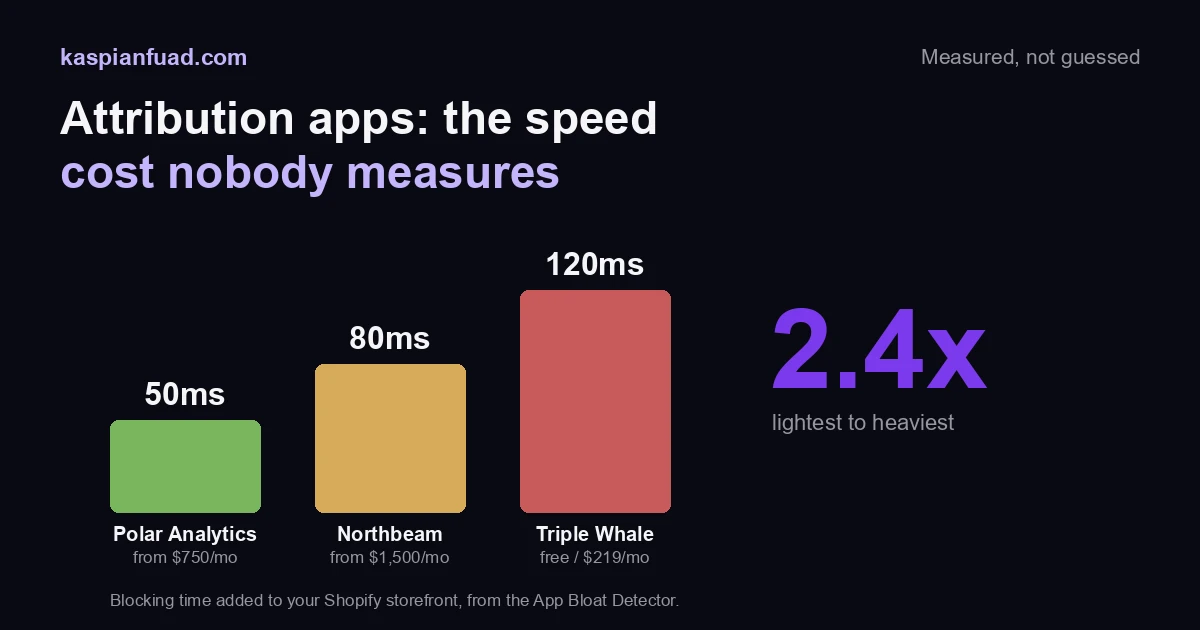
TL;DR: These three tools do not compete for the same buyer, and the fastest one is not the priciest. I measured what each adds to a Shopify storefront: Polar Analytics 50ms, Northbeam 80ms, Triple Whale 120ms of blocking time. On price the order flips: Triple Whale starts free, Polar at $750 a month, Northbeam at $1,500. Pick by fit, then by the speed cost none of the vendor comparison pages will show you.
Every “Triple Whale vs Polar” post online compares dashboards, attribution windows, and AI features. Not one measures the thing that decides your Core Web Vitals: how much the app’s script blocks the browser. I run these numbers in my App Bloat Detector, and the spread here is 2.4x from lightest to heaviest. That is the gap this post fills, alongside the real 2026 pricing and who each tool is actually for.
Which attribution app is fastest on Shopify?
Polar Analytics is the lightest at 50ms of blocking time. Northbeam sits in the middle at 80ms. Triple Whale is the heaviest at 120ms, which is 2.4x Polar. Here is the full picture, speed and cost together.
| App | What it is | From (per month) | Blocking time (measured) | Best for |
|---|---|---|---|---|
| Triple Whale | All-in-one profit + attribution + AI | Free, then $219 | 120 ms | Operators who want one dashboard |
| Northbeam | Paid-media attribution + MMM | $1,500 | 80 ms | Brands scaling paid ad spend |
| Polar Analytics | BI dashboards + data warehouse | $750 | 50 ms | Teams that want SQL and a warehouse |
Blocking time is the share of page load where the main thread is frozen and cannot answer a tap. Google folds it into Interaction to Next Paint, a Core Web Vitals metric. An extra 70ms from one analytics tool is not fatal on its own, but it stacks with every other app, and attribution apps rarely travel alone.
What does each one actually do?
They look similar on a feature grid and feel different in use. Triple Whale is the all-in-one. Northbeam is the paid-media specialist. Polar is the data platform.
Triple Whale calls itself an “AI operating system for ecommerce.” It unifies profit, multi-touch attribution, and creative analytics behind an AI assistant called Moby. Its Shopify listing sits at 4.1 stars across 84 reviews. In January 2026 it acquired Anteater, an AI-visibility tool that tracks how large language models cite your brand, which tells you where the roadmap is heading.
Northbeam is built for advertisers, not operators. It leads with multi-touch attribution plus media mix modeling and incrementality testing, the tools you reach for when you are spending enough on ads to distrust the numbers each platform reports about itself. Its own tiers gate the entry plan at brands under $1.5M a year in ad spend, so the product assumes scale.
Polar Analytics is a business-intelligence layer. It pipes your data into a dedicated Snowflake warehouse, gives you SQL access, and lets you build custom dashboards across 45-plus sources. Its Shopify listing is the strongest of the three on paper at 4.9 stars across 103 reviews. This is the one you buy when a dashboard is not enough and you want the raw data.
What do Triple Whale, Northbeam, and Polar cost in 2026?
The price gap is wider than the feature gap. Triple Whale is the only one with a real free plan.
- Triple Whale: free plan, then Foundation from $219 a month and Automate from $749, with an Enterprise quote above that. Tiers scale by your annual GMV band, so the entry prices are the floor.
- Polar Analytics: Core from $750 a month per its pricing page, bundling BI, AI agents, and data activations, with a demo-gated Custom plan for incrementality. No free plan.
- Northbeam: Starter at $1,500 a month, Professional at $3,500, per its pricing page, with Growth and Enterprise on quote. No free plan and no free trial.
So Northbeam’s entry tier costs roughly 7x Triple Whale’s first paid plan. That is not Northbeam overcharging, it is a different buyer: a brand spending six figures a month on ads treats $1,500 as a rounding error if the attribution changes one budget decision.
Why is Polar the lightest and Triple Whale the heaviest?
Because they inject their tracking in different ways, and they ask the browser to do different amounts of work. This is the part the feature comparisons skip.
Polar’s pixel ships as a native Shopify Web Pixel app extension, which Shopify runs in a sandboxed context built to limit main-thread blocking. That architecture is the likely reason it measured lightest at 50ms. Northbeam takes the opposite route: its install docs have you paste a raw script into theme.liquid inside the <head>, the most direct injection of the three. Triple Whale loads an app-embed Triple Pixel plus a checkout Web Pixel, and its 120ms reflects the fuller suite doing more on the page.
Most CRO advice gets this backward. It treats analytics as free because it does not cost you a checkout step. It is not free. It costs main-thread time on every page a shopper loads, and Triple Whale’s number is the price of its all-in-one convenience. That is fair, not a knock: the heaviest tool here is also the one doing the most. You just deserve to see the number before you decide it is worth it.
Which one is right for your store?
Match the tool to your stage, not to the loudest comparison page.
If you are a solo operator or a small team who wants profit and attribution in one screen without hiring a data analyst, Triple Whale is the default. Free to start, cheapest to grow, one dashboard. If you are scaling paid media hard and platform-reported ROAS no longer adds up, Northbeam earns its price with real media mix modeling and incrementality. If you have someone who writes SQL and you want a governed warehouse feeding custom reporting, Polar Analytics is the one that does not box you in.
For the session-recording and heatmap side of analytics, that is a separate stack. I compared those in Clarity vs Hotjar vs Lucky Orange, and the speed lesson there is the same: the heaviest option is often several times the lightest.
Download the Attribution App Comparison (PDF)
How do I keep an attribution app from slowing my store?
Pick the lightest integration the tool offers, then verify it on real data.
- Prefer the Web Pixels or server-side install over a raw
theme.liquidscript when the app gives you the choice. Polar’s sandboxed pixel is the model here. - Load only one attribution tool. Running Triple Whale and Northbeam together doubles the blocking time and double-counts conversions.
- Check the result on real users. Run the CrUX grader on your highest-traffic pages before and after install, and use the App Bloat Detector to see where each app ranks. If your Vitals-style app stack is already heavy, add attribution carefully.
The takeaway
- Measure the speed cost first: Polar 50ms, Northbeam 80ms, Triple Whale 120ms, a 2.4x spread the vendor pages leave out.
- Start with Triple Whale if you are a small or mid-size operator. Free plan, paid from $219, one dashboard.
- Pay for Northbeam only when you are scaling ad spend and need real MMM and incrementality, from $1,500 a month.
- Choose Polar when you have a data person who wants SQL and a warehouse, from $750 a month.
- Verify on real-user Core Web Vitals after install, and never run two attribution pixels at once.
I measure every app on this list in my own App Bloat Detector. If you want your live app stack audited for what it costs in speed, my 30-minute store diagnostic is free.