

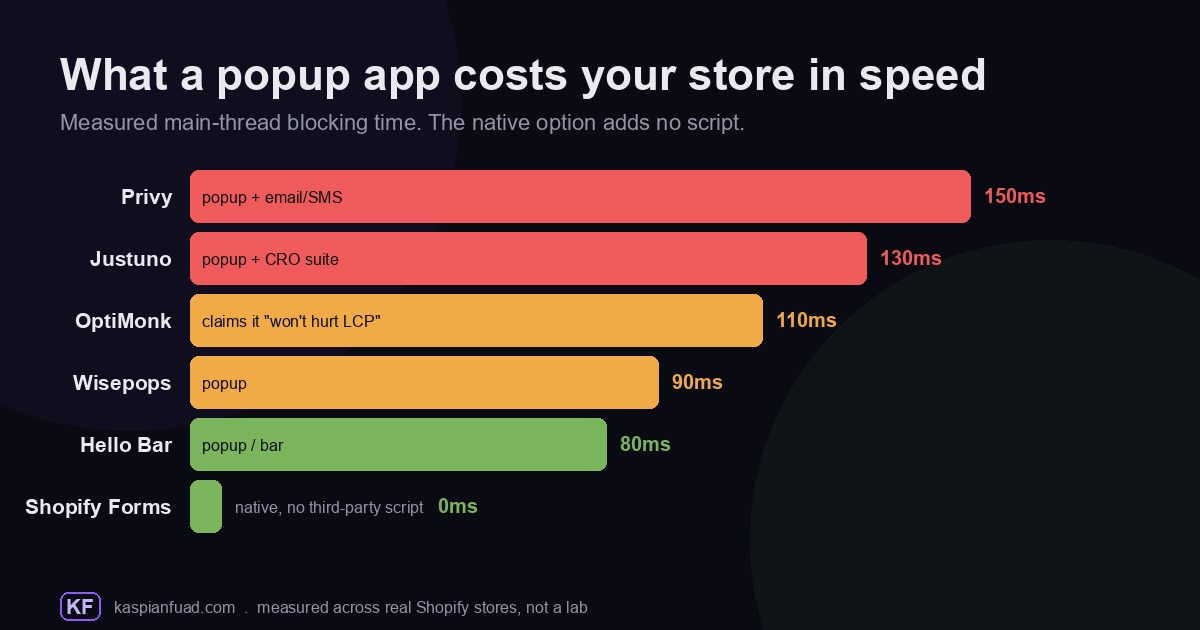
TL;DR: The popup vendors are arguing about speed, so I measured them. OptiMonk states its popup “will not interfere with the Largest Contentful Paint.” Privy, the heaviest at 150ms of blocking time, makes no such claim. The apps that promise they are fast (OptiMonk 110ms, Wisepops 90ms) genuinely are lighter than Privy, but none is free of cost, and Shopify’s native Forms adds no script at all. Here is which to run, and the truth about “won’t hurt LCP.”
Almost every store I audit runs a popup, and lately the vendors have started competing on speed. That is new, and worth taking seriously: speed has become a competitive axis in this category.
So I ran the numbers. Here is what six ways to capture an email cost your store.
What do Shopify popup apps cost?
The prices spread as much as the speed does, and both matter.
| App | Blocking time | Price | Vendor speed claim |
|---|---|---|---|
| Shopify Forms | Native, no script | Free | It is native |
| Hello Bar | 80ms | Paid | None found |
| Wisepops | 90ms | $99 (Shopify) or $299 (App Store) | No perceptible impact |
| OptiMonk | 110ms | Free, then $29/mo | Says it will not hurt LCP |
| Justuno | 130ms | From $59/mo | Loads asynchronously |
| Privy | 150ms | From $24/mo, no free plan | None |
Shopify Forms is free and built by Shopify. OptiMonk has a real free tier for up to 10,000 pageviews a month, then $29. Privy starts at $24 a month for popups and no longer runs the free plan some older roundups still mention. Justuno is the priciest of the three head-to-head apps at $59 a month, priced by visitor sessions. Wisepops runs higher still, at the premium end.
Notice the pattern in that last column. The three apps that market themselves as fast all measured lighter than Privy, which markets nothing about speed. The claims are not lies. They are also not the whole story.
Do popup apps slow down your store?
Yes, and the mechanism is the same one behind every app-speed post I write. The app runs a script in the browser.
Every one of these popup tools, except Shopify’s native Forms, loads a third-party JavaScript file on your storefront to build and trigger the overlay. That script parses and executes on the main thread, and I measured the cost at 80ms to 150ms of blocking time, from the same library behind my 191-app bloat report. Privy landed heaviest at 150ms, OptiMonk at 110ms, and the lightest paid option, Hello Bar, at 80ms.
Shopify’s native Forms skips the script. Shopify renders the form through a theme app embed, so the browser never downloads a third-party popup library. That is why it does not appear in your blocking time. You can see what your own store carries with my App Bloat Detector.
“Won’t hurt LCP” is true, and also not the point
This is where the vendor claims deserve a fair hearing, and a correction.
OptiMonk writes, word for word: “Since your popup will load asynchronously, it will not interfere with the Largest Contentful Paint (LCP).” Wisepops says its Preact-based engine means, in its words, “no perceptible impact on page speed.” Justuno makes a similar async argument about load speed. OptiMonk is the only one that names LCP, and on that narrow point it is right: a script loaded asynchronously, after your content, is not in the render path, so it does not delay your largest element from painting. The broader “won’t slow your page” claims hold for LCP the same way.
The problem is that LCP is one of three Core Web Vitals, and “async” only protects one of them.
It does nothing for CLS. web.dev is direct that overlays inserted after render are “a very common source of layout shifts”: a popup that pushes content when it appears shifts your layout, and Google’s “good” threshold is a CLS of 0.1 or less. It does nothing for INP either. The tap to close the popup is an interaction the browser has to respond to, and Google wants that under 200ms. And the blocking time I measured, the 80ms to 150ms of main-thread work, can contribute to poor INP if a shopper taps to close the popup while the main thread is still busy, the same stall I fixed in my INP case study.
So the honest read: the fast-marketing apps are lighter, and their LCP claim is technically fair. But “won’t hurt LCP” is not “free,” and it quietly sidesteps the two metrics a popup is most likely to wreck.
Privy vs Justuno vs OptiMonk: which one?
If you have decided you need a paid app, here is the head-to-head.
Privy is the default most stores reach for, with 3,968 reviews, and it is the most familiar. It is also the heaviest I measured at 150ms, it dropped its free plan, and it makes no speed claim while its lighter rivals do. Familiarity is its main argument.
Justuno is the CRO-heavy option with strong targeting and A/B testing, and it markets itself as fast. It is also the most expensive to start at $59 a month, and at 130ms it is not actually the lightest.
OptiMonk is the one I would default to of the three. It measured the lightest at 110ms, it is the only one with a genuine free tier, and it backs its speed with a public claim you can hold it to. Wisepops measured lighter still at 90ms, but its premium pricing puts it out of range for most of the stores I audit.
Is Shopify’s free Forms app good enough?
For a lot of stores, yes, and this is the option most people forget they already have.
Shopify Forms builds popup and inline capture forms for email, SMS, and WhatsApp, it can attach a signup discount, and it creates a customer segment for every form that feeds straight into Shopify Email, which sends up to 10,000 emails a month for free. It is native, so it adds no third-party script. For the job most popups actually do, collect an email, give a code, it is enough and it is the lightest option on the board.
What it will not do is the advanced work. There is no A/B testing, no exit-intent, no spin-to-win, and only basic targeting. If those are conversion levers you will actually pull, a paid app is worth its weight.
When do you need a paid popup app?
Be honest about which of these you will use, because most stores use none of them.
- A/B testing of popup copy, offers, and timing.
- Exit-intent triggers and multi-step flows.
- Gamification like spin-to-win, which lifts opt-in rates for some brands.
- Granular targeting by traffic source, cart value, or behavior.
If you will genuinely run those, pick the lightest app that offers them, which points at OptiMonk over Privy. If you will not, native Forms captures the email for free and for zero script. Either way, how you use the popup matters more than which app renders it, and I covered that side, the timing and frequency that decide whether a popup helps or hurts, in popups kill Shopify conversions.
Want the decision on one page? I put the speed, price, and capability of all six into a quick reference.
Download the Shopify popup app speed and price table (PDF)
The takeaway
- Lighter apps exist. OptiMonk (110ms) and Wisepops (90ms) beat Privy (150ms), which makes no speed claim at all.
- Async is not free. “Won’t hurt LCP” protects LCP but does nothing for the CLS and INP a popup is most likely to hurt.
- Native is the no-script option. Shopify Forms is free, and enough for email capture with a discount.
- Pay for CRO you will use. A/B testing, exit-intent, and gamification are the reasons to buy an app, and OptiMonk delivers them lightest.
- Measure your store. Blocking time is one number; check your CLS and INP with the popup live, on a product page.
I am Kaspian Fuad, a Shopify CRO consultant. I measure the speed cost of the apps most comparison sites only price, because the millisecond your shopper waits is the number that moves conversion.