

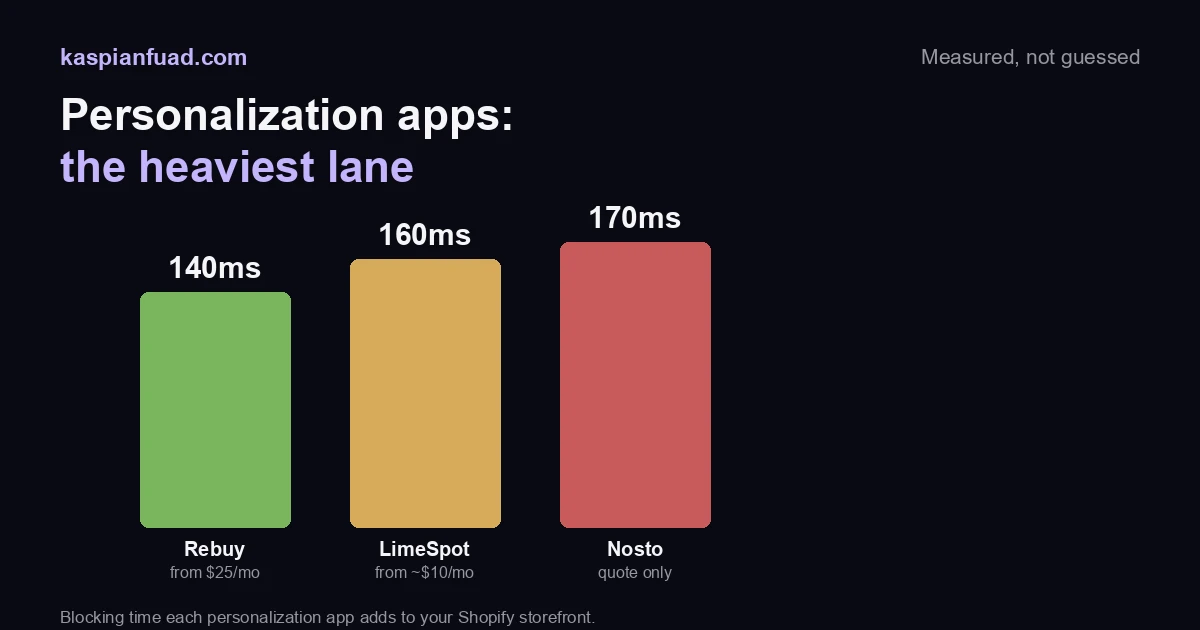
TL;DR: Personalization apps promise more revenue, and they are the heaviest scripts you can bolt onto a Shopify store. I measured all three: Rebuy 140ms, LimeSpot 160ms, Nosto 170ms of blocking time. The priciest one, Nosto, is also the heaviest. On cost they split cleanly: LimeSpot starts near $10, Rebuy at $25, and Nosto is quote-only enterprise. Here is what each costs in speed and subscription, and which fits your store.
Product recommendations sell. A “you might also like” carousel that actually learns lifts average order value, and I recommend them to clients constantly. What the vendor pages never tell you is the tax: these apps render their widgets in the browser, on every page, and that costs main-thread time. In my App Bloat Detector, personalization is the single heaviest app lane I track, all three of these land between 140 and 170ms.
Which personalization app is lightest on Shopify?
Rebuy is lightest at 140ms, then LimeSpot at 160ms, then Nosto at 170ms. Here is the full picture, speed and cost together.
| App | What it is | From (per month) | Blocking time (measured) | Best for |
|---|---|---|---|---|
| Rebuy | AI recommendations + smart cart | $25 per package | 140 ms | Growth-stage Shopify brands |
| LimeSpot | Recommendations, upsells, bundles | ~$10 (App Store) | 160 ms | SMB and self-serve stores |
| Nosto | Enterprise AI personalization | Quote only | 170 ms | Enterprise brands |
For context, a session recorder or a review app usually lands under 100ms. These three sit well above that, because they do more work on the page: they fetch shopper-specific recommendations and render them live. That is the trade. The question is whether the revenue lift clears the speed cost, and you cannot answer that without knowing the speed cost.
What does each one actually do?
They all show product recommendations, and they are built for different sizes of store.
Nosto calls itself an “Intelligent Commerce Experience Platform.” It bundles AI personalization, search, merchandising, and a customer-data layer, and it is sold to larger brands. Its Shopify listing sits at 4.8 stars across 51 reviews. In May 2026 it wired its personalization into Shopify’s Sidekick as agentic workflows, which tells you where the roadmap points: deeper into the enterprise stack.
LimeSpot is the self-serve one. It does product recommendations, upsells, and bundles with a no-code setup aimed at SMB and mid-market stores, and it has been owned by the app roll-up Pantastic since 2022. Its current consolidated listing is “LimeSpot AI Bundles & Upsells” at 4.6 stars across 391 reviews.
Rebuy targets growing brands. It leads with an AI-powered Smart Cart plus recommendation widgets, search, and post-purchase upsells, and its listing is 4.8 stars across 746 reviews. It overlaps my ReConvert vs Zipify vs Rebuy upsell comparison, because Rebuy straddles both jobs: recommendations and cart upsell.
What do Nosto, LimeSpot, and Rebuy cost in 2026?
The pricing tells you who each is for, and one of them is a mess.
- Rebuy publishes its numbers. “Build Your Own Plan” starts at $25 a month per package (cart, search, checkout, or flows), scaling with your orders per month, and the everything-bundle “Platform One” starts at $534 a month. There is also a free tier that pays you a small cut of post-purchase ad revenue. See the pricing page.
- LimeSpot is where it gets murky. Its Shopify App Store listing shows a free tier scaling to about $50 a month, while its own marketing site quotes a single $150 plan. Two of the vendor’s own surfaces disagree. Treat the App Store listing as the live number and the marketing page as a separate, unreconciled one.
- Nosto publishes nothing. Its pricing page says “no rigid tiers” and routes you to a demo, priced on your GMV and traffic. That is enterprise-speak for “it depends, and it is not cheap.”
So the spread runs from LimeSpot’s roughly $10 entry to Nosto’s quote-gated enterprise contract, with Rebuy in the practical middle for a growing store.
Download the Personalization App Comparison (PDF)
Why are personalization apps so heavy?
Because they do their thinking in the shopper’s browser. Most CRO advice gets this backward and treats personalization as free because it does not add a checkout step. It is not free. Each of these apps loads a script that fetches recommendations tuned to the individual visitor and paints widgets into the page as it renders, on the home page, the product page, the cart, and sometimes checkout. That is real main-thread work, repeated on every page view.
Nosto’s 170ms is the price of the fullest suite: personalization plus search plus a data layer, all executing client-side. Rebuy’s 140ms is lighter because more of its logic rides Shopify’s own cart and checkout surfaces. None of this is a knock. The weight buys genuine per-shopper rendering that a static theme cannot do. You just deserve to see the number before you decide the lift is worth it, and the comparison pages leave that number out.
Which one is right for your store?
Match the tool to your stage.
Choose LimeSpot if you are a small or mid-size store that wants recommendations and bundles running this afternoon without a data team or a sales call. It is the cheapest real entry and the most self-serve. Choose Rebuy if you are a growing brand that wants a smart cart and recommendations in one engine and you will actually use the A/B testing. It is the lightest of the three and its pricing is honest. Choose Nosto if you are an enterprise brand where personalization, search, and a unified data layer justify a quote-based contract and a strategist. For most Shopify stores, that last one is more platform than you need.
How do I keep a personalization app from slowing my store?
Pick the lightest tool that does the job, then keep it honest.
- Run one personalization app, not two. Stacking Rebuy and Nosto doubles the blocking time and the recommendations start fighting each other.
- Lazy-load below-the-fold widgets. A “recommended” carousel at the bottom of a product page does not need to block the first paint. Most of these apps have a defer or on-scroll option; use it.
- Measure on real users. Run the CrUX grader on your busiest pages before and after install, and watch Interaction to Next Paint, not just Lighthouse. If the app adds more blocking time than your existing app stack can absorb, the revenue lift has to be large to break even.
The takeaway
- Measure the speed cost first: Rebuy 140ms, LimeSpot 160ms, Nosto 170ms, the heaviest app lane on Shopify.
- Start with LimeSpot if you are SMB and self-serve, from about $10 a month.
- Pick Rebuy if you are growth-stage and want a smart cart, from $25 a month and the lightest of the three.
- Reserve Nosto for enterprise, where its data platform earns the quote-only price and the 170ms.
- Run one app, lazy-load the widgets, and verify Core Web Vitals on real users after install.
I measure every app on this list in my own App Bloat Detector. If you want your personalization stack audited for what it costs in speed, my 30-minute store diagnostic is free.