

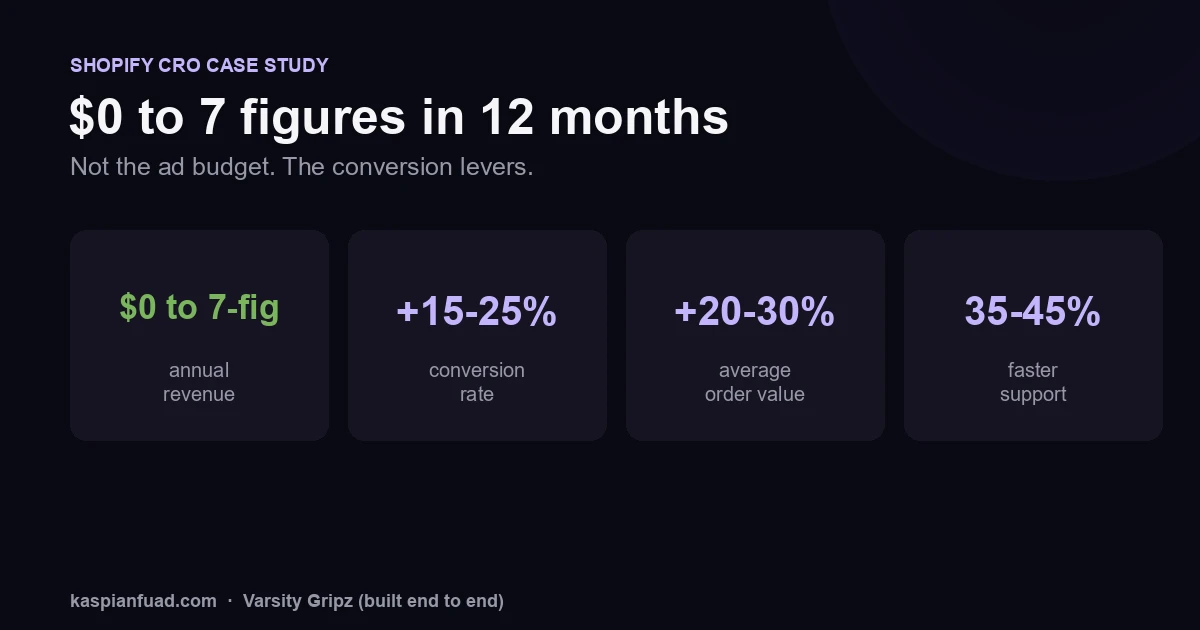
TL;DR: I joined Varsity Gripz, a sports accessories brand, at day zero as Founding Ecommerce Lead and helped take it from $0 to 7-figure annual revenue in under 12 months. The growth was not an ad budget. It was conversion-first architecture: a product page built to convert, a fix for the zero-review problem, Starter Kit bundles that lifted AOV 20-30%, and cart cross-sells. Conversion rose 15-25%. Here are the exact levers, and how to apply them whether you are launching or fixing an existing store.
Most CRO is a retrofit. A store launches, traffic arrives, sales disappoint, and someone gets hired to patch the funnel months later. Varsity Gripz was the opposite. I built the conversion optimization into the store before the first product went live, and that decision is why it scaled instead of stalling. The numbers below are real, from a brand I ran end to end. The full breakdown is in the Varsity Gripz case study.
What actually moves conversion and AOV on Shopify?
Four levers did most of the work, and none of them was a clever ad. A product page built to convert, a solution to the zero-review trust gap, a bundle strategy, and cart cross-sells. Each is transferable to a store that already exists.
The mistake I see most is treating CRO as a phase that comes after launch. When you build a store first and optimize later, every visitor who arrives before the fixes is a partially wasted acquisition cost. Varsity Gripz inverted that. By the time paid traffic scaled, the store was already built to convert, the email flows already ran, and the reviews were already collecting. The gap between a store built to convert and one built to look nice widens every month you spend on ads.
How do you sell a Shopify product with zero reviews?
You compensate for the missing social proof, because it is the single strongest trust signal a new visitor has and you do not have it yet.
Launching with zero reviews is one of the hardest conversion problems in ecommerce. When a shopper lands on a brand they have never heard of, they are looking for a reason to leave. So before any reviews existed, the product page had to fill that gap: detailed descriptions with specific use cases, lifestyle imagery showing the grips in real use, and clear spec tables that answered the questions a review normally would.
Then I set up Okendo as the review platform, chosen for its photo reviews and structured data, which feeds Google Shopping and organic results as reviews accumulate. Once they started arriving, I placed them at two points: a star summary near the product title for quick proof, and a full review block lower down for the shopper who needs deeper validation. Photo reviews of a product in use persuade far more than text, which matters more for a physical accessory than almost anything else on the page.
How do Starter Kit bundles increase average order value?
By removing decision paralysis. That single lever drove a 20-30% AOV increase, and it is the one I would copy to almost any store.
A first-time visitor to a new brand faces a paradox: interested enough to browse, but not familiar enough to buy with confidence. One grip or three? Which style? What goes with it? Every extra decision is a chance to leave, and with cart abandonment near 70% across ecommerce, fewer decisions is the whole game. Starter Kits removed that friction by making the decision for the shopper. Each kit bundled complementary products at a slight discount, so the question changed from “which of these do I buy?” to “do I want the kit?”, a much easier yes or no.
I built the kits as native Shopify products, each with its own page, imagery, and value proposition, not as a discount stacked through a bundle app. That kept the checkout clean, avoided extra JavaScript, and kept inventory accurate across individual SKUs and bundles. The cart added a second AOV mechanism on top: Rebuy Smart Cart surfaced complementary items based on what was already in the cart, so the curated kit on the page and the dynamic cross-sell in the cart worked together without feeling pushy. I compared the cart-app options and their real speed cost in Rebuy vs UpCart.
What makes a Shopify product page convert?
Structure, and a mobile-first one. The product page layout lifted conversion 15-25%, and it followed the same skeleton I use on every build.
Imagery on the left, a sticky add-to-cart on the right, and trust signals placed between the price and the CTA button, not in the footer where nobody looks. Shipping information, the return policy, and security badges sit inside the purchase flow, at the exact moment a nervous first-time buyer is deciding. On mobile, the gallery sits above the fold with the price and primary button visible on scroll, with no layout shift and no information hidden behind extra taps. A sticky add-to-cart bar keeps the action one tap away as the shopper scrolls.
Download the Conversion-First Store Playbook (PDF)
The apps behind it were chosen to work as one system, not a pile of widgets: Rebuy for cart logic, Okendo for reviews, Klaviyo as the email hub receiving data from the others, Loop for returns, and Gorgias plus Zendesk for support, which cut response time 35-45%. Klaviyo sat in the middle so every tool fed one customer profile instead of competing streams.
Is it too late to add CRO to an existing store?
No, and this is the part that matters most if you already have a store.
CRO compounds. A 15-25% conversion gain is not just more orders this month. It is more customers entering your email flows, more post-purchase review requests generating social proof, more data for segmentation, and more repeat-purchase chances, every one of them building on the last. That is why building it in early beats bolting it on late. But an existing store gets the same levers: a stronger product page, a bundle strategy, cart cross-sells, and automated review collection.
The honest sequence is to audit before you scale, not after. Whether you are launching from zero or optimizing a store doing real volume, a CRO audit tells you which lever is leaking the most money before you spend another dollar on traffic. I ran the same playbook to fix a broken store in this +51% teardown, and to build one from scratch here. The levers are the same. Only the starting point changes.
The takeaway
- Build CRO into the architecture, do not bolt it on. Every visitor who lands before the fixes is wasted acquisition cost.
- Solve the zero-review gap on the page. Descriptions, lifestyle imagery, and spec tables carry the trust until real reviews arrive.
- Use curated bundles to kill decision paralysis. Starter Kits lifted AOV 20-30% by making the choice a simple yes or no.
- Give the product page a conversion structure. Sticky ATC, trust signals between price and button, mobile-first, no layout shift.
- It is never too late. An existing store gets the same levers, and a CRO audit before scaling ad spend pays for itself.
I am Kaspian Fuad, a Shopify CRO and performance consultant, and Varsity Gripz is one of the brands I built end to end. If you want the same conversion-first architecture on your store, new or established, see how I work or book a call.